PRINTED PAGE 2059NKJV · STUDY EDITION
3 john 10 | 2059
Greeting to Gaius
T
he Elder,
To the beloved Gaius, a whom
I love in truth:
2 Beloved, I pray that you may prosper
in all things and be in health, just as your
soul prospers. 3 For I b rejoiced greatly
when brethren came and testified of the
truth that is in you, just as you walk in
the truth. 4 I have no greater c joy than to
hear that d my children walk in 1 truth.
Gaius Commended for Generosity
5 Beloved, you do faithfully whatever
you do for the brethren 2 and for strang
ers, 6 who have borne witness of your
love before the church. If you send them
forward on their journey in a manner
worthy of God, you will do well, 7 be
cause they went forth for His name’s
sake, e taking nothing from the Gentiles.
8 We therefore ought to f receive 3 such,
that we may become fellow workers for
the truth.
Diotrephes and Demetrius
9 I wrote to the church, but Diotrephes,
who loves to have the preeminence among
them, does not receive us. 10 Therefore, if
I come, I will call to mind his deeds which
1 The Elder is the apostle John. The word Elder can refer to an old
man, an older person deserving respect, or a church leader. Here the
word is an appeal to writer’s authority in the church. Gaius was a
common Roman name. The Gaius to whom John wrote was a Chris-
tian in one of the churches of Asia Minor.
2 may prosper . . . be in health . . . soul prospers: John’s greeting
may imply that Gaius was physically weak, though spiritually strong.
More probably John is simply following the pattern of greetings
common to Greek letters.
3 The reason for John’s prayer is the testimony of others that Gaius
walks in the truth. Truth here refers to the body of truth given to
the church through the apostles and prophets, that is, the Scripture.
Gaius walks according to the Word of God rather than the ways of
the world.
4 My children is likely a term John uses to describe those under
his pastoral care, as reflected in 1 John 2:1, 12, 18, 28; 3:7, 18; 4:4;
5:21. To walk in truth means to walk according to God’s Word, the
revelation of His truth.
5–12 In these verses John affirms Gaius’s responsibility to assist
Demetrius despite the opposition of Diotrephes and his expulsion
of those who received traveling missionaries. In the first part of this
section (vv. 5–8), John says that Gaius’s support of itinerant preach-
ers should be continued in order for him to be a fellow worker in the
truth. In the last part of the section (vv. 9–11), John promises that
Diotrephes’s opposition will be addressed by him when he arrives.
Meanwhile, John endorses Demetrius as a legitimate teacher who
is deserving of shelter and support (v. 12).
5 you do faithfully: Gaius’s support of the brethren, including
those he does not know personally, reflects his faithfulness to the
Lord. This emphasizes the importance of serving the Lord by being
faithful in our responsibilities within our local churches.
6 worthy of God: These people had reported to others about Gai-
us’s ministry in their lives.
7 Gentiles here refers to unbelievers, not to Gentile Christians. The
majority of Christians in the churches of Asia Minor were Gentile
converts rather than Jewish.
8 We become fellow workers in the Lord’s service when we
support the ministries of others, publicly as well as financially. To
receive means to identify with people publicly, welcome them into
our homes, and supply their needs.
9 I wrote: John had written an earlier letter that was either lost or
possibly destroyed by Diotrephes, who was asserting his control
over the church out of his own personal ambition (see 1 Pet. 5:1–5).
John had probably written asking Diotrephes’s church to extend
hospitality to the traveling missionaries the apostle had sent out
(v. 10), and Diotrephes had refused to heed John’s request.
10 If I come reflects the idea of “when I come.” John intends to
come and take Diotrephes to task for his attitudes and actions, and
to exercise his apostolic authority in punishing him. This is a warning
similar to those of Paul in 2 Cor. 10:2; 13:1, 2. Diotrephes’s sins include
verbal attacks on John and his representatives, as well as active op-
position to those who wanted to support legitimate ministers.
1 a 2 John 1 3 b 2 John 4 4 c 1 Thess. 2:19, 20; 2 John 4
d [1 Cor. 4:15] 1 NU the truth 5 2 NU and especially for
7 e 1 Cor. 9:12, 15 8 f Matt. 10:40; Rom. 12:13; Heb. 13:2;
1 Pet. 4:9 3 NU support
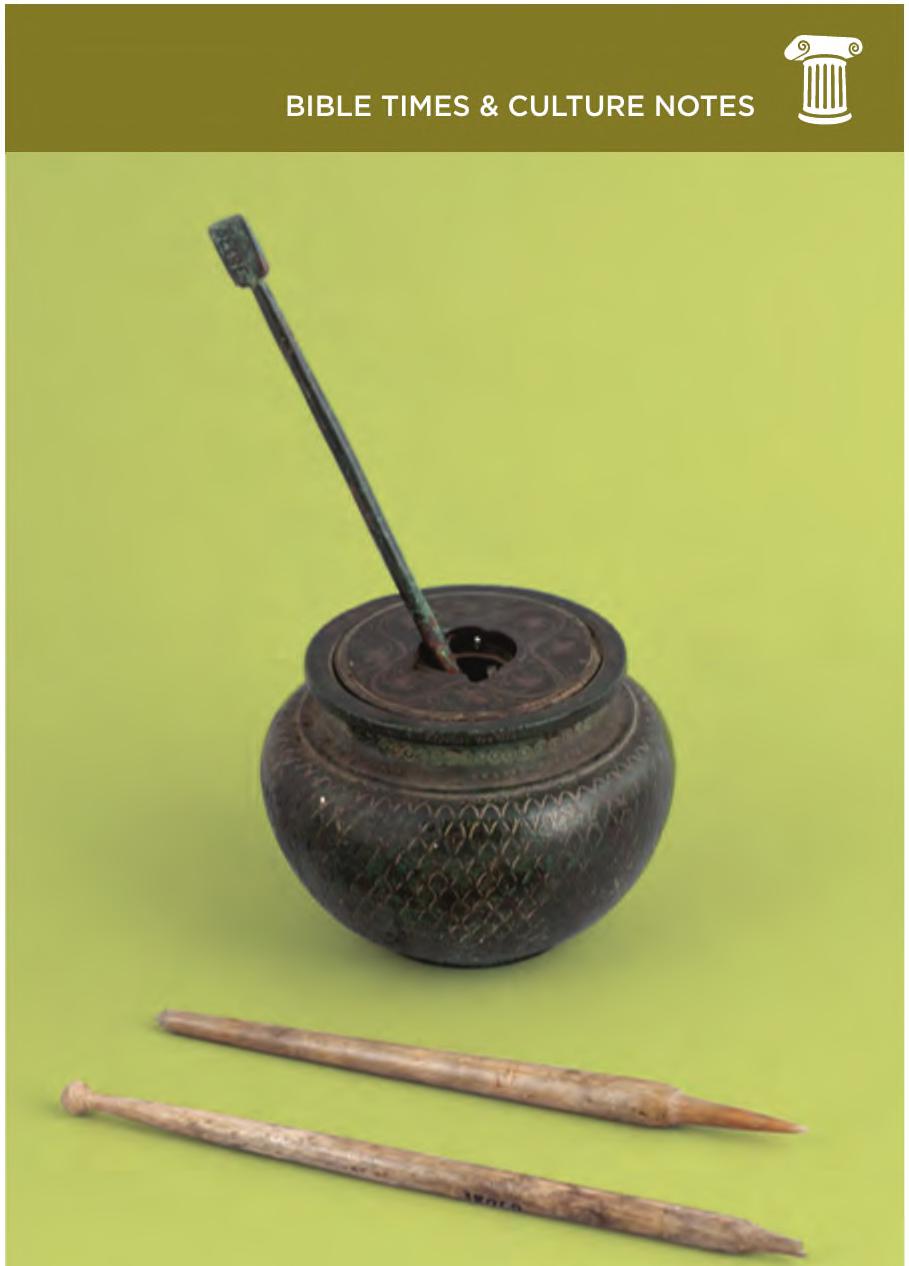
Bible Times & Culture Notes
A Roman period inkpot and stylus pens, similar to the
instruments John would have used to write his papyrus letters
Roman/Museo Archeologico Nazionale, Siena, Italy/The Bridgeman Art
Library
Original illustrations
End of source page 2094