PRINTED PAGE 2054NKJV · STUDY EDITION
2054 2 John INTRODUCTION
The fact that both Paul and John personified the church as a woman in other passages provides supporting
evidence for the theory that this letter was addressed to the church as a whole (see 2 Cor. 11:2; Eph. 5:25–27,
31, 32; Rev. 21:2, 9; 22:17). And finally, the greeting of verse 13 makes better sense when it is understood as a
greeting from one congregation to another rather than from a group of relatives to their aunt.
It is just as possible that John wrote this letter to a literal woman. The phrase “elect lady” makes sense as a
title for a well-known and respected woman. The reference to her children walking in the truth also makes sense
when taken literally. The greeting from her sister’s children in verse 13 would fit this interpretation. The Greek
word translated elect could be a woman’s name, with lady added as a title of respect, as in “Lady Eklekta.” As for
the greeting, Paul forwarded greetings from others in his personal letter to Philemon (see Philem. 23–25), so for
John to do so in verse 13 of this letter would not be unprecedented. And finally, the plural references in verses
6, 8, 10, and 12 could well refer to the woman and her children. The proof is not conclusive for either possibility,
so the true identity of John’s audience for this letter probably will always remain unknown. Yet the message of
the letter remains clear: vigilantly guard against false teaching, and persevere in the truth.
Christ in the Scriptures
Once again John takes sharp aim at those who deny the bodily reality of Jesus. The Jesus of whom he writes
(and whom he knows intimately) had flesh and blood and bones. He labels the insurrectionists as false teachers.
And whereas John often proclaims the message to “love one another,” he forcefully demands that Christians
have nothing to do with heretics. The reason is obvious. In order to have a relationship with God the Father, we
must abide “in the doctrine of Christ” (v. 9). We cannot approach the Father without going through Jesus. For
John, the person and work of Jesus Christ affect every area of life and faith.
2 John Outline
I. Opening greeting 1–3
II. Walking in the truth 4–11
A. Walking in truth and love 4–6
B. Responding to deceivers 7–11
III. Closing greeting 12, 13
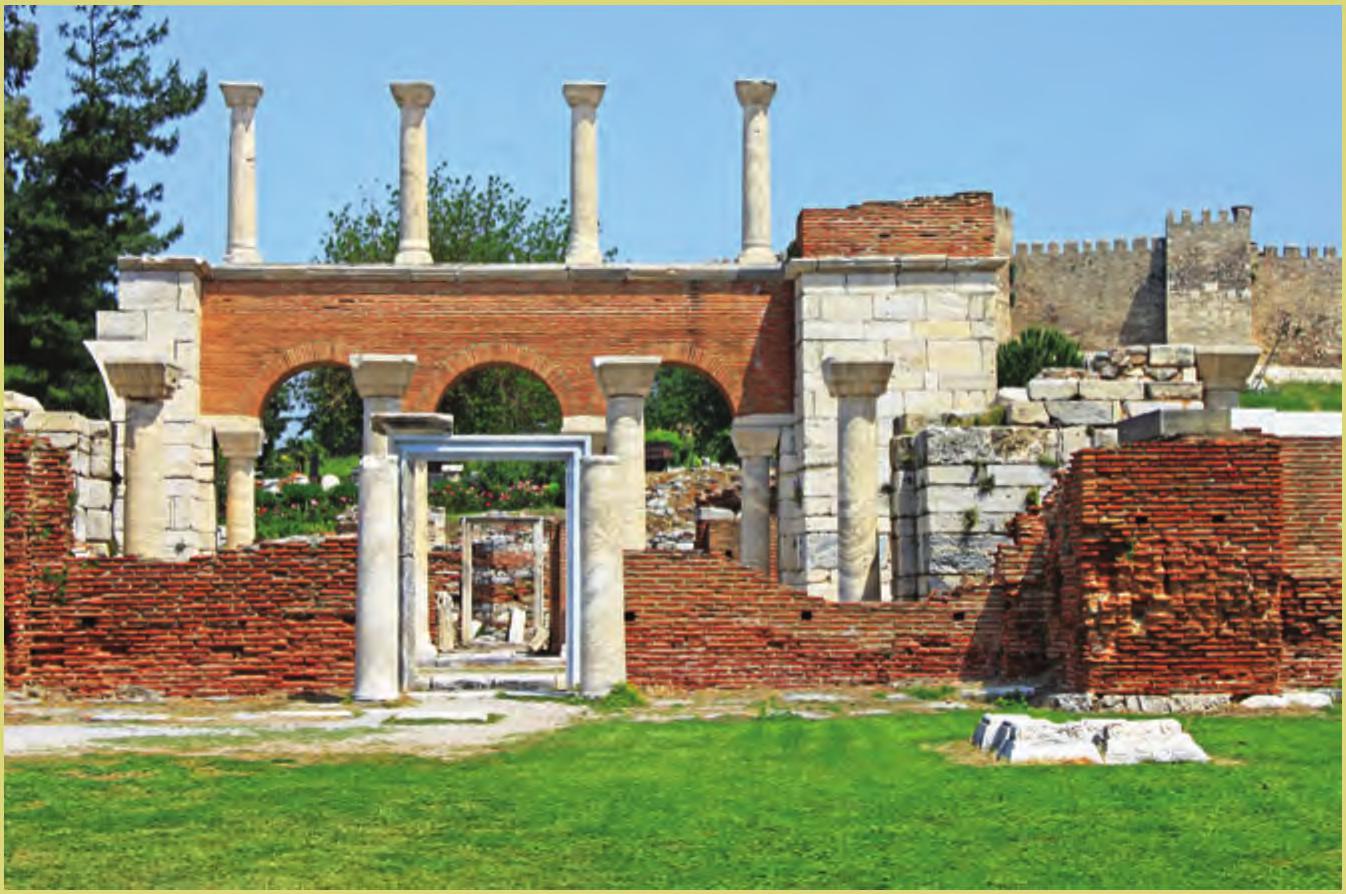
The ruins of St. John’s Basilica, located near Ephesus, constructed in the fifth century a.d. by
Emperor Justinian. It stands on what is believed to be the burial site of John the apostle.
© Gelia/Shutterstock
Original illustrations
End of source page 2089