PRINTED PAGE 2042NKJV · STUDY EDITION
2042 1 John INTRODUCTION
Historical Background Gnos-
ticism was a problem that threat-
ened the church in Asia Minor
during the second century a.d.
Gnosticism was a teaching that
blended Eastern mysticism with
Greek dualism (which claimed
that the spirit is completely good,
but matter is completely evil).
This teaching was present in the
church in a seminal form during
the latter years of the first cen-
tury. By the middle of the second
century it had become a fully
developed theological system,
which included Gnostic gospels
and epistles. John recognized the
danger of Gnosticism and wrote to
counteract its influence before it
could sweep through the churches
of Asia Minor. Based on the con-
cept that matter is evil and spirit is good, some Gnostics concluded that if God was truly good He could not have
created the material universe. Therefore, some lesser god had to have created it. According to them, the God
of the Old Testament was this lesser god. The dualistic views of Gnosticism were also reflected in the prevalent
belief that Jesus did not have a physical body. This teaching, called Docetism, claimed that Jesus only appeared
to have a human body and never actually suffered pain and death on the Cross.
Another heresy that John addressed in this letter and personally confronted at Ephesus was Cerinthianism.
This heresy taught that Jesus was just a man upon whom the “Christ” descended at His baptism, that the Christ
then departed from Jesus just before His crucifixion, and that thus the spiritual Christ did not really suffer and
die for humanity’s sins on the Cross, but only appeared to.
There are several indications that John was addressing these heresies in this epistle. Note the use of expres-
sions like “which we have looked upon, and our hands have handled” (1:1); “every spirit that confesses that Jesus
Christ has come in the flesh is of God” (4:2); and “He who came by water and blood” (5:6). All of these phrases
use explicit and vivid language to describe the Incarnation, the truth that Jesus is both completely God and
completely human.
Purpose and Themes John most likely wrote this letter with two purposes in mind—one pastoral and one
polemical. John’s pastoral purpose was to promote fellowship (1:3). But for the believers to have true fellowship,
they needed to understand the true nature of God (1:5; 2:29; 4:7, 8). Thus the pastoral purpose naturally leads to
the polemical purpose (2:26), which was to protect his readers against the deceptive ideas of false teachers. If the
believers were deceived by false doctrine, they would eventually lose their unity, which is possible only in the
love of Christ. Evidently some deceivers had arisen among the believers (2:18, 19, 26). If Christians could sort out
truth from falsehood, they would be able to maintain their unity in the faith and have an opportunity to show
love to their fellow believers (3:11). For John, a person’s behavior was naturally a result of that person’s belief.
In accordance with John’s purpose, fellowship dominates the first portion of this letter (1:5—2:27), while
assurance of salvation dominates the remainder. Key concepts in the letter include eternal life, knowing God,
and abiding in the faith. In addition, John develops theological ideas in this letter through explicit contrasts,
such as walking in light or in darkness, children of God or of the devil, life or death, love or hate. With these
contrasts John was attempting to draw a clear line between true and false teachers.
John was writing to believers who were dealing with a particular type of false teaching, the contagious
heresy of early Gnosticism. He wrote this letter to encourage them to abide in what they had heard from the
beginning so that they could maintain their fellowship with God and their love for fellow believers. In short, he
exhorted them to make their belief in Christ evident to all, so that correct doctrine could be identified by their
righteous life and their wholehearted love for others.
Christ in the Scriptures
A heretical movement known as Gnosticism was gaining in popularity. It denied that Jesus really did have a
human body. John explains clearly that Jesus was both divine and human—he had seen that with his own eyes,
having been witness to Jesus’ life as well as to His transfiguration. “That which was from the beginning, which
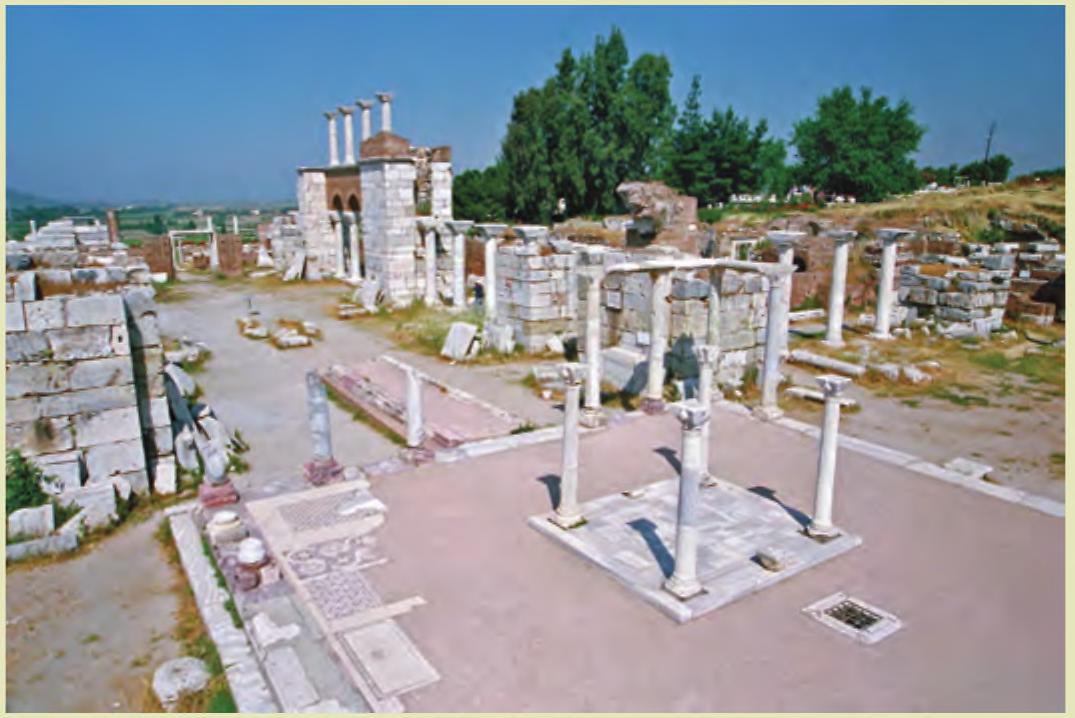
Ruins of the Basilica of St. John near Ephesus. The traditional grave of John
is under the square platform at bottom right.
© William D. Mounce
Original illustrations
End of source page 2077