PRINTED PAGE 2018NKJV · STUDY EDITION
2018 1 Peter INTRODUCTION
Date and Place of Writing Church tradition tells us that Peter died in Rome
during the anti-Christian persecution that took place during the reign of Nero
(a.d. 54–68), so a.d. 67 is probably the latest this letter could have been written.
There are several indications that Peter wrote the letter around a.d. 62–64. First,
Paul makes no reference to Peter being in Rome when Paul was writing his letters
from there (Ephesians, Philippians, Colossians, and Philemon), sometime between
a.d. 60–62. Moreover, in his letter Peter makes no reference to Paul as being in
Rome, identifying only Silvanus and Mark as his companions (5:12, 13). These facts
suggest that Peter was writing after a.d. 62. But the fact that Peter admonishes his
readers to submit to governmental authorities in 2:13–15 may indicate a date before
the more severe persecution which occurred after the burning of Rome in a.d. 64.
Of course, this dating assumes that Peter wrote this letter from Rome and not
from some other location. Peter concludes the letter by sending greetings from
“she who is in Babylon” (5:13). Three locations are generally suggested for this
reference: Babylon on the Euphrates River in Mesopotamia, a lesser-known city in
the ancient world also called Babylon, and Rome.
The argument in favor of the Mesopotamian Babylon is its identity in the Old
Testament as a city of great power, a city feared and hated by the Israelites (see
2 Kin. 24; 25; Is. 39; Jer. 25). Yet by the first century a.d., Babylon was an insignificant
town with no real power. More importantly, there is no record of Peter ever hav-
ing been there. Other cities named Babylon (such as the Roman military outpost
located in Egypt near where Cairo stands today) are excluded as well, because none
of these towns played a significant role in early Christian history.
However, Rome was a widely-recognized center of opposition to Christianity
and also the seat of power in the Roman Empire. In the New Testament, Babylon is
used as a veiled reference to the city of Rome, the center of the kingdom of dark-
ness (see Rev. 14:8; 16:19; 17:5; 18:2, 10, 21). Moreover, many of Peter’s readers would
understand Babylon as a place of exile, something with which they themselves
could identify, since Peter addresses them as pilgrims scattered throughout Asia
Minor. In this way Peter was concluding his letter where it began, with a sense that
he and his fellow Christians had not yet arrived “home.” Peter was using Babylon
as a code word readily understood by early Christians to mean Rome, yet at the
same time symbolizing more than just that earthly city.
Setting To reach the centers of the provinces of ancient Asia Minor (present-day
Turkey) to which Peter was writing, his letter had to travel many hundreds of miles
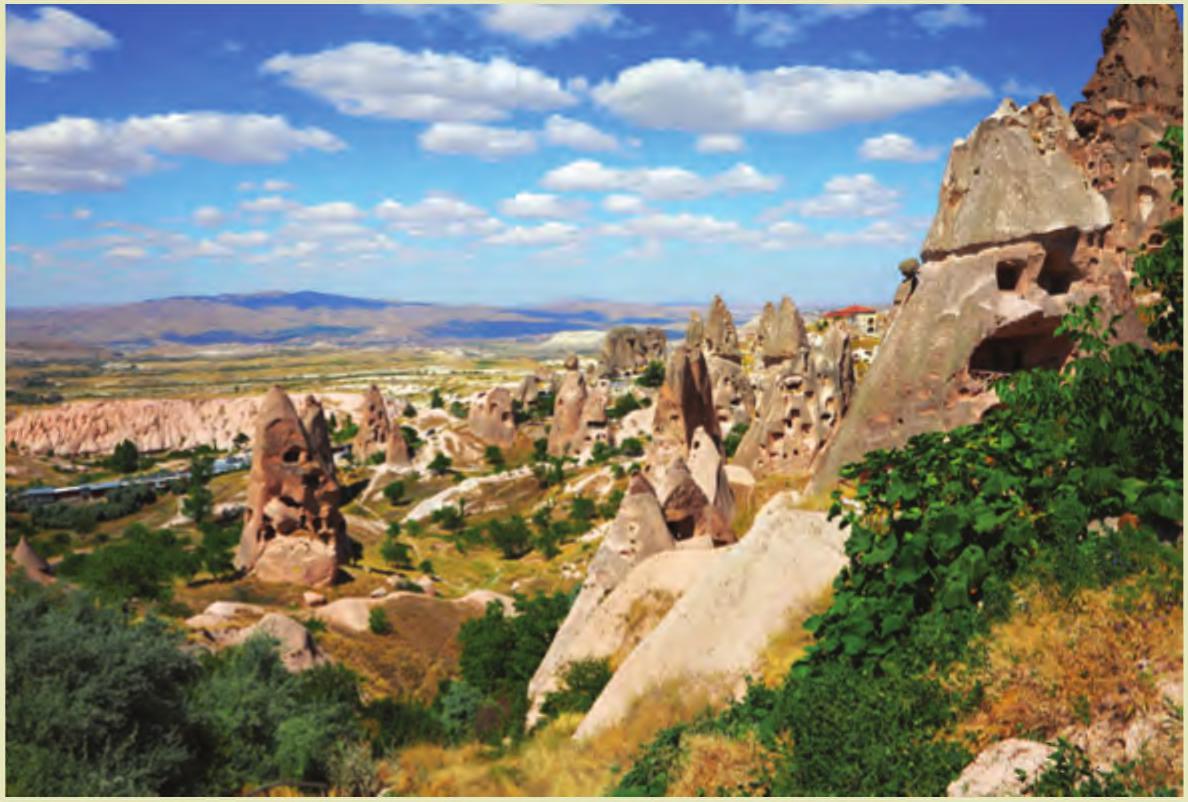
First Peter was written to the churches in Asia Minor (see 1:1), including Cappadocia,
seen here. Cappadocia is known for these strange rock formations, into which local
peoples carved subterranean towns, seeking shelter from the conquerors.
© Adisa/Shutterstock
c. a.d. 27
Andrew brings
his brother Simon
Peter to Jesus
c. a.d. 29
Peter witnesses
the Transfiguration
c. a.d. 30
Peter denies his
Lord on the eve of
the Crucifixion
c. a.d. 30
Peter becomes a
church leader after
Pentecost
c. a.d. 41
Peter first takes
the gospel to
Gentiles
c. a.d. 50
Peter speaks at the
Jerusalem council
c. a.d. 62–64
1 Peter is written
c. a.d. 64–67
2 Peter is written
c. a.d. 67
Peter and Paul are
executed in Rome
Original illustrations
End of source page 2053