PRINTED PAGE 2003NKJV · STUDY EDITION
Hebrews 12:17 | 2003
so that what is lame may not be dislo
cated, but rather be healed.
14 s Pursue peace with all people, and
holiness, t without which no one will see
the Lord: 15 looking carefully lest anyone
u fall short of the grace of God; lest any
v root of bitterness springing up cause
trouble, and by this many become defiled;
16 lest there be any w fornicator or 6 pro
fane person like Esau, x who for one mor
sel of food sold his birthright. 17 For you
know that afterward, when he wanted to
inherit the blessing, he was y rejected, for
and live? 10 For they indeed for a few days
chastened us as seemed best to them, but
He for our profit, p that we may be partak
ers of His holiness. 11 Now no 5 chasten
ing seems to be joyful for the present, but
painful; nevertheless, afterward it yields
q the peaceable fruit of righteousness to
those who have been trained by it.
Renew Your Spiritual Vitality
12 Therefore r strengthen the hands
which hang down, and the feeble knees,
13 and make straight paths for your feet,
10 p Lev. 11:44
11 q Is. 32:17; 2 Tim.
4:8; James 3:17, 18
5 discipline
12 r Is. 35:3
14 s Ps. 34:14
t Matt. 5:8; [Heb.
9:28]
15 u 2 Cor. 6:1; Gal.
5:4; Heb. 4:1 v Deut.
29:18
16 w [1 Cor. 6:13-
18] x Gen. 25:33
6 godless
17 y Gen. 27:30-40
12:10, 11 our profit: Although fathers discipline for awhile as they
see fit, God disciplines us with our good welfare in mind. With every
trial, God is fashioning us into a holy people, set apart for His good
purposes (see v. 14; 10:10). The peaceable fruit of righteousness
suggests that the result of God’s chastening is peace and righ-
teousness.
12:12, 13 Borrowing the language of Is. 35:3, the author admonishes
his readers to renew their strength so that they can endure the race
of faith (see v. 1).
12:15–17 Believers pursuing peace and practical righteousness
(v. 14) should watch for three dangers: (1) falling short of God’s
grace—that is, refusing Christ’s gracious offer of salvation and His
provision for their needs (see 4:16); (2) allowing a root of bitterness
to grow in their assembly—perhaps allowing idol worshipers to
remain in the church (see Deut. 29:18); and (3) becoming sexually
immoral or irreligious. Esau illustrates those who are irreligious.
Under the Law, the eldest son would receive a double inheritance
(see Deut. 21:17). Esau lost his inheritance, which included God’s
gracious promises, by despising it and valuing the pleasure of food
over it (Gen. 25:34).
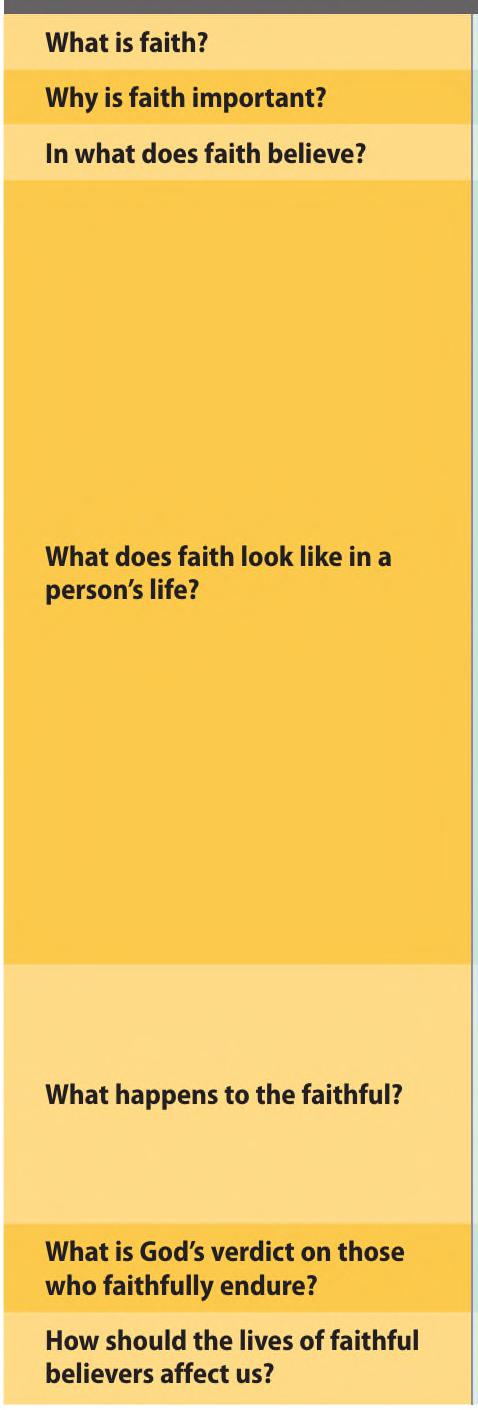
The Imperative of Faith
What is faith?
• Faith is the substance of things hoped for, the evidence of things not seen (11:1).
Why is faith important?
• Without faith it is impossible to please God (11:6).
In what does faith believe?
• Faith believes that God is, and that He is a rewarder of those who diligently seek Him (11:6).
What does faith look like in a
person’s life?
• Abel offered a costly sacrifice (11:4).
• Enoch lived in a way that pleased God (11:5).
• Noah obeyed divine warnings and built a giant ark (11:7).
• Abraham left Ur at God’s calling and went out, not knowing where he was going (11:8).
• Sarah bore Isaac in her old age (11:11).
• Abraham was willing to offer up Isaac, his only son, trusting that God was able to raise him up
(11:17–19).
• Isaac blessed his sons and exhorted them to obey the covenant (11:20).
• Jacob likewise reminded his sons of God’s promises (11:21).
• Joseph expressed his confidence that God would bring the Israelites out of Egypt (11:22).
• Moses’ parents refused to carry out the commands of Pharaoh to kill their child (11:23).
• Moses turned his back on the passing pleasures of sin and sided with the downtrodden children
of Israel, leading them out of Egypt and obediently carrying out the difficult commands of God
(11:24 –29).
• The Israelites, led by Joshua, trusted God to give them victory over the city of Jericho (11:30).
• Rahab believed in the power of God and helped the Israelite spies (11:31).
• Many other Old Testament people of faith trusted God for power and victory and refused to
compromise their faith in God, even in the midst of life-threatening circumstances (11:32–38).
What happens to the faithful?
• Some died without having received the promises (11:13).
• Some have to find consolation in the truth that they will not realize the full blessings of God
until they enter heaven (11:14 –16).
• Some experience miraculous deliverance (11:33 –35).
• Others, despite their implicit trust in God, experience torture, mockings, scourgings, imprison-
ment, stonings, destitution, affliction, and torment (11:35 –38).
What is God’s verdict on those
who faithfully endure?
• They are those of whom the world is not worthy (11:38).
How should the lives of faithful
believers affect us?
• We should be motivated to lay aside every weight, and the sin which so easily ensnares us, and
. . . run with endurance the race that is set before us (12:1).
Original illustrations
End of source page 2038