PRINTED PAGE 1991NKJV · STUDY EDITION
Hebrews 6:1 | 1991
to Him j who was able to save Him from
death, and was heard k because of His
godly fear, 8 though He was a Son, yet He
learned l obedience by the things which
He suffered. 9 And m having been per
fected, He became the author of eternal
salvation to all who obey Him, 10 called
by God as High Priest n “according to the
order of Melchizedek,” 11 of whom o we
have much to say, and hard to explain,
since you have become p dull of hearing.
Spiritual Immaturity
12 For though by this time you ought to
be teachers, you need someone to teach
you again the first principles of the 2 or
acles of God; and you have come to need
q milk and not solid food. 13 For everyone
who partakes only of milk is unskilled in
the word of righteousness, for he is r a
babe. 14 But solid food belongs to those
who are 3 of full age, that is, those who
by reason of 4 use have their senses exer
cised s to discern both good and evil.
The Peril of Not Progressing
6
Therefore, a leaving the discussion of
the elementary principles of Christ,
let us go on to 1 perfection, not laying
Jesus’ special relationship with God the Father. The quote from
Ps. 110:4 highlights the eternal nature of Jesus’ priesthood. He will
be Mediator between God and us forever.
5:8 He learned obedience: Jesus experienced all of what a person
goes through on this earth. He knows how difficult it is to obey God
completely, just as He understands the attractions of temptation
(2:18). Yet He persisted in obedience, leading a sinless life (1 John 3:5).
5:9 having been perfected: This phrase does not suggest that
Jesus had not been perfect before. It means that He successfully
carried out God’s plan for Him. He endured suffering and temptation
so that He could truly function as our High Priest, understanding
our weaknesses and interceding before God for us. Author means
“cause” or “source.” Jesus’ obedience to the Father led to Calvary,
His own death on the Cross. The sacrifice of this sinless One in our
place makes Him the source of our salvation.
5:10 Called here means “designated” and introduces Christ’s formal
title, High Priest.
5:11 Though the author of Hebrews has much more to say about
Jesus’ priesthood, it will be hard to explain to the readers of this
letter because they are dull of hearing. Dull means “sluggish.”
When these people heard the word of God they were not quick to
accept it (6:11, 12). They had grown even more lazy in the faith, so
explaining the truth to them would be difficult.
5:12 First principles are basic truths (6:1, 2). The phrase refers to
the letters of the alphabet in writing or to addition and subtraction
tables in arithmetic. First principles are the elements out of which
everything else develops.
5:13 unskilled in the word of righteousness: The
readers of this letter did not necessarily lack information
concerning righteousness; they lacked experience in
practicing the information they had. Maturity comes from practice.
5:14 Full age describes the spiritually mature. Reason of use
means “practice” or “habit.” Those who make a habit of obeying
the message of righteousness mature in the faith and are able to
distinguish good and evil.
6:1, 2 The author urges the readers of his letter to leave the basics
and go on to perfection, meaning “maturity.” He lists six items in
three couplets that he calls the elementary principles of Christ
7 j Matt. 26:53 k Matt. 26:39 8 l Phil. 2:8 9 m Heb. 2:10
10 n Ps. 110:4 11 o [John 16:12]; Heb. 7:1-22
p [Matt. 13:15] 12 q 1 Cor. 3:1-3; 1 Pet. 2:2 2 sayings,
Scriptures 13 r Eph. 4:14 14 s Is. 7:15; Phil. 1:9 3 mature
4 practice
CHAPTER 6 1 a Heb. 5:12 1 maturity
oracles
(Gk. logion) (5:12; Acts 7:38; Rom. 3:2; 1 Pet. 4:11) Strong’s
#3051
The Greek term logion is a diminutive of the word logos
(in 5:13). Here it is not “the Word of God,” but “words from
God” or “divine communications.” Peter uses the word
for the teaching of Christian preachers (1 Pet. 4:11), while
Paul employs the word to refer to the writings of the OT
prophets (Rom. 3:2). Stephen uses the word to speak of
God’s utterances on Mt. Sinai and His promises concerning
the coming of the Messiah. The author of Hebrews uses
this word for the basics of Christian doctrine, perhaps
consciously contrasting this word to the logos, “the word
of righteousness,” which is for the mature Christian (5:13).
Bible Times & Culture Notes
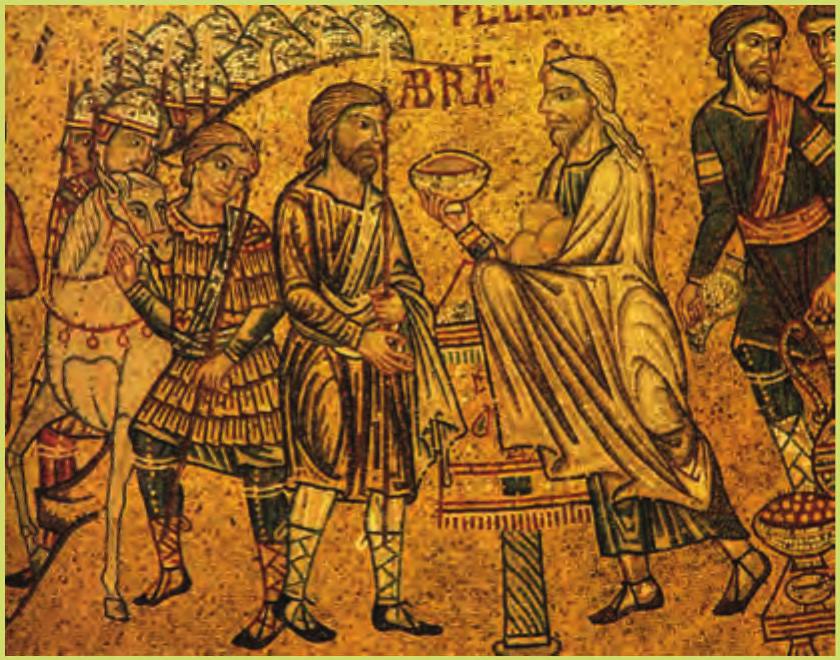
Melchizedek
One of the most mysterious figures in the OT serves as an illustra-
tion of Christ. Melchizedek appears in Gen. 14:18–20 and in Ps. 110.
He was a real man, king of Salem (Jerusalem) and a priest of God.
It was apparently in this priestly role that he first met Abraham
returning from the rescue of his nephew Lot. Melchizedek praised
God for giving the victory to Abraham, showing that there were
people other than Abraham and his family who served the true
God in ancient times. The writer to the Hebrews recalls the inci-
dent between Abraham and Melchizedek and shows the paral-
lels between him and Christ. Both are kings of righteousness and
peace, both have priesthoods superior to the Levitical order. In Ps.
110, a messianic psalm written by David, Melchizedek is also seen
as a type of Christ.
A thirteenth-century a.d. mosaic of Abraham meeting
Melchizedek
Wikimedia Commons
Original illustrations
End of source page 2026