PRINTED PAGE 1979NKJV · STUDY EDITION
Philemon 18 | 1979
appeal to Philemon on the basis of love. Appeal is the same word
translated consolation in v. 7. Paul, the aged: The apostle is speak-
ing either of the office of elder or of his old age.
10 My son is the Greek word for “child.” The imagery of a father and
child is used at other times by Paul when speaking of his converts
(see 1 Tim. 1:2; Titus 1:4). begotten: The apostle was personally re-
sponsible for bringing Onesimus to Christ (see 1 Cor. 4:15; Gal. 4:19).
11 Paul uses an interesting play on words here. Having just men-
tioned Onesimus, whose name means “Useful” (v. 10), the apostle
describes him as someone who was formerly unprofitable (unuse-
ful) but is now profitable. Paul is saying that Onesimus had become
good and useful, even more so than Philemon could have imagined.
12 I am sending him back: Paul is referring the case back to Phile-
mon for a decision. He encourages Philemon not to view Onesimus
as a runaway slave. In fact, Onesimus had become a part of Paul’s
own heart (vv. 7, 20).
13 wished: Paul wanted to keep Onesimus in Rome, helping in the
ministry, confident that Philemon would approve. Onesimus had
been serving Paul in place of Philemon, giving Paul the aid Phile-
mon could not.
14 Paul expressed his desire to have Philemon involved in the de-
cision of whether Onesimus could remain with him. Therefore, he
would act only with Philemon’s consent. Philemon’s good deed
had to be voluntary. Service for Christ is never forced. Paul had
given Philemon several good reasons to forgive Onesimus, but here
he returns to the foundation of his argument: Philemon’s actions
had to proceed from his own love (v. 9).
15 departed for a while: It was God’s plan that Onesimus would
run away. receive him forever: Paul contrasts the temporary sep-
aration because of Onesimus’s running away to the eternal benefit
of his salvation.
16 no longer as a slave but . . . a beloved brother: Paul con-
trasts the lowly position of a slave to the high privilege of a Christian
brother. in the flesh and in the Lord: Not only will Onesimus be
useful on the human level, he will be useful for the work of the Lord.
17, 18 partner . . . owes: Onesimus had probably stolen something
from Philemon when he left. Furthermore, he owed Philemon for
the time he was gone. Paul uses business imagery in offering to
pay for any loss Philemon suffered because of Onesimus’s actions.
Partner is a form of the Greek word for fellowship. Philemon was
to receive Onesimus as he would his partner in Christ, Paul. put
that on my account: This accounting imagery reminds us of the
theological truth that our sins were charged over to Christ even
though He had not earned them. Forgiveness is costly (see Is. 53:6).
10 g Col. 4:9
12 7 NU back to
you in person, that
is, my own heart,
8 See v. 7.
14 h 2 Cor. 9:7;
1 Pet. 5:2
16 i Eph. 6:5; Col.
3:22
the aged, and now also a prisoner of
Jesus Christ— 10 I appeal to you for my son
g Onesimus, whom I have begotten while in
my chains, 11 who once was unprofitable
to you, but now is profitable to you and
to me.
12 I am sending him 7 back. You there
fore receive him, that is, my own 8 heart,
13 whom I wished to keep with me, that
on your behalf he might minister to me
in my chains for the gospel. 14 But with
out your consent I wanted to do nothing,
h that your good deed might not be by
compulsion, as it were, but voluntary.
15 For perhaps he departed for a while
for this purpose, that you might receive
him forever, 16 no longer as a slave but
more than a slave—a beloved brother,
especially to me but how much more to
you, both in the i flesh and in the Lord.
Philemon’s Obedience Encouraged
17 If then you count me as a partner,
receive him as you would me. 18 But if he
Bible Times & Culture Notes
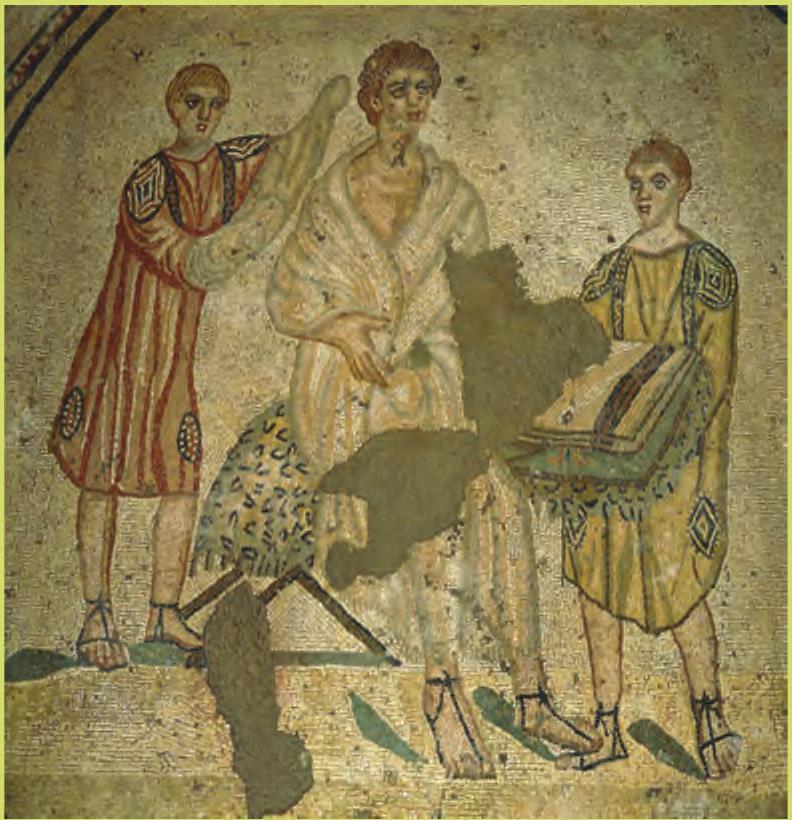
Paul and Slavery
Although he was a Roman citizen himself, Paul brought
to the nature of slavery a unique Christian understand-
ing that was grounded in Hebraic ethics. In his letters
Paul did not approve of slavery, but he also did not con-
demn it. He exhorted slaves to demonstrate Christian
obedience and humility even to their masters (Eph.
6:5–8; Col. 3:22–25). In turn, Christian masters were to
treat their slaves fairly (Eph. 5:9; Col. 4:1).
Some have criticized Paul and the NT church for not
calling for an end to slavery. It is true that first-century
believers didn’t actively campaign for an end to slav-
ery, petition the government, or urge slaves to rebel.
However, Paul clearly declared the equality of both
slaves and free persons before Christ, a principle that
would eventually undermine the institution of slavery
(see 1 Cor. 7:22; Gal. 3:28; Eph. 6:8; Col. 3:11).
Fourth-century mosaic of Roman slaves helping to dress their master
Mosaico delle Terme, fourth century a.d./Villa Romana del Casale, Piazza Armerina,
Sicily, Italy/De Agostini Picture Library/A. Dagli Orti/The Bridgeman Art Library
Original illustrations
End of source page 2014