PRINTED PAGE 1976NKJV · STUDY EDITION
1976 Philemon INTRODUCTION
Slavery in the Ancient World To recognize the significance of this letter, it is essential to understand slav-
ery as it existed in the first century. At that time the slave-master relationship was as common as the employee-
employer relationship is today. Onesimus was a runaway Roman slave.
During this period, the Jews practiced slavery according to the provisions of the Law of Moses. A Jewish
slave belonged to the family of the owner and had certain religious and social rights. If the slave was a Hebrew,
the term of slavery was limited to six years. Jeremiah had warned that permanent slavery would bring about
divine disfavor ( Jer. 34:8–22). But even if the slave was a Gentile, the owner’s power was limited by Jewish law.
If a master punished and injured a slave in his possession, the slave was to be set free. If the punishment resulted
in the slave’s death, then the master was to be punished. The slave was viewed as a person and was to be treated
fairly, which differed from the Roman system of slavery.
Among the Jews, slaves were only a small part of the total population. But in Rome, slaves outnumbered
Roman citizens. Some of the wealthy Roman landowners may have had ten to twenty thousand slaves working
on their estates. To the Romans, a slave was not a person and was basically thought of as property. Many slaves
were treated humanely and sometimes were better off economically than many free persons, but there was
still the fact that they were considered a possession. They were vulnerable to cruel treatment and could even be
killed with impunity. With slaves far outnumbering citizens, controlling the slave population was an imperative
to the Romans. To lose control of the slaves was to forfeit the social and economic basis of the Roman Empire.
Theology The Epistle to Philemon was not written to refute theological error or to teach doctrine. However,
into this short letter Paul skillfully weaves the concepts of salvation (vv. 10, 16), substitution (v. 17), imputation
(v. 18), and redemption (v. 19). Although here these ideas speak of Paul’s relationship with Onesimus, they
remind us of Christ’s relationship with us (Gal. 4:1–7). We were once slaves to sin, but Christ redeemed us from
our awful fate, death.
This letter is basically an earnest plea for a Christian love that would confront the cruelty and hatred embod-
ied in the cultural institutions of that day. Paul commends Philemon for already expressing that type of love
(vv. 5, 7). But to ensure that this love would be shown to Onesimus, Paul offers to pay Onesimus’s debt (v. 19).
Paul’s love for Onesimus went beyond mere words; he was willing to give out of his own poverty to guarantee
this slave’s well-being.
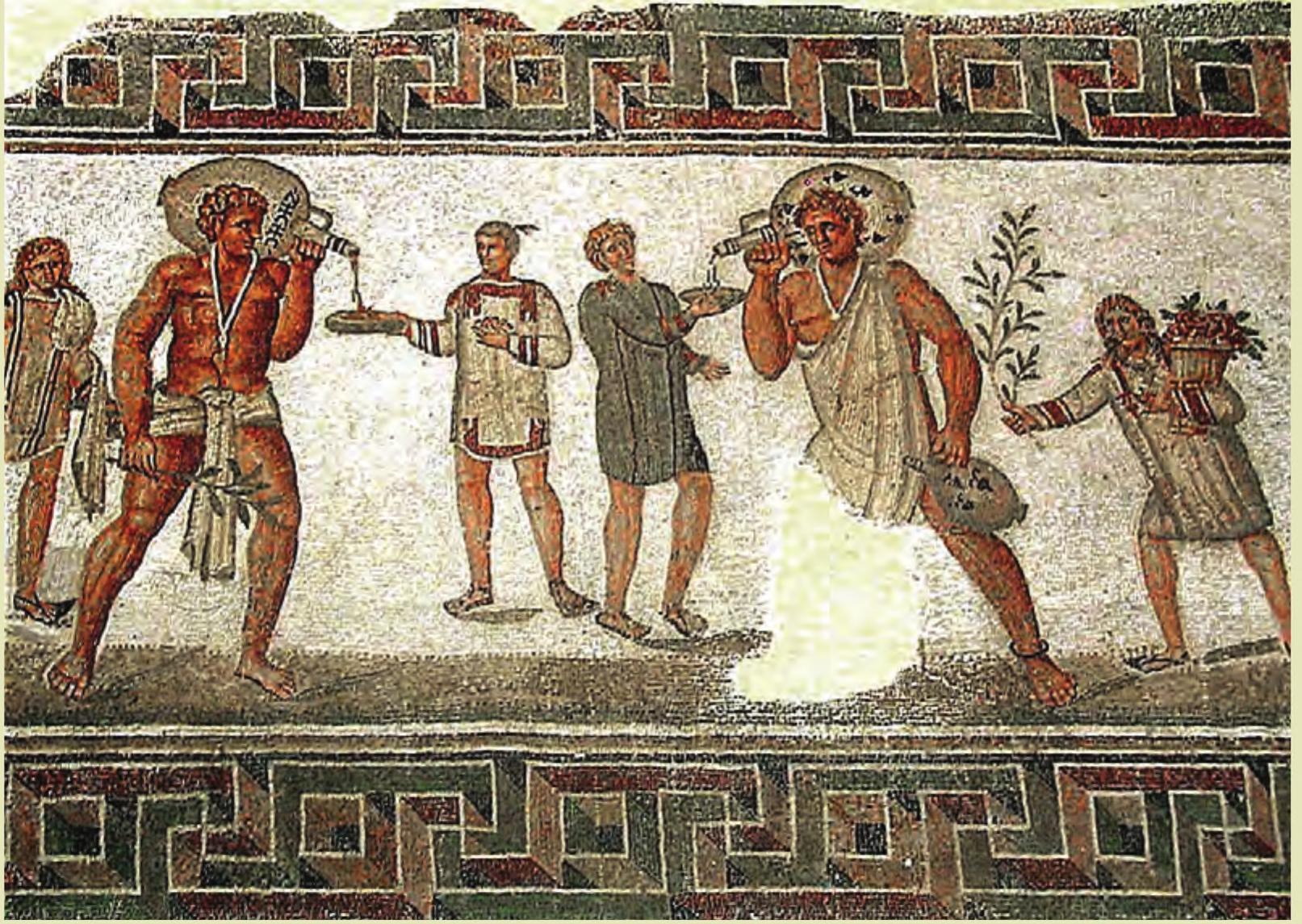
Mosaic of slaves pouring wine for guests at a banquet (third century a.d.). In Philemon, Paul makes a plea on behalf
of Onesimus, Philemon’s slave.
Pascal Radigue/Wikimedia Commons, CC-BY 3.0
Original illustrations
End of source page 2011