PRINTED PAGE 1971NKJV · STUDY EDITION
Titus 1:12 | 1971
5 e 1 Cor. 11:34
6 f 1 Tim. 3:2-4;
Titus 1:6-8
2 debauchery, lit.
incorrigibility
7 g Lev. 10:9 3 Lit.
overseer
10 h James 1:26
11 i 1 Tim. 6:5
12 j Acts 17:28
Qualified Elders
5 For this reason I left you in Crete, that
you should e set in order the things that
are lacking, and appoint elders in every
city as I commanded you— 6 if a man is
blameless, the husband of one wife, f hav
ing faithful children not accused of 2 dissi
pation or insubordination. 7 For a 3 bishop
must be blameless, as a steward of God,
not self-willed, not quick-tempered, g not
given to wine, not violent, not greedy
for money, 8 but hospitable, a lover of
what is good, sober-minded, just, holy,
self-controlled, 9 holding fast the faithful
word as he has been taught, that he may
be able, by sound doctrine, both to exhort
and convict those who contradict.
The Elders’ Task
10 For there are many insubordinate,
both idle h talkers and deceivers, espe
cially those of the circumcision, 11 whose
mouths must be stopped, who subvert
whole households, teaching things which
they ought not, i for the sake of dishonest
gain. 12 j One of them, a prophet of their
1:5 Lacking indicates an unfinished organization of the churches
in Crete due to the brevity of Paul’s visit. Paul identifies three spe-
cific areas of shortcoming: (1) a lack of organization in the churches
(vv. 5–9); (2) unchallenged false teachers (vv. 10, 11; 3:10, 11); (3) a
need for teaching in doctrine and practical living (2:1–10; 3:1, 2). Titus
was left behind to set in order these deficiencies. Titus’s first step
toward completing his task was to appoint elders in every city
(see Acts 14:23). Apparently the early church had several leaders in
a particular church instead of one principal leader. The Greek words
for elder and bishop (literally, overseer) seem to have been used in-
terchangeably by Paul (see v. 7). Elder perhaps speaks more of the
office and its authority, while bishop may speak more of the person’s
function and the ministry of oversight (see Acts 20:17).
1:6 Blameless means to have nothing in one’s conduct on which
someone could base an accusation (see 1 Tim. 3:2). Such is to be
the overall characteristic of an elder. Yet Paul further defines this
blamelessness with 16 qualities. These qualities are in three areas:
family life (v. 6), personal life (vv. 7, 8), and doctrinal beliefs (v. 9).
The contrast between the blameless behavior of church elders and
the base behavior of the false teachers should have been evident
to all (vv. 10–16). husband of one wife: This phrase is found only
in the Pastoral Epistles (see 1 Tim. 3:2, 12; 5:9). Its exact meaning is
debated. The apostle might be barring a polygamist, a divorced or
remarried man, or a man known to be unfaithful to his wife. Paul
was emphasizing, as Jesus did (see Matt. 19:5), the importance of
marital faithfulness. Marriage is the uniting of a man and a woman
into “one flesh.” faithful children: Not only should the man have
a good relationship with his wife, he should also have children who
demonstrate faithfulness to God. If a man has children who reject
the ways of God, this reflects on the father’s ability to lead others
outside his home. This rule would apply to children who are not yet
fully grown, but possibly not to adult children.
1:7–9 Elders were not to be self-willed, but self-controlled. If
they were self-seeking, like the false teachers on Crete (vv. 10–16),
they would not possess the character required to promote good
works and sound doctrine among the believers. Convict means to
rebuke in such a way as to produce repentance and confession of sin
(see John 16:8). A rebuke can have the positive results of producing
change in a person’s life.
1:10, 11 many insubordinate: In these verses, Paul describes the
characteristics of the false teachers whose teaching was contrary
to the truth and was undermining the authority of church lead-
ers. those of the circumcision: Apparently there were Jewish
Christians in the churches of Crete who were limiting the Christian
freedom of Gentile Christians by requiring an adherence to Jewish
laws (see Gal. 3).
1:12 Cretans are always liars, evil beasts, lazy gluttons: Paul
is quoting the Cretan poet Epimenides, who wrote these words
around 600 b.c. The Cretans were so much regarded as liars in the
Mediterranean world that the expression “to Cretanize” meant to lie.
Paul was contrasting the Cretans’ reputation with God’s. The Lord
was incapable of lying (see v. 2).
Bible Times & Culture Notes
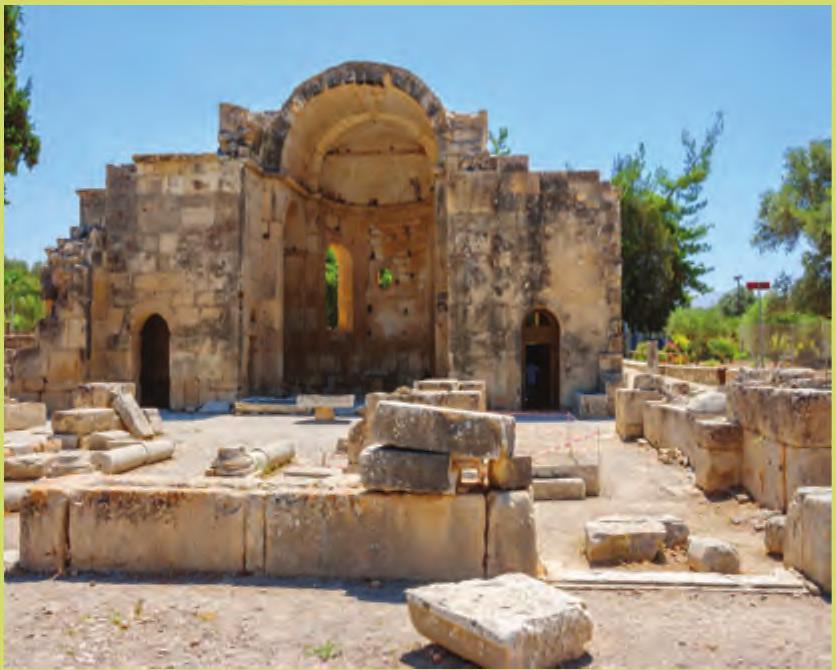
Crete
The Mediterranean island of Crete is 160 miles long
and up to 35 miles wide. Its first-century inhabitants
were notorious for untruthfulness and immorality
(1:12, 13) and the expression “to act the Cretan”
became an idiom meaning “to play the liar.” A num-
ber of Jews from Crete were present in Jerusalem
on the Day of Pentecost (Acts 2:11) and some of
them may have believed in Christ and introduced
the gospel to their country. Although Paul was
shipwrecked on Crete during his trip to Rome (Acts
27:7–13), he probably had little time for active min-
istry during that brief sojourn. The apostle spread
the gospel in the cities of Crete after his release
from Roman imprisonment and he left Titus there
to finish organizing the churches. Not long after his
departure, Paul wrote this letter to encourage and
assist Titus in that task.
The seventh-century a.d. Church of Titus on Crete
© Andrei Nekrassov/Shutterstock
Original illustrations
End of source page 2006