PRINTED PAGE 1958NKJV · STUDY EDITION
1958 2 Timothy INTRODUCTION
faith by placing more and more responsibility on his shoulders. Timothy had functioned as Paul’s representative
to Thessalonica (1 Thess. 3:2) and Corinth (1 Cor. 4:17). But leaving Timothy at Ephesus was a major step for Paul;
as a concerned mentor, he wrote a letter to Timothy repeatedly charging him to remain faithful to the essentials
of the Christian faith (1 Tim. 1:18; 4:12–16; 5:21; 6:11–13). Paul had served as Timothy’s spiritual mentor throughout
his life. Now as he neared his death Paul wanted to see him one last time. And if that could not be, he wanted
at least to give Timothy some final words of encouragement.
Purpose Paul’s primary purpose for writing this letter was to offer final instructions to Timothy regarding the
Christian life. Second Timothy has an intensely personal nature and tone. One senses Paul’s strong love and
concern for Timothy. Paul encourages his close friend to use his spiritual gifts. He writes to strengthen Timothy’s
loyalty to Christ in the face of the suffering and persecution that would come. The apostle challenges Timothy
to handle the Word of God accurately, faithfully instructing others in the truths of the faith. Warnings and
instructions are given concerning how a believer should relate to the world in times of apostasy. In the closing
chapter, Paul offers Timothy his final word of advice: “Preach the word! Be ready in season and out of season.”
This was Paul’s own mission, to preach the gospel to the Gentiles; now he was passing it on to his beloved son
in the faith, Timothy.
Paul’s second purpose for writing this letter was to urge Timothy to join him in Rome. Paul knew that he was
soon to die. He longed to see and have fellowship with his child in the faith one last time.
Theology Paul was well aware that hardships and conflict are a part of Christian ministry. One of the essential
characteristics of a faithful servant of Christ is endurance in the midst of difficulties. To encourage Timothy in
this virtue, the apostle reminds him that Jesus Christ is “of the seed of David” and “was raised from the dead”
(2:8). Mention of the seed of David links Christ with the Davidic covenant (see 2 Sam. 7:11–16), which states that
a Son of David will rule on his throne forever. Furthermore, Christ has been resurrected; He is alive. The promise
of ruling and reigning with Him (see 2:11–13) is set before Timothy as a motive for faithful endurance in ministry.
A special crown will be given to those who faithfully serve the Lord and wait for His return (4:8).
Chapter 3 develops the theme of apostasy in the latter days. Paul warns Timothy that difficulties are coming
for believers, and he instructs him about how Christians are to respond and behave. Jesus had predicted that
such times would come (John 15:18–25; 16:33; 17:15–18), and Paul himself had referred previously to these times
(1 Thess. 3:1–8). Although he would not live to see these dreadful days, Paul still cared enough to urge Timothy
to be bold in the work of the Lord, even in the midst of troubling times.
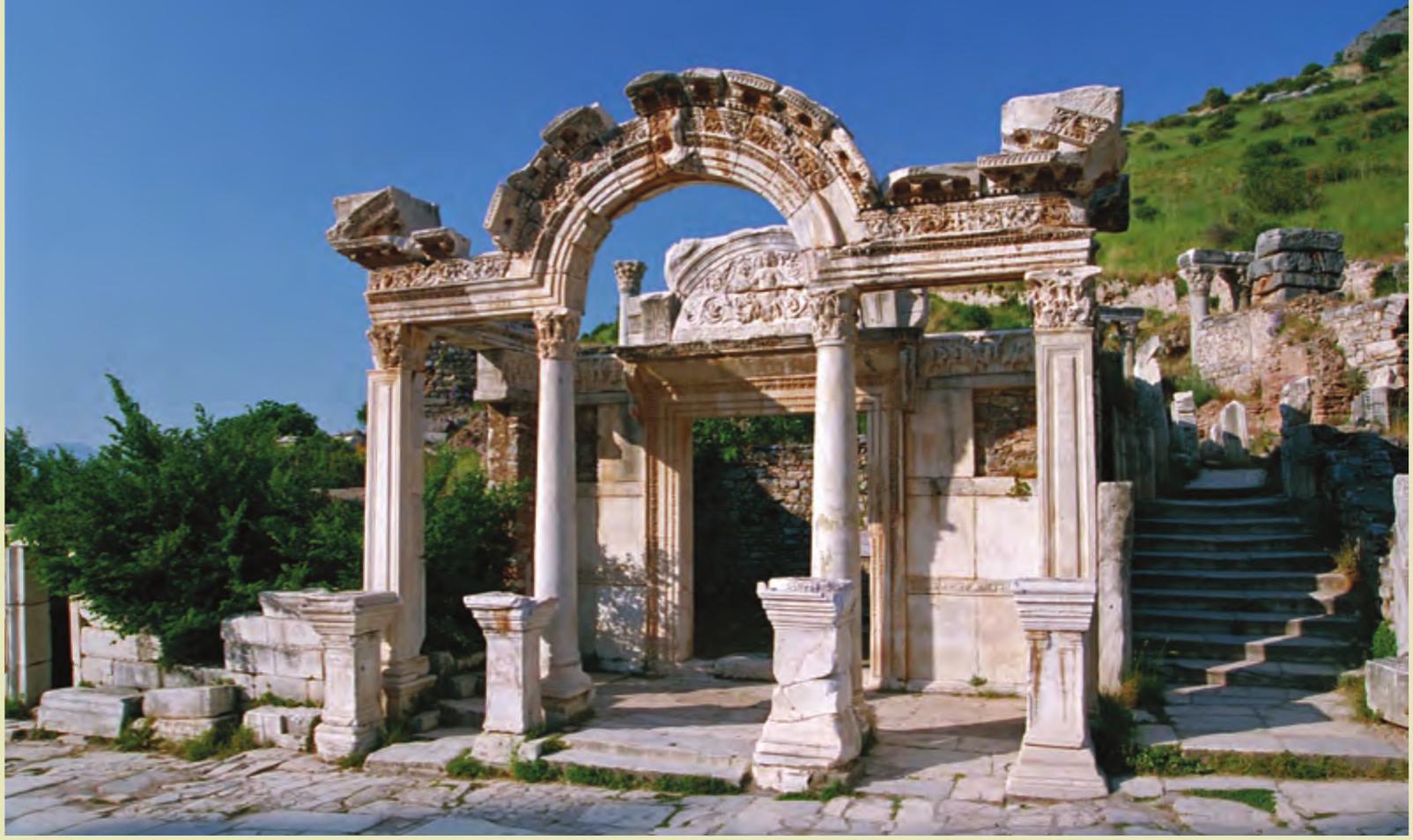
Temple of Hadrian (second century a.d.) at Ephesus. Paul wrote this letter to Timothy, who was serving in Ephesus.
© William D. Mounce
Original illustrations
End of source page 1993