PRINTED PAGE 1953NKJV · STUDY EDITION
1 TIMOTHY 5:7 | 1953
younger women as sisters, with all pu
rity.
Honor True Widows
3 Honor widows who are really wid
ows. 4 But if any widow has children
or grandchildren, let them first learn to
show piety at home and a to repay their
parents; for this is 1 good and acceptable
before God. 5 Now she who is really a
widow, and left alone, trusts in God and
continues in supplications and prayers
b night and day. 6 But she who lives in
2 pleasure is dead while she lives. 7 And
these things command, that they may be
to reading, to exhortation, to 6 doctrine.
14 k Do not neglect the gift that is in you,
which was given to you by prophecy
l with the laying on of the hands of the el
dership. 15 Meditate on these things; give
yourself entirely to them, that your prog
ress may be evident to all. 16 Take heed to
yourself and to the doctrine. Continue in
them, for in doing this you will save both
yourself and those who hear you.
Treatment of Church Members
5
Do not rebuke an older man, but ex
hort him as a father, younger men
as brothers, 2 older women as mothers,
13 6 teaching
14 k 2 Tim. 1:6
l Acts 6:6; 1 Tim.
5:22
CHAPTER 5
4 a Gen. 45:10 1 NU,
M omit good and
5 b Acts 26:7
6 2 indulgence
4:14 Paul encourages Timothy to be diligent. The gift is the spiritual
gift Timothy received from Christ (see Eph. 4:7, 8). by prophecy:
Timothy’s gift was given through a prophetic message (1:18) and
with the laying on of . . . hands, probably at Lystra (see Acts 16:1).
The laying on of hands signified the elders’ commission and recog-
nition of God’s work in Timothy’s life. Paul himself was part of the
group that laid their hands on Timothy (see 2 Tim. 1:6).
4:15 Paul’s care for Timothy, his “son in the faith” (see 1:2), is evident.
He was instructing Timothy so that his progress would be evident
to everyone in the church.
4:16 Save . . . yourself is not a reference to justification by works
but to sanctification, the Christian’s daily walk of faith (see Mark
8:34–38; John 12:25, 26). Those who hear you refers to the mem-
bers in the church to whom Timothy was reading, exhorting, and
teaching.
5:2 All purity is a word of caution to young men. They must respect
the purity of the younger women as the purity of a sister.
5:3 Honor is a command to show respect, a respect demonstrated
by one’s attitude and through financial support (vv. 4, 8). Widows
are those who have family to help support them (vv. 4, 16); the one
who is really a widow is one without family support.
5:4 Family members are instructed to care for widows. Piety is
respect, reverence, or obligation. repay: Honoring our parents
includes caring for them physically and financially as they grow
older. In effect, we are returning the time and energy they gave to
us while we were young.
5:5 Trusts means to have hope or confidence in God.
5:6 This verse identifies widows living ungodly lives, who are not
to be supported by the church. Lives in pleasure refers to a life of
comfort focused on one’s own desires. Dead means separated from
fellowship (see James 2:26). Widows in the church who choose to
live for themselves are separating themselves from fellowship with
God and the church.
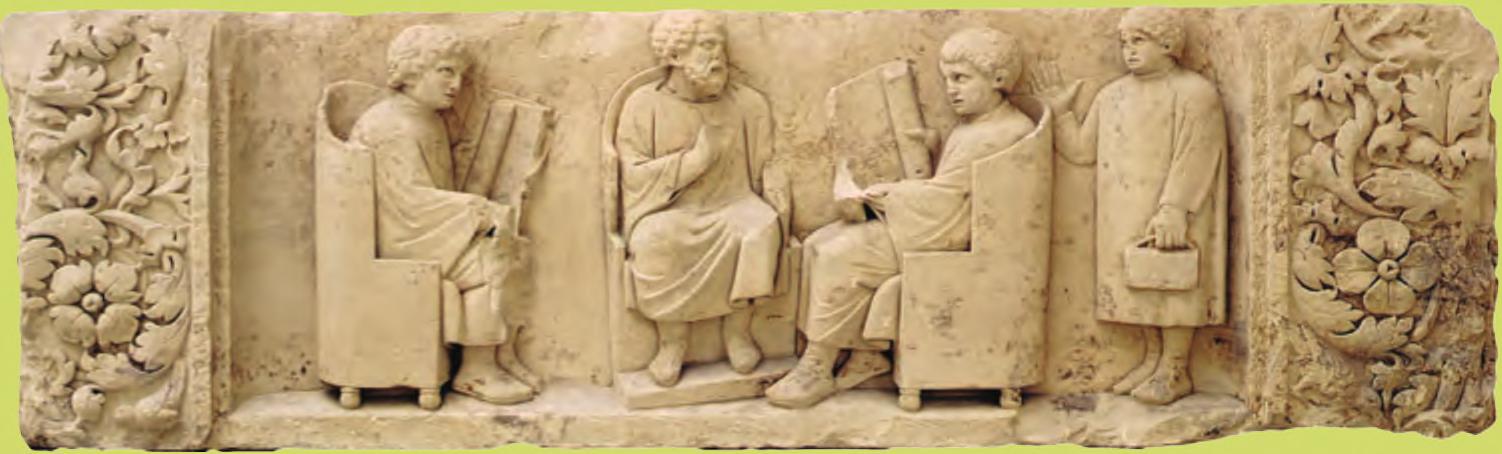
Bible Times & Culture Notes
Greek and Roman Schools
Ancient Greek and Roman schools were not compulsory, nor were they run by the government. In the Greek system, boys
were sent to school at age six. Their education had three main divisions: music, gymnastics, writing. All Greek children
were taught to play the lyre. Greek girls were taught to read and write by their mothers, who also taught them to weave,
dance, and play a musical instrument. Greek boys could attend school until they were 16. After that, they were expected
to train in sports.
Unlike the Greeks, the Romans used people of other nationalities to teach their children. Boys and girls entered formal
school at age seven. At 13, if they had done well, children went to high school; there were 20 such schools in Rome in
a.d. 30. Even Roman secondary education was taught in Greek, and the teachers were generally Greek slaves or freedmen.
A second-century a.d. Roman school scene
Relief depicting a school scene, from Neumagen, Gallo-Roman/Rheinisches
Landesmuseum, Trier, Germany/Giraudon/The Bridgeman Art Library
Original illustrations
End of source page 1988