PRINTED PAGE 1944NKJV · STUDY EDITION
1944 1 Timothy INTRODUCTION
the second century, it is also certain that the heresy began slowly and evolved before it became a complete
theological system. Paul dealt with similar false teachings in Colosse (see Col. 1:9–15). The heresy in 1 Timothy
appears to be an early form of gnostic teaching that combined elements of Judaism (see 1:7), Persian thought,
and Christianity.
There is no reason, therefore, to conclude that 1 and 2 Timothy are not authentic Pauline Epistles. First
Timothy was probably composed shortly after Paul’s release from his first Roman imprisonment. This means
the book was composed in Macedonia around a.d. 62.
Historical Setting Timothy was a native of Lystra in Phrygia (see Acts 16:1–3). His father was Greek, and
his mother Eunice and grandmother Lois were godly Jewish women (see 2 Tim. 1:5; 3:14, 15). It was through the
influence of these women that Timothy learned the Hebrew Scriptures as a child. Paul calls Timothy a “true son
in the faith” (1:2), suggesting that he was converted during Paul’s first missionary visit to Lystra (see Acts 14:6, 19).
At the beginning of Paul’s second missionary journey, Timothy was chosen by Paul to accompany him and
Silas (see Acts 16:3). Since they would be preaching to Jews, Paul had Timothy circumcised (Acts 16:3), and
evidently the leadership of the church laid hands on Timothy (4:14; 2 Tim. 1:6). He traveled with Paul and Silas
helping them in their evangelization of Philippi and Thessalonica. Apparently he remained in Thessalonica
(see Acts 17:10) and then joined Paul and Silas in Berea. In Corinth, Paul employed Timothy as a liaison between
himself and the church in Thessalonica (see the Introduction to 1 Thessalonians). Later he used Timothy as a
liaison again, this time to the church in Corinth, to teach the believers there (1 Cor. 4:17; 16:10). Acts does not
record Timothy’s travels during this period. He reappears in Ephesus (Acts 19:22), where Paul commissioned
Timothy and Erastus to prepare the churches in Macedonia for his arrival. Timothy remained in Macedonia and
accompanied Paul to Corinth, where presumably Paul wrote his letter to the Romans (see Rom. 16:21).
Then Timothy, along with six others, spearheaded Paul’s journey to Troas (see Acts 20:4, 5). Later he com-
forted Paul in Rome during the apostle’s first imprisonment (a.d. 60–62), sending greetings to the Colossians
(see Col. 1:1), Philemon (see Philem. 1), and the Philippians (see Phil. 1:1). During Paul’s imprisonment, Timothy
traveled to Philippi to encourage the believers there and then report back to Paul in Rome (Phil. 2:19). After
Paul’s release, Timothy traveled with him to Ephesus. Timothy stayed there to confront the false teachers who
were infiltrating the church, and Paul went on to Macedonia, where he wrote his first letter to Timothy (1:3). He
wrote his second letter to him from prison (2 Tim. 1:8), imploring Timothy to come quickly. This was probably
Paul’s last letter, for he was soon to die. If Timothy did come quickly, he would have been with him as his “true
son” in the final days before his execution (see 2 Tim. 4:11, 21).
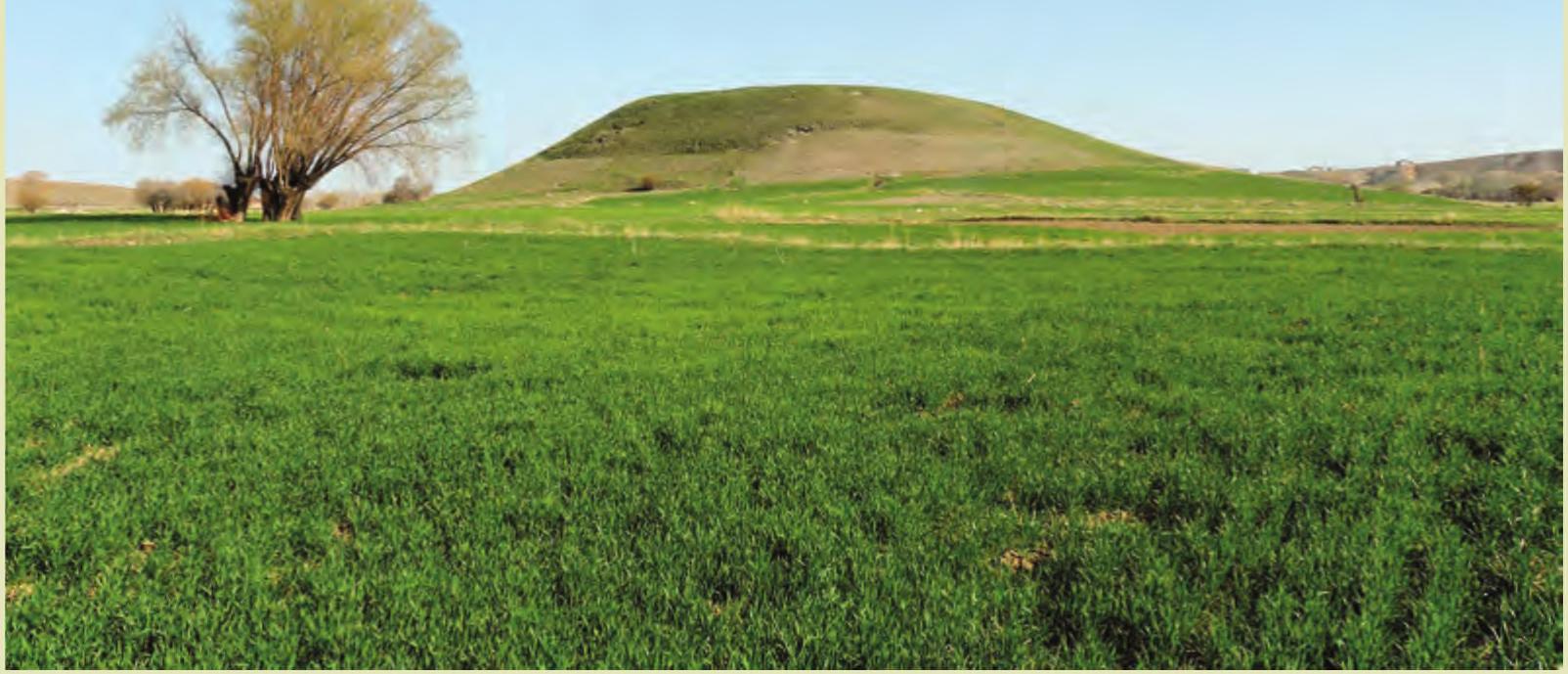
Unexcavated tell at Lystra, Timothy’s hometown. Paul visited Lystra during his first missionary journey. Timothy
joined his missionary team on the second journey (Acts 16:1 – 3).
Todd Bolen/www.BiblePlaces.com
Original illustrations
End of source page 1979