PRINTED PAGE 1928NKJV · STUDY EDITION
1928 | 1 THESSALONIANS 1:6
blessing, Paul’s preaching persuaded some of the Jews in the syna-
gogue, together with “a great multitude of the devout Greeks, and
not a few of the leading women” (Acts 17:4).
1:6 followers of us and of the Lord: Everyone needs teachers,
especially new converts. At times, Paul encouraged new believers
to imitate him (1 Cor. 11:1) as he was imitating Christ. All the writers
of the NT lead their readers back to the footprints of Christ as shown
in the Gospels (see Phil. 2:5; Heb. 12:2; 1 Pet. 2:21; 1 John 2:6). This
should be our goal also, to lead others to Christ by our own virtuous
example. As we focus on Jesus, we will reflect His image to others
(2 Cor. 3:18). Having received is not the usual word for reception,
but a word expressing a warm welcome. The Thessalonians seized
the gospel with joy, even if it meant facing persecution.
1:8 Your faith . . . has gone out: Testimony of the Thessalonians’
remarkable faith rang out throughout Greece and Macedonia. Since
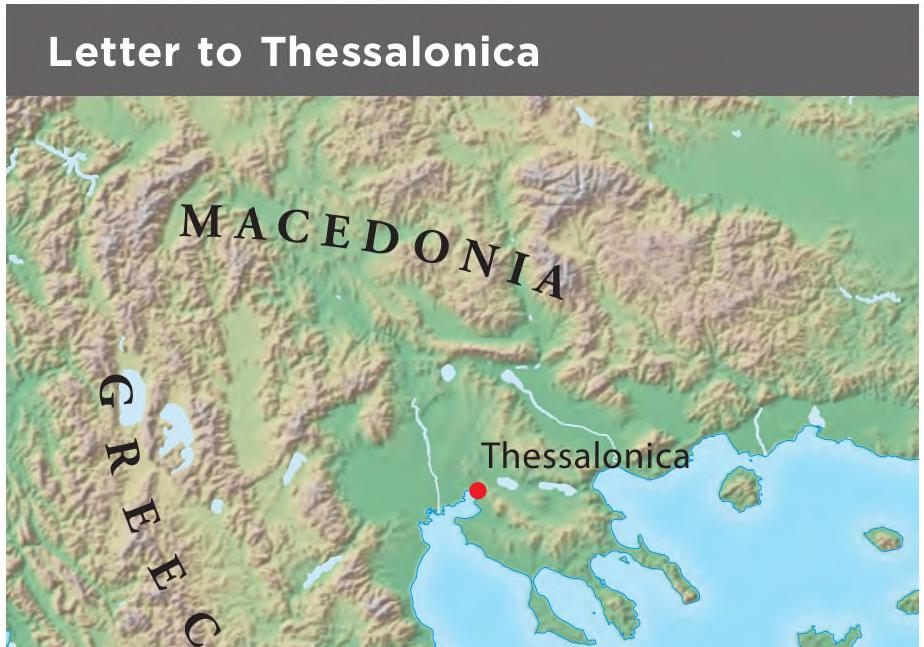
Thessalonica was a port city and was on the much-traveled Egna-
tian Way, those who saw the virtuous life and persistent faith of
the Thessalonian Christians would spread the word throughout the
entire region. The same had occurred at the Jerusalem church (see
Acts 6:7); that is, vital Christian living was making an impact on the
people who lived in and traveled through the city.
1:9 they themselves declare concerning us: These reports were
not from missionaries but from ordinary travelers who were giving
their impressions of the Thessalonian believers. turned to God
from idols: The truth of the gospel exposed the falsehood of idol-
atry. Since Jews avoided idolatry, Paul was primarily speaking to a
Greek audience (see Acts 17:4).
1:10 to wait for His Son: Paul hoped for the Lord’s return to occur
at any moment. The phrase to wait for pictures an eager and expec
tant looking forward to the return of our Lord Jesus who delivers us
from the wrath to come. This is a future deliverance, but this verse
does not make clear whether Paul is referring to a specific time or
to the outpouring of God’s wrath on unbelievers in a more general
sense. Because Christ endured God’s wrath at Calvary, all who are
in Christ will escape all aspects of God’s wrath (see 5:9). Thus, they
have nothing to fear.
2:1, 2 Paul’s motives for coming to Thessalonica had apparently
been attacked after he left by pagan Gentiles and by Jews clinging
to their traditional faith. Paul pointed out what the Thessalonians
knew, that he had not preached to them in vain (see 1:9) but had
declared his message in the face of opposition, including the painful
experience of being beaten and put in the stocks in Philippi (Acts
16:22–24).
2:3, 4 Answering criticism of his motives for preaching, Paul asserted
that he used the truth, not error; his motives were pure, not from
uncleanness; his presentation was in sincerity, not in deceit (a
word used also of a fishing lure to catch fish, suggesting trickery). In
contrast to these criticisms, Paul asserted that he and his coworkers
were approved messengers, missionaries shown by testing to be
genuine. Their ministry was not their personal choice, but God’s
appointment.
2:5–8 Paul denied that in his visit to the Thessalonians he had used
flattery. Instead, he preached boldly that everyone was a sinner
who needed to be saved by the grace of God. His preaching did not
serve as a cloak for covetousness, that is, as a mask to hide greed.
Here he appeals to God as his witness because no person could
6 And j you became followers of us and
of the Lord, having received the word in
much affliction, k with joy of the Holy
Spirit, 7 so that you became examples to
all in Macedonia and Achaia who believe.
8 For from you the word of the Lord l has
sounded forth, not only in Macedonia
and Achaia, but also m in every place.
Your faith toward God has gone out, so
that we do not need to say anything. 9 For
they themselves declare concerning us
n what manner of entry we had to you,
o and how you turned to God from idols
to serve the living and true God, 10 and
p to wait for His Son from heaven, whom
He raised from the dead, even Jesus who
delivers us q from the wrath to come.
Paul’s Conduct
2
For you yourselves know, brethren,
that our coming to you was not in
vain. 2 But 1 even after we had suffered
before and were spitefully treated at
a Philippi, as you know, we were b bold in
our God to speak to you the gospel of God
in much conflict. 3 c For our exhortation
did not come from error or uncleanness,
nor was it in deceit.
4 But as d we have been approved by God
e to be entrusted with the gospel, even so
we speak, f not as pleasing men, but God
g who tests our hearts. 5 For h neither at
6 j 1 Cor. 4:16; 11:1 k Acts 5:41; 13:52; 2 Cor. 6:10; Gal. 5:22
8 l Rom. 10:18 m Rom. 1:8; 16:19; 2 Cor. 2:14; 2 Thess. 1:4
9 n 1 Thess. 2:1 o 1 Cor. 12:2 10 p [Rom. 2:7] q Matt. 3:7; Rom. 5:9
CHAPTER 2 2 a Acts 14:5; 16:19-24; Phil. 1:30 b Acts 17:1-9
1 NU, M omit even 3 c 2 Cor. 7:2 4 d 1 Cor. 7:25 e Titus 1:3
f Gal. 1:10 g Prov. 17:3 5 h 2 Cor. 2:17
0
50 miles
0
50 km.
Thessalonica
Corinth
M A
C E
D O
N I
A
G
R
E
E
C
E
A
C
H
A I
A
Aege
an
Se
a
Letter to Thessalonica
Original illustrations
End of source page 1963