PRINTED PAGE 1925NKJV · STUDY EDITION
1 Thessalonians INTRODUCTION 1925
Themes First Thessalonians gives us an intimate introduction to how Paul men-
tored young believers. As this epistle demonstrates, his teaching for young con-
verts was rich in doctrine and application, accurately describing salvation in its
full dimensions.
In 1 Thessalonians, Paul reviewed some of the basics of the faith and applied
these truths to the believers’ lives. He challenged them to persevere in godly living
despite persecution. He extended the comfort of the Resurrection to those who
were in mourning, and he spoke about details of the Second Coming. In addition,
Paul responded to the angry attacks of his Jewish opponents, who were jealous
because Christians were drawing God-fearing Gentiles away from the local syna-
gogue. Paul’s opponents may have charged that his failure to return to Thessalonica
proved that he was insincere. Paul devoted the first three chapters of his letter to
correcting this false impression.
In a brief space, Paul covered a wide spectrum of the essential doctrines of
Christianity. These include such beliefs as the Trinity (1:5, 6), the deity of Christ (3:11,
12), the power of the Holy Spirit (1:5, 6), the nature of Scripture (2:13), the timing
and the events of the Second Coming (1:10; 2:19; 3:13; 4:13–17; 5:23), the day of the
Lord (5:1–3), assurance of salvation (1:5), conversion (1:9), sanctification (4:3; 5:23),
the Resurrection (4:14–18), the relation of faith to works (1:3), the relation of love
to service (1:3), and the relation of patience to hope (1:3).
Because 1 Thessalonians is one of Paul’s earliest letters, it reveals much of what
Paul preached during his second missionary journey. Evidently the return of Christ
was central to his message, for Paul answers many questions about the Second
Coming. In fact, perhaps the most significant doctrinal contribution of this small
letter is its detailed explanation of Christ’s return.
Christ in the Scriptures
Not only does Paul encourage the Thessalonians, but he also motivates their faith-
fulness by alluding to the Second Coming. Jesus is pictured in this letter as the
believers’ hope of salvation both now and when He returns to earth. At that time
He will deliver us from the wrath that will envelop the world (1:10; 5:4–11). This same
Jesus will reward our faithfulness with His physical presence (2:19) after He has
resurrected our mortal bodies. “For the Lord Himself will descend from heaven. . . .
We who are alive and remain shall be caught up together. . . . And thus we shall
always be with the Lord” (4:16, 17).
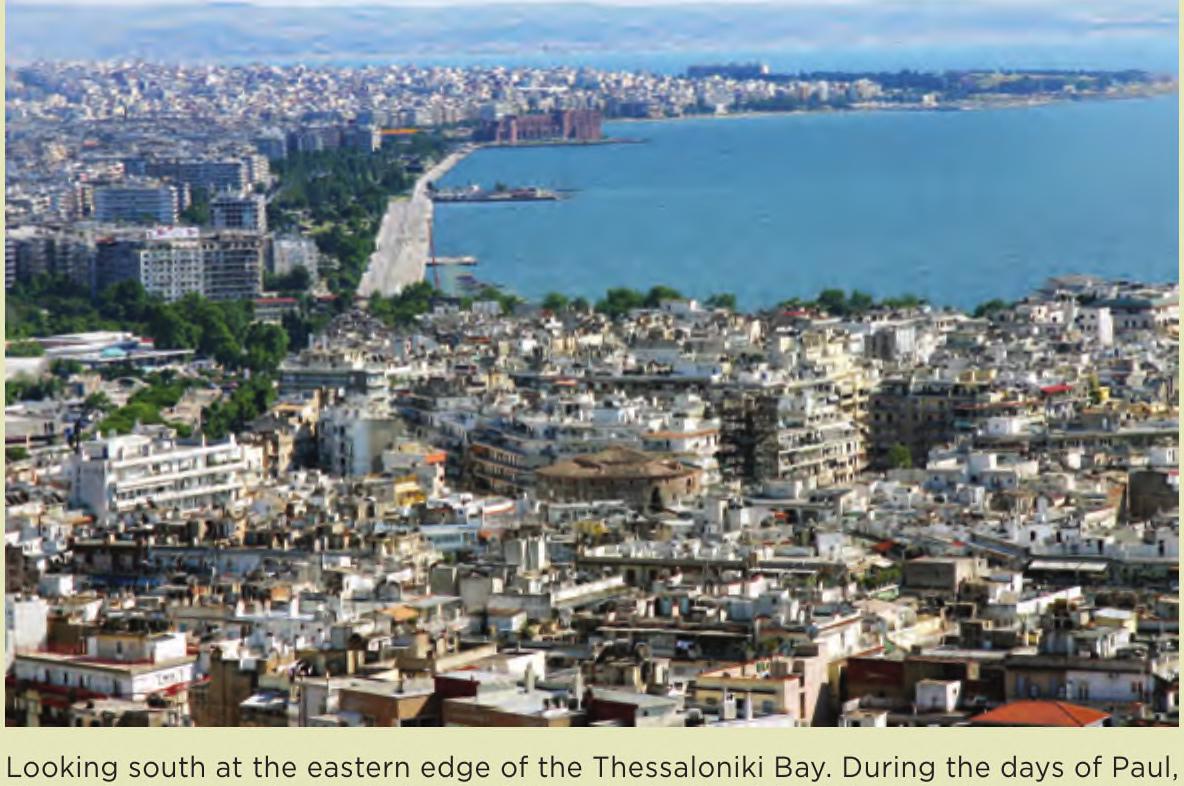
Looking south at the eastern edge of the Thessaloniki Bay. During the days of Paul,
Thessalonica was the capital city of Macedonia. He visited there on his second and
third missionary journeys.
www.HolyLandPhotos.org
c. a.d. 47–49
Paul’s first
missionary
journey
c. a.d. 50
The Jerusalem
council
c. a.d. 50–53
Paul’s second
missionary
journey
c. a.d. 51
The church at
Thessalonica is
started
c. a.d. 51
1 Thessalonians is
written
c. a.d. 53–57
Paul’s third
missionary
journey
c. a.d. 58
Paul is arrested in
Jerusalem
c. a.d. 60–62
Paul is imprisoned
in Rome
c. a.d. 67
Peter and Paul are
executed
Original illustrations
End of source page 1960