PRINTED PAGE 1921NKJV · STUDY EDITION
Colossians 3:13 | 1921
the body, but are of no value against the
indulgence of the flesh.
Not Carnality but Christ
3
If then you were a raised with Christ,
seek those things which are above,
b where Christ is, sitting at the right hand
of God. 2 Set your mind on things above,
not on things on the c earth. 3 d For you
died, e and your life is hidden with Christ
in God. 4 f When Christ who is g our life
appears, then you also will appear with
Him in h glory.
5 i Therefore put to death j your mem
bers which are on the earth: k fornication,
uncleanness, passion, evil desire, and
covetousness, l which is idolatry. 6 m Be
cause of these things the wrath of God is
coming upon n the sons of disobedience,
7 o in which you yourselves once walked
when you lived in them.
8 p But now you yourselves are to put
off all these: anger, wrath, malice, blas
phemy, filthy language out of your
mouth. 9 Do not lie to one another, since
you have put off the old man with his
deeds, 10 and have put on the new man
who q is renewed in knowledge r accord
ing to the image of Him who s created
him, 11 where there is neither t Greek
nor Jew, circumcised nor uncircumcised,
barbarian, Scythian, slave nor free, u but
Christ is all and in all.
Character of the New Man
12 Therefore, v as the elect of God, holy
and beloved, w put on tender mercies,
kindness, humility, meekness, long
suffering; 13 x bearing with one another,
and forgiving one another, if anyone
has a complaint against another; even
19 w Eph. 4:15
x Eph. 1:23; 4:16
20 y Rom. 6:2-5
z Gal. 4:3, 9 4 NU, M
omit Therefore
21 a 1 Tim. 4:3
22 b Is. 29:13; Matt.
15:9; Titus 1:14
23 c Rom. 13:14;
1 Tim. 4:8 5 severe
treatment,
asceticism
CHAPTER 3
1 a Rom. 6:5; Eph.
2:6; Col. 2:12 b Ps.
68:18; 110:1; [Rom.
8:34]; Eph. 1:20
2 c [Matt. 6:19-21]
3 d [Rom. 6:2; 2 Cor.
5:14; Gal. 2:20]; Col.
2:20 e [2 Cor. 5:7]
4 f [1 John 3:2]
g John 14:6 h 1 Cor.
15:43
5 i [Rom. 8:13]
j [Rom. 6:13] k Eph.
5:3 l Mark 7:21;
1 Cor. 6:9, 18; 2 Cor.
12:21; Gal. 5:19;
Eph. 4:19; 5:3, 5
6 m Rom. 1:18;
Eph. 5:6; Rev. 22:15
n [Eph. 2:2]
7 o 1 Cor. 6:11; [Eph.
2:2]; Titus 3:3
8 p Eph. 4:22;
1 Pet. 2:1
10 q Rom. 12:2;
2 Cor. 4:16 r [Rom.
8:29] s [Eph. 2:10]
11 t Rom. 10:12;
[1 Cor. 12:13]; Gal.
3:27, 28 u Eph. 1:23
12 v [1 Pet. 1:2]
w Luke 1:78; Phil.
2:1; 1 John 3:17
13 x [Mark 11:25]
puffed up by his fleshly mind, 19 and not
holding fast to w the Head, from whom all
the body, nourished and knit together by
joints and ligaments, x grows with the in
crease that is from God.
20 4 Therefore, if you y died with Christ
from the basic principles of the world,
z why, as though living in the world, do
you subject yourselves to regulations—
21 a “Do not touch, do not taste, do not
handle,” 22 which all concern things
which perish with the using—b accord
ing to the commandments and doctrines
of men? 23 c These things indeed have an
appearance of wisdom in self-imposed
religion, false humility, and 5 neglect of
who do not champion salvation in Christ alone often appear to be
humble. But their search for a new spiritual experience or advocacy
of some work as necessary for salvation is actually human pride.
They do not want to submit to God’s plan of salvation revealed in
the Bible.
2:20–23 regulations: Since believers have been released from
ritualistic observances why should they let others bind them down
again (see Rom. 6:3–14)? No human work can be added to the merit
of Christ’s death. His work on the Cross is the only acceptable work in
God’s eyes. The legalistic commands of others are a self-imposed
religion and are of no value for salvation.
3:1–4 Paul’s exhortations in ch. 3 are practical applications of the
doctrine he has presented in ch. 2. if . . . you were raised with
Christ: Paul ties his ethical teaching (v. 5) to the doctrine of the Res-
urrection (see 2:12, 13). Set your mind on things above: The false
teachers were instructing the Colossians to concentrate on temporal
observances; in contrast, Paul instructs them to concentrate on the
eternal realities of heaven. The Greek verb for set emphasizes an
ongoing decision. Christians must continually discipline themselves
to focus on eternal realities, instead of the temporal realities of this
earth. A Christian’s life is no longer dictated by this world but is hid-
den with Christ. The Greek word for hidden indicates that God has
accomplished this in the past so that it is a present reality.
3:5–8 While obedience to rules cannot bring salvation, those who
are saved ought to live worthy of that salvation. Thus Paul gives
the Colossians instructions concerning proper conduct. He states
in negative and positive terms the kind of life that God wants Chris-
tians to live. Although the believers at Colosse were once captivated
by the evil practices listed in vv. 5, 8, 9, they were to abandon such
practices.
3:9, 10 The analogies between the old man and our old sinful
ways and the new man and our new lives in Jesus Christ parallels
Paul’s discussion in Rom. 6 about dying to sin and living for Christ.
The two words old man and new man do not refer to the Christian’s
fleshly and spiritual natures. Instead, Paul describes our former un-
redeemed life as the old man, and our life as God’s child as the new
man. The new man has the image of the new creation in Christ, just
as the old man bears the image of our fallen nature. The old man is
under an old master, Satan, while the new man has a new master,
the Spirit of God living within.
3:11 barbarian: In the Roman Empire a person who did not speak
Greek was despised. Scythian: An uncultured person who came
from the area around the Black Sea. Greek . . . Jew . . . slave . . .
free: This list is similar to the list in Gal. 3:28. In both places the point
is not the functions of the persons in the body of Christ, but equal
acceptance of all the groups into God’s family.
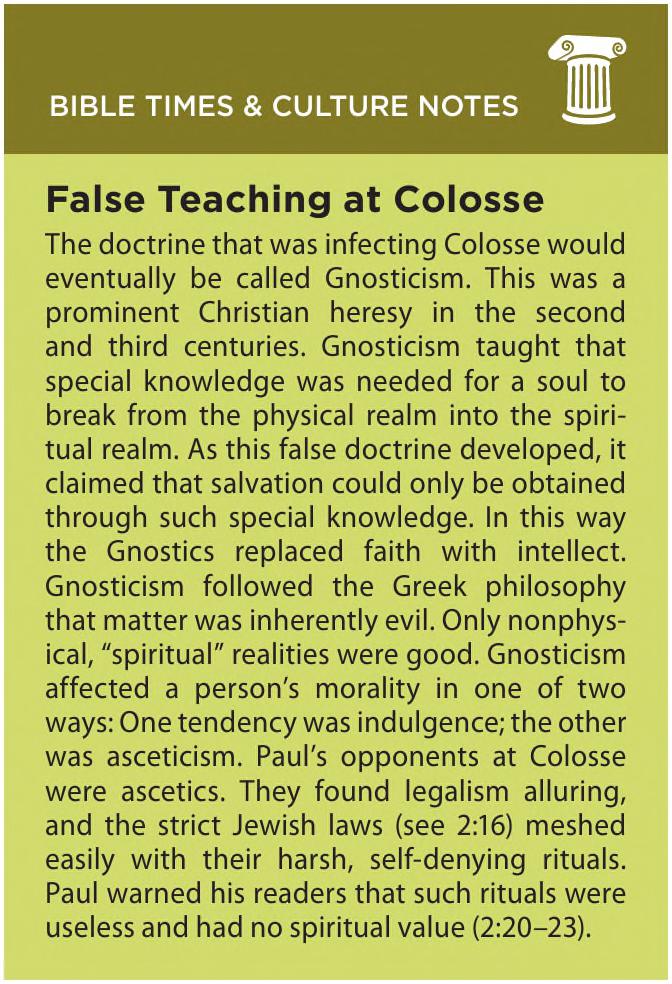
Bible Times & Culture Notes
False Teaching at Colosse
The doctrine that was infecting Colosse would
eventually be called Gnosticism. This was a
prominent Christian heresy in the second
and third centuries. Gnosticism taught that
special knowledge was needed for a soul to
break from the physical realm into the spiri-
tual realm. As this false doctrine developed, it
claimed that salvation could only be obtained
through such special knowledge. In this way
the Gnostics replaced faith with intellect.
Gnosticism followed the Greek philosophy
that matter was inherently evil. Only nonphys-
ical, “spiritual” realities were good. Gnosticism
affected a person’s morality in one of two
ways: One tendency was indulgence; the other
was asceticism. Paul’s opponents at Colosse
were ascetics. They found legalism alluring,
and the strict Jewish laws (see 2:16) meshed
easily with their harsh, self-denying rituals.
Paul warned his readers that such rituals were
useless and had no spiritual value (2:20–23).
Original illustrations
End of source page 1956