PRINTED PAGE 1914NKJV · STUDY EDITION
1914 Colossians INTRODUCTION
Setting The city of Colosse was about a hundred miles east of Ephesus, in the valley of the Lycus River. During
the Persian Wars of the fifth century b.c., Colosse was a large and strategic city. By the time of the apostle Paul,
however, it had declined into the shadows of its two sister cities, Laodicea and Hierapolis, and had become a
small merchant town on the trade route from Rome to the east.
Evangelization of Colosse probably took place during Paul’s three-year stay in Ephesus. Luke records in Acts
19:10 that people throughout the Asian region heard the gospel. Apparently Epaphras was converted in Ephesus,
and after being instructed by Paul returned home to Colosse to proclaim the gospel. Evidently the church that
emerged was largely composed of Gentiles, for Paul refers to their “uncircumcision,” a word employed by Paul
to designate Gentiles (see 2:13; Rom. 2:24–27; Eph. 2:11).
Relationship of Colossians to Philemon The circumstances of Colossians and Philemon are the same.
Paul is imprisoned, along with others, for preaching the gospel (4:10; Philem. 1, 23). The companions Paul lists
are identical in the two letters, with the exception of Justus, who is found only in the letter to Colossians (see 1:1;
4:9–14, 17; Philem. 1, 2, 10, 23, 24). Furthermore, Onesimus (the slave of Philemon) went to Colosse with Tychicus,
the bearer of the Colossian letter (4:7–9). Thus the two letters are companion epistles: one for the Colossian
church as a whole and one addressed to a member of that church, Philemon.
Relationship of Colossians and Ephesians The many parallels between Colossians and Ephesians
indicate that the two letters were written about the same time. Both letters reveal the centrality of Christ and
His relationship to the church. Ephesians shows Christ as Head of the church, while Colossians extends that
imagery of His authority over all creation (see 1:16–18; 2:10). In Ephesians, Paul highlights how Christians are
the members of the body of Christ, who is the Head. In Colossians, he places emphasis on Christ the Head, of
whose body Christians are members.
The differences in the epistles are significant as well. Colossians stresses the completeness of the believer
in Christ; Ephesians points to Christian unity which is found in Christ. The mystery in Colossians is that Christ is
in believers (1:26, 27), while the mystery in Ephesians is the unity of Jew and Gentile in Christ. Colossians speaks
of Jesus as Lord over all creation, while Ephesians concerns itself with Christ’s authority over the church. Finally,
Colossians has a stronger tone because it confronts a specific false teaching in Colosse. Ephesians has a softer
tone; it does not address a specific heresy.
But with all their similarities and differences, Ephesians and Colossians together present a mature under-
standing of who Christ is and what His life and death mean for the believer. From prison, Paul was teaching the
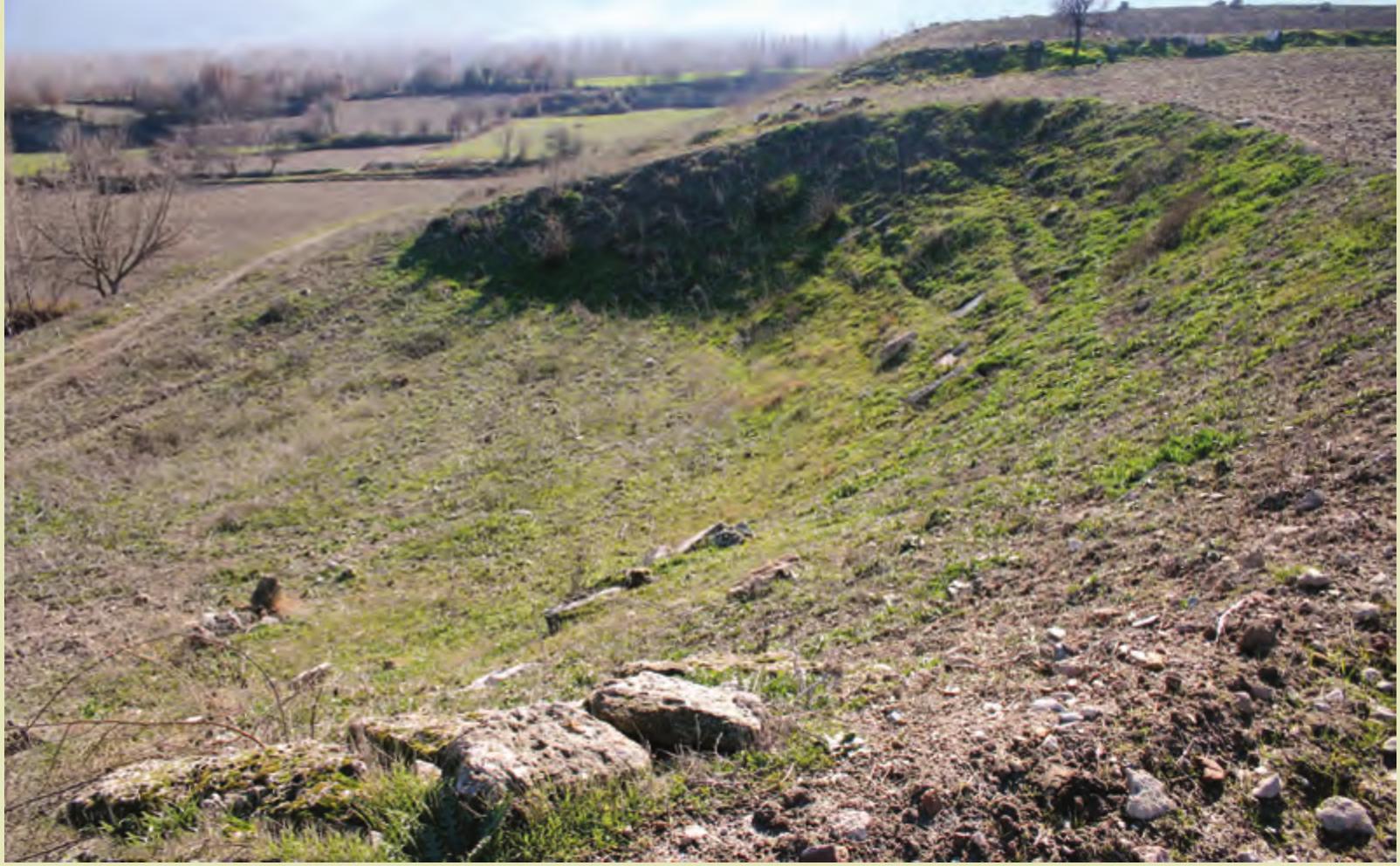
The unexcavated theater (or possibly odeon) at Colosse
www.HolyLandPhotos.org
Original illustrations
End of source page 1949