PRINTED PAGE 1889NKJV · STUDY EDITION
Ephesians INTRODUCTION 1889
City wall
Temple of
Serapis
Agora
Town Hall
Baths
Theater
Gymnasium
Stadium
Temple of
Artemis
Magnesian
Gate
Mt. Coressus
Curetes Street
Arcadian Way
To Cayster River
and Aegean Sea
Mt. Pion
N
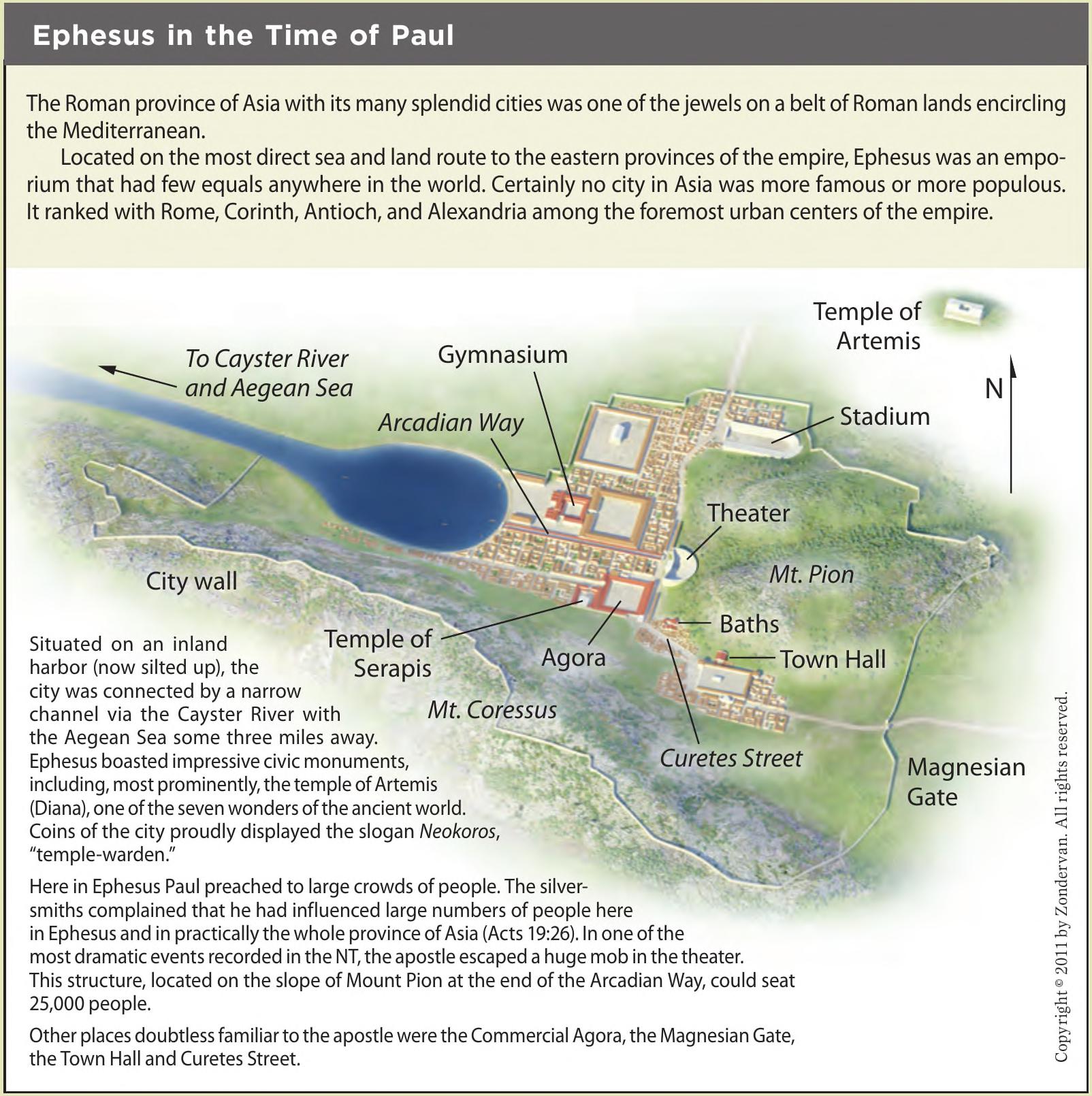
The Roman province of Asia with its many splendid cities was one of the jewels on a belt of Roman lands encircling
the Mediterranean.
Located on the most direct sea and land route to the eastern provinces of the empire, Ephesus was an empo-
rium that had few equals anywhere in the world. Certainly no city in Asia was more famous or more populous.
It ranked with Rome, Corinth, Antioch, and Alexandria among the foremost urban centers of the empire.
Situated on an inland
harbor (now silted up), the
city was connected by a narrow
channel via the Cayster River with
the Aegean Sea some three miles away.
Ephesus boasted impressive civic monuments,
including, most prominently, the temple of Artemis
(Diana), one of the seven wonders of the ancient world.
Coins of the city proudly displayed the slogan Neokoros,
“temple-warden.”
Here in Ephesus Paul preached to large crowds of people. The silver-
smiths complained that he had influenced large numbers of people here
in Ephesus and in practically the whole province of Asia (Acts 19:26). In one of the
most dramatic events recorded in the NT, the apostle escaped a huge mob in the theater.
This structure, located on the slope of Mount Pion at the end of the Arcadian Way, could seat
25,000 people.
Other places doubtless familiar to the apostle were the Commercial Agora, the Magnesian Gate,
the Town Hall and Curetes Street.
Copyright © 2011 by Zondervan. All rights reserved.
Ephesus in the Time of Paul
Original illustrations
End of source page 1924