PRINTED PAGE 1887NKJV · STUDY EDITION
Ephesians INTRODUCTION 1887
In Acts 20:17–38 Paul warned the elders of the Ephesian church about “savage wolves” who would not spare
the congregation. About four decades later, the Lord Jesus Himself dictated to the apostle John a letter to the
same congregation (see Rev. 2:1–7). He commended the Ephesians for hearing Paul and not tolerating false
teachers, but He exhorted them to recapture their first love for God.
Recipients There is much evidence that the Epistle to the Ephesians was originally a circular letter sent to
several congregations in the province of Asia, where Ephesus was the capital. Some manuscripts lack “in Ephe-
sus” in 1:1. Another clue that Ephesians is a circular letter is its lack of personal references. The phrases in 1:15
and 3:2 imply that Paul had only heard of the recipients of the letter but had never met them. This is especially
noteworthy since Paul had spent three years ministering at Ephesus. It seems likely that the apostle would have
mentioned at least some of the Ephesians by name in his letter. In addition to the lack of personal references,
the content and teaching of the letter is itself very general. Paul refers to the church as the body of Christ as
a whole, and not to a specific local church. If the letters to the Corinthians bristle with local congregational
problems, Ephesians lacks such allusions entirely.
The idea that Ephesians is a circular letter is not unparalleled. In a way, all the New Testament epistles are
circular in the sense that they eventually were circulated among many churches. While the question of desti-
nation is interesting, it does not strongly affect the meaning or the relevance of the letter. To a greater or lesser
extent all the letters in the New Testament are for the general edification of the church.
Themes Ephesians, like so much of Paul’s writing, underscores the truth that salvation is by faith alone and
not through works or human striving. The first half of the epistle (chs. 1–3) addresses the central doctrines of
the Christian faith, while the second half of the letter (chs. 4–6) describes how those spiritual truths should be
reflected in a Christian’s behavior. Some would divide the second half of the letter into two sections—first
the Christian’s conduct and then spiritual conflict with the forces of evil. Such a division highlights the familiar
passage describing the spiritual armor of a Christian.
The whole letter emphasizes the truth that all believers are united in Christ because the church is the one
body of Christ. In the early chapters, Paul describes how God formed this new body from Jews and Gentiles with
His Son as the Head. Through Jesus’ death, God reconciled sinful people to Himself. This reconciliation with God
has its effects on earth. People who were normally divided, like the Jews and the Gentiles in the first century,
were reconciled to each other through Christ. In Ephesians, Paul exhorted his readers to live out the spiritual
truth of being joined together with Christ. Whether Jew or Gentile, they had to work together to make the unity
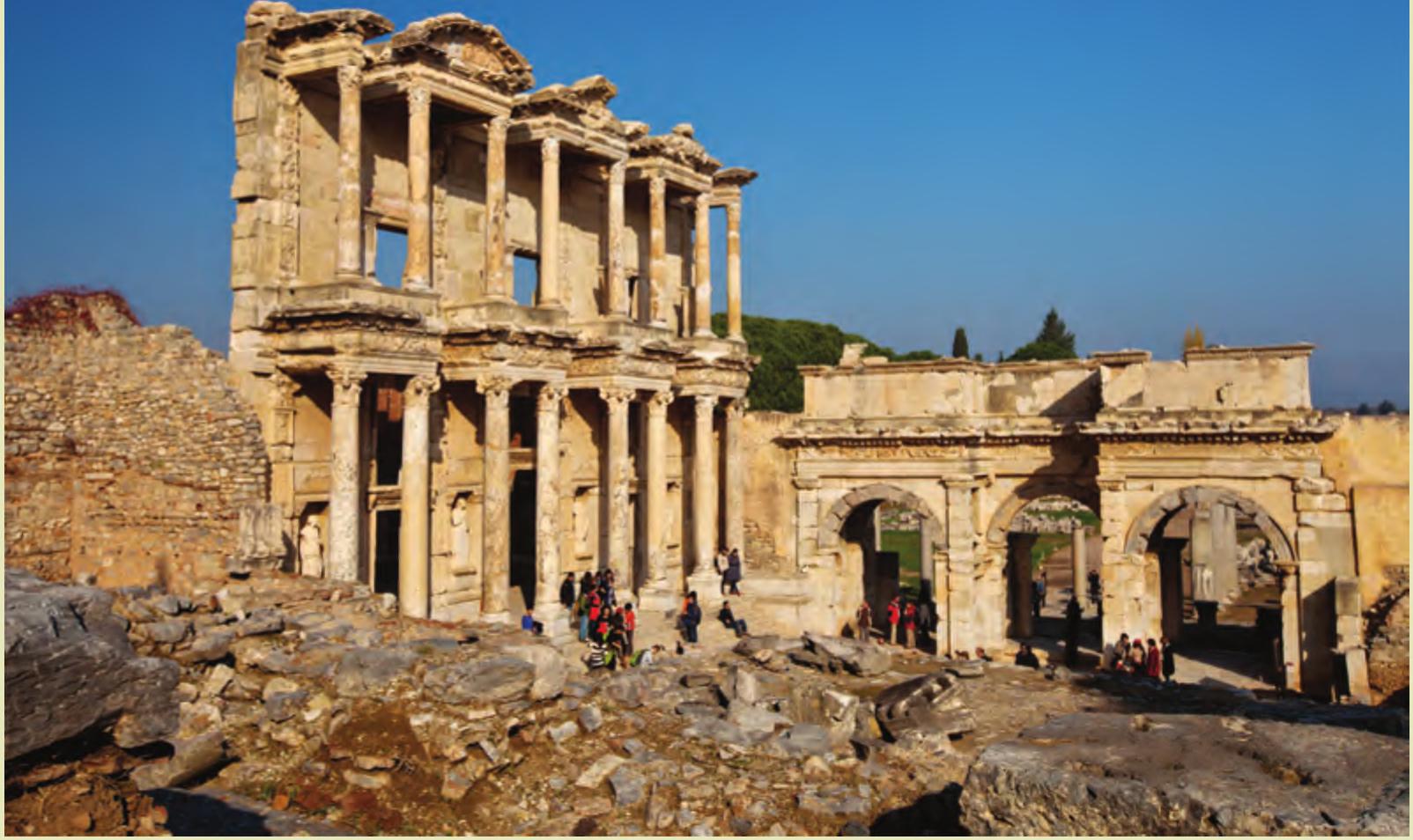
Library of Celsus at Ephesus, built during the period a.d. 110 – 135
© 2012 by Zondervan
Original illustrations
End of source page 1922