PRINTED PAGE 1884NKJV · STUDY EDITION
1884 | Galatians 6:1
CHAPTER 6
1 a Eph. 4:2
1 caught
2 b Acts 20:35; Rom.
15:1; 1 Thess. 5:14
c [James 2:8]
3 d Rom. 12:3
e [2 Cor. 3:5; James
1:22]
4 f 1 Cor. 11:28
g Luke 18:11
self. 4 But f let each one examine his own
work, and then he will have rejoicing in
himself alone, and g not in another. 5 For
h each one shall bear his own load.
Be Generous and Do Good
6 i Let him who is taught the word share
in all good things with him who teaches.
7 Do not be deceived, God is not
mocked; for j whatever a man sows, that
he will also reap. 8 For he who sows to his
flesh will of the flesh reap corruption, but
he who sows to the Spirit will of the Spir
it reap k everlasting life. 9 And l let us not
grow weary while doing good, for in due
season we shall reap m if we do not lose
heart. 10 n Therefore, as we have oppor
tunity, o let us do good to all, p especially
to those who are of the household of
faith.
Glory Only in the Cross
11 See with what large letters I have
written to you with my own hand! 12 As
many as desire to make a good showing
in the flesh, these would compel you to
be circumcised, q only that they may not
suffer persecution for the cross of Christ.
13 For not even those who are circum
Bear and Share the Burdens
6
Brethren, if a man is 1 overtaken in
any trespass, you who are spiritual
restore such a one in a spirit of a gentle
ness, considering yourself lest you also be
tempted. 2 b Bear one another’s burdens,
and so fulfill c the law of Christ. 3 For d if
anyone thinks himself to be something,
when e he is nothing, he deceives him
6:1 Any trespass probably recalls the sinful “works of the flesh” in
5:19–21. Overtaken means to be caught off guard, perhaps at a vul-
nerable point. A believer devastated by sin needs to be approached
with gentleness (5:23) by fellow believers. Those not controlled by
the Holy Spirit would tend to boast by comparing themselves to the
fallen believer (vv. 3, 4). Even as a doctor can catch a disease from
treating a patient, so one restoring a fallen sinner can be tempted
to fall into sin. That danger is well worth considering.
6:2 The law of Christ referred to here is probably the summation of
the law: “Love your neighbor” (see 5:14; Matt. 22:39; John 13:34, 35).
The term fulfill suggests that choosing to bear another Christian’s
burdens (or restore another Christian from burdensome sin, v. 1) is
precisely what Christ expects of all believers. The Greek word for
burdens refers to something beyond the normal capacity to carry,
as opposed to a “load” (v. 5), which is what a person could be ex-
pected to carry.
6:3, 4 Anyone who concludes that he is something special, through
shortsighted self-comparison with those who seem to have fallen,
truly deceives himself. Instead of examining and judging others, a
Christian should always examine his own work to see if he is closely
following Christ’s example (see 1 Cor. 11:31; 2 Cor. 13:5).
6:6 One important way to bear other believers’ burdens (v. 2) is to
share in all good things, including financial support, with one
who teaches God’s word. After all, teachers and preachers work
hard in their ministry (see 1 Tim. 5:17).
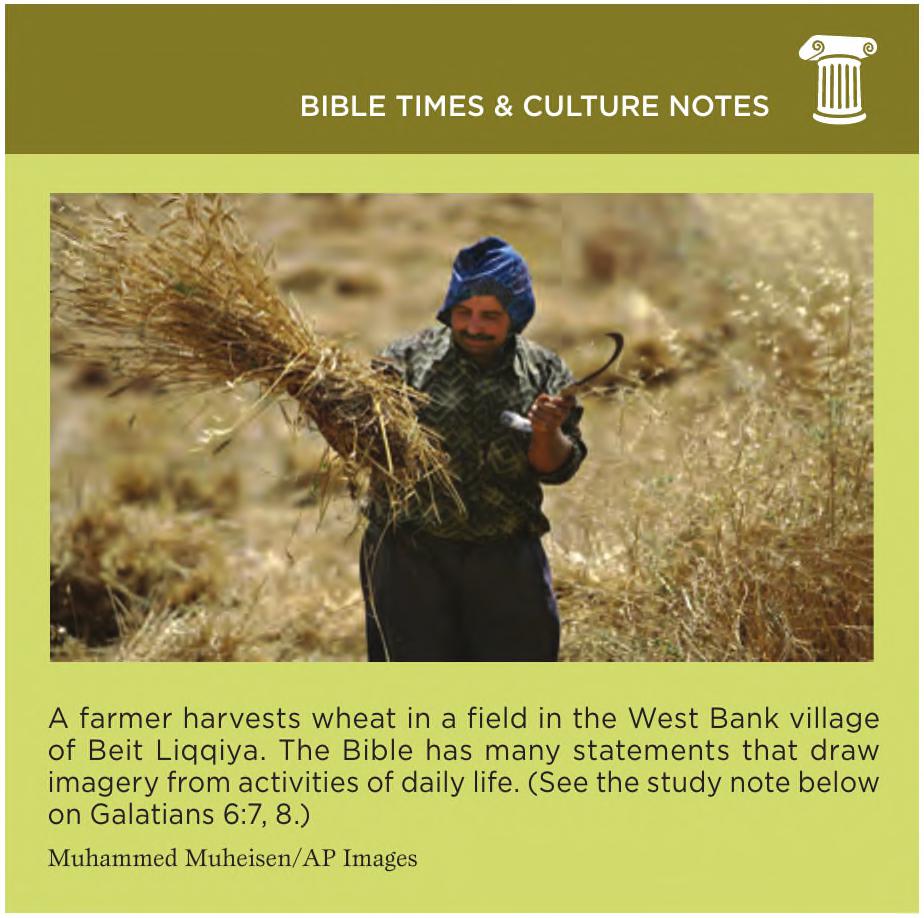
6:7, 8 The principle of sowing and reaping was known to everyone
in a largely agricultural society. It is a vain attempt to “mock” God
for a Christian to think that if he sows to his flesh he can escape
the harvest of destruction and judgment that comes upon those
who participate in sin (5:19–21; Hos. 8:7). Corruption is a term used
for a field in which the produce is too rotten to harvest (see Heb.
6:8). Some interpret corruption to imply eternal destruction, either
through losing salvation or through never having been truly saved
at all. Others understand a tragic loss of rewards for the carnal be-
liever (see 1 Cor. 3:12–15; 2 Cor. 5:10; Rev. 22:12). He who sows to the
Spirit will . . . reap everlasting life does not mean that eternal
life is earned by works. Rather, Paul is saying that everlasting life
is the glorious end of those who follow the guidance of the Spirit
(see Rom. 6:22).
6:9 In this verse, Paul speaks of doing good. The apostle has ar-
gued at length that such works cannot justify (2:16) or sanctify (3:3)
anyone. However, good works are, in fact, an important fruit of the
life of faith (5:5) that God has planned for each believer (see Eph.
2:8–10). In 5:19–23, the apostle describes the attitudes and actions
of those controlled by the “flesh” versus those controlled by the
Spirit. In vv. 7–9, Paul shows the impact of those two contradictory
ways over the length of a Christian’s life (see 2 Cor. 5:10; Rev. 22:12).
6:10 Therefore indicates that this verse speaks of an important
application of the spiritual sowing and reaping process (vv. 7–9).
Christians are not only to serve one another in love (see v. 2; 5:13),
they also should do good to non- Christians.
6:11 Probably here Paul began to write with his own hand, after
having up to now dictated the letter to a secretary. His reference to
large letters in light of the wording of 4:13–15 implies that Paul had
problems with his eyesight or was even partly blind. Paul commonly
ended his letters with personal greetings (see 2 Thess. 3:17).
6:12 a good showing: The Judaizers were trying to appear spiri-
tual by becoming circumcised and demanding that others become
circumcised (5:2–12). persecution: By teaching that all Christians
should become circumcised, the Judaizers were trying to make
Christianity into a sect of Judaism. This would have two advantag-
es. First, they could counter the persecution that they suffered from
zealous Jews. Second, they could include themselves with an offi-
cially sanctioned religion of the Roman Empire, Judaism.
6:13 Even the Judaizers who advocated the Galatians’ circumcision
did not really keep the entire law. They knew they were required
5 h [Rom. 2:6] 6 i 1 Cor. 9:11, 14 7 j [Rom. 2:6] 8 k [Rom.
6:8] 9 l 1 Cor. 15:58; 2 Cor. 4:1; 2 Thess. 3:13 m [Matt. 24:13];
Heb. 12:3, 5; [James 5:7, 8] 10 n Prov. 3:27; [John 9:4; 12:35]
o Titus 3:8 p Rom. 12:13 12 q Gal. 5:11; Phil. 3:8
Bible Times & Culture Notes
A farmer harvests wheat in a field in the West Bank village
of Beit Liqqiya. The Bible has many statements that draw
imagery from activities of daily life. (See the study note below
on Galatians 6:7, 8.)
Muhammed Muheisen/AP Images
Original illustrations
End of source page 1919