PRINTED PAGE 1873NKJV · STUDY EDITION
Galatians INTRODUCTION 1873
gospel. Paul had to convince his “little children” in the faith, whom he had evangelized personally, that the
new teaching was in fact a distortion of the gospel of Christ. In his argument Paul reasserted his authority as an
apostle, which apparently had been minimized by the Judaizing teachers. Paul wrote not out of anger, but out
of love. He saw the Galatians leaving the correct path by their additions to the gospel message, and he loved
his fellow believers too much to allow them to go astray.
Literary Form Galatians contains the three standard elements of a typical first-century letter: introduction
(1:1–5), body (1:6—6:10), and conclusion (6:11–18). However, Galatians differs from many of Paul’s other letters.
For example, most of Paul’s other letters contain an introductory thanksgiving section that serves as a prologue
(Phil. 1:3–11). The startling absence of such a thanksgiving at the beginning of Galatians probably indicates the
severity of the situation in Paul’s eyes. There is virtually nothing for which Paul can be thankful, since some of
the Galatians were abandoning the gospel they had once embraced. Likewise, the letter contains no concluding
greetings, whether long, like Rom. 16:3–23, or short, like 2 Cor. 13:12, 13. There is only a terse benediction and
concluding salutation (6:16, 18).
Theology If there is one repeated phrase that summarizes the subject of Galatians, it is “the truth of the
gospel.” Unlike Romans, which presents the gospel as the answer to universal human sinfulness (see Rom. 3:23;
6:23), Galatians clarifies the gospel message against the subtle, but ever deadly, danger of works salvation. No
sinful person has ever been granted eternal life based on works. What is more, everyone who lives by such a
confidence in works is “cursed,” because no one can perfectly obey the law (3:10). Thus, to add works, rituals, or
the law to the message of what it takes to become a Christian is to overturn the Good News. The proper place of
the law is to convict us of our sin, demonstrating the urgent need for the redemption provided by Jesus Christ.
What then is the basic gospel that Paul goes to such lengths to clarify and safeguard? The only way a person
can be justified before God is by faith in Jesus Christ (2:16). Paul emphasizes this point over and over. Faith in
Christ, nothing more and nothing less, is the proper response to the gospel. This emphasis on faith is not about
the historical dimension of the gospel that is open to reasonable inquiry: Jesus perfectly kept the Law of Moses
(4:4), died on the Cross (2:20), and rose from the dead (1:1). Rather Paul underscores faith in Christ because the
controversies in Galatia raged around the reception of the gospel in the lives of new believers.
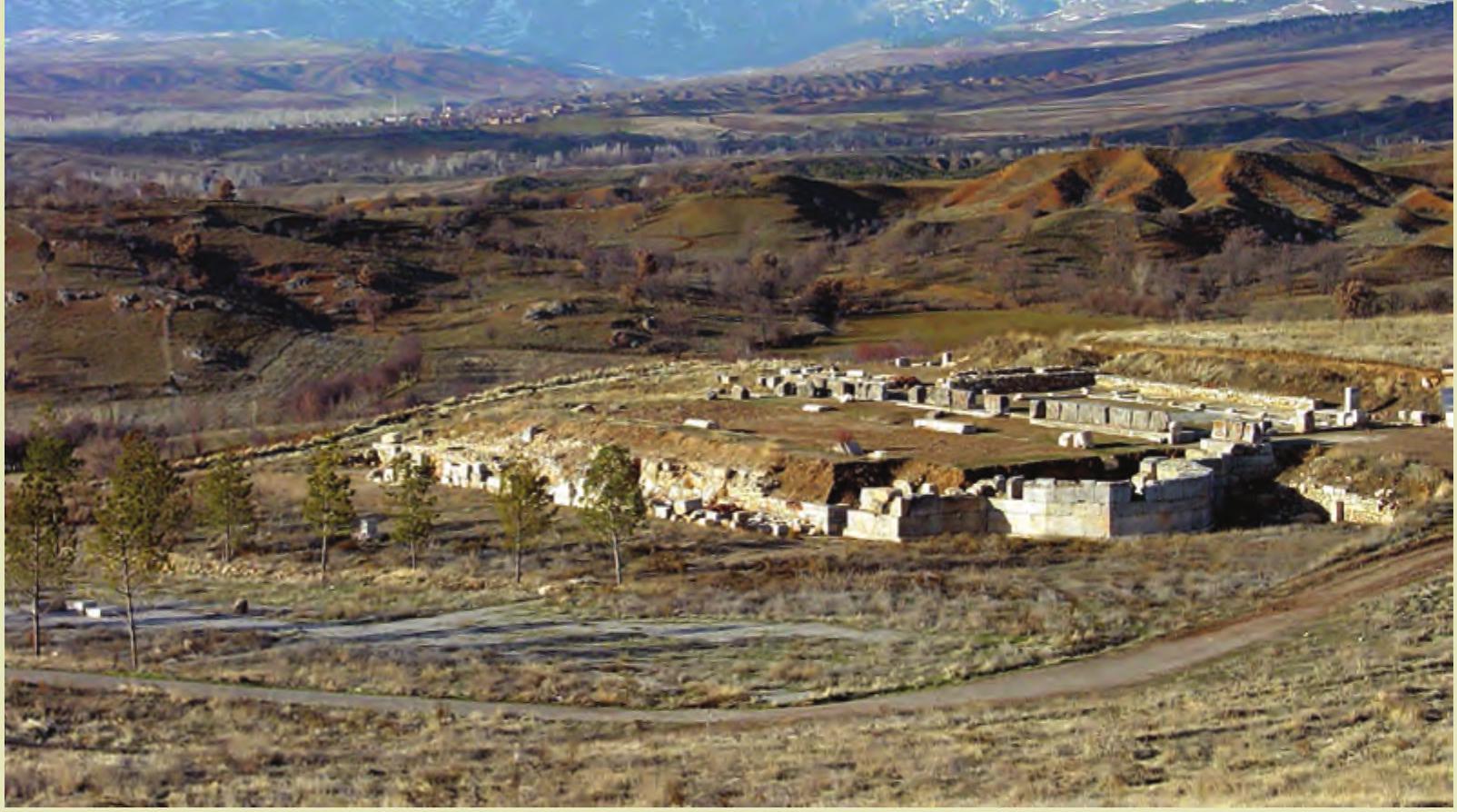
Basilica of St. Paul in Pisidian Antioch, built in the fourth century a.d. Paul preached one of his sermons in the
synagogue at Antioch (Acts 13:13 – 43).
www.HolyLandPhotos.org
Original illustrations
End of source page 1908