PRINTED PAGE 1857NKJV · STUDY EDITION
2 CORINTHIANS 3:3 | 1857
2:7, 8 forgive and comfort him: The purpose of church discipline
is repentance and restoration. Forgiveness should always follow the
correction, just as Christ instructed (see Matt. 18:15–35).
2:11 One of Satan’s devices, or designs, is to cheat the believer
out of true forgiveness. The devil will try to divide the church any
way he can.
2:12, 13 Troas was a city on the Aegean coast, where Paul had re-
ceived his call to preach the gospel in Macedonia (see Acts 16:8).
Paul had no rest because he was deeply concerned about the
Corinthians and was looking for Titus, who was on his way back
from Corinth. Paul then crossed the Aegean Sea and arrived in
Macedonia, probably at the city of Philippi.
2:14 When Titus gave Paul good news about the Corinthians (see
7:5–7), Paul burst forth with a hymn of praise. This interruption
became an extended digression. Paul did not resume the story of
his trip to Macedonia and his meeting with Titus until 7:5. Verses
2:14—7:4 give a long account of his ministry. God . . . leads us in tri-
umph: Paul used the metaphor of the Roman triumphal procession
to praise God. When a Roman general was victorious in a war, he led
his army and the captives in a parade down the main street. God is
the general who has conquered. Paul is one of His officers following
in His train. In the Roman procession, priests carrying censers filled
with incense followed the conqueror. Paul the priest set forth the
fragrance of Christ by preaching the gospel.
2:15 In v. 14 the fragrance was the knowledge of Christ; here it was
Paul, who was a sweet smell to God for his faithfulness in preaching
the gospel.
2:16 The leader in a Roman procession was followed by priests
(dispensing incense), officers, soldiers, and captives. The aroma
of the event represented victorious life to the soldiers and slavery
or death to the captives. In the same way, the gospel message
gives life to those who accept it, but it represents death and judg-
ment to those who reject it. The answer to Paul’s question who is
sufficient for these things is given in 3:5. It is God who makes
us sufficient.
2:17 Peddling means “to make merchandise of,” “to sell.” Some
people use religion for personal gain. To them the gospel is mer-
chandise to be peddled for profit. Thus they corrupt or compromise
it. This is the first reference in this epistle to false teachers. It may
be a subtle reference to Paul’s opponents. Paul, unlike some others,
was sufficient for the gospel ministry because he was sincere; his
motives were pure.
3:1 Having again declared his sincerity (2:17), Paul asked if he need-
ed a letter of commendation to back him up, as some others
did. The language implies that the false apostles mentioned later
in this letter (11:13) had tried to gain acceptance by using such
references.
3:2 You are . . . written in our hearts: The Corinthians were Paul’s
letter of recommendation. These verses do not mean that letters of
recommendation should not be used. Paul himself used such letters
before his conversion (see Acts 9:1, 2) and after (see 8:22; Rom. 16:1;
1 Cor. 16:10; Col. 4:10). In this case Paul did not need one because he
already had one: the believing Corinthians and his ministry among
them. Paul’s love for the Corinthians was known to all who were
acquainted with his ministry. One of the qualifications for ministry
is love for people, both God’s people and the lost.
3:3 an epistle of Christ: Paul appealed to the Corinthians them-
selves for proof of his ministry’s authenticity. God had changed
them—an obvious matter of public record.
7 i Gal. 6:1; Eph.
4:32
9 j 2 Cor. 7:15; 10:6
10 2 NU indeed,
what I have
forgiven, if I have
forgiven anything, I
did it for your sakes
12 k Acts 16:8
l 1 Cor. 16:9
3 Opportunity
13 m 2 Cor. 7:6,
13; 8:6; Gal. 2:1,
3; 2 Tim. 4:10;
Titus 1:4
14 4 manifests
15 n [1 Cor. 1:18]
o [2 Cor. 4:3]
16 p Luke 2:34;
[John 9:39; 1 Pet.
2:7] q [1 Cor. 15:10]
17 r 2 Pet. 2:3
s 1 Cor. 5:8; 2 Cor.
1:12; 1 Thess. 2:4;
1 Pet. 4:11 5 M the
rest 6 adulterating
for gain
CHAPTER 3
1 a 2 Cor. 5:12;
10:12, 18; 12:11
b Acts 18:27
2 c 1 Cor. 9:2
3 d 1 Cor. 3:5 e Ex.
24:12; 31:18; 32:15;
2 Cor. 3:7 f Ps. 40:8
Christ’s Epistle
3
Do a we begin again to commend our
selves? Or do we need, as some oth-
ers, b epistles of commendation to you or
letters of commendation from you? 2 c You
are our epistle written in our hearts,
known and read by all men; 3 clearly you
are an epistle of Christ, d ministered by
us, written not with ink but by the Spir
it of the living God, not e on tablets of
stone but f on tablets of flesh, that is, of
the heart.
7 i so that, on the contrary, you ought rath
er to forgive and comfort him, lest per
haps such a one be swallowed up with
too much sorrow. 8 Therefore I urge you
to reaffirm your love to him. 9 For to this
end I also wrote, that I might put you
to the test, whether you are j obedient
in all things. 10 Now whom you forgive
anything, I also forgive. For 2 if indeed I
have forgiven anything, I have forgiven
that one for your sakes in the presence
of Christ, 11 lest Satan should take advan
tage of us; for we are not ignorant of his
devices.
Triumph in Christ
12 Furthermore, k when I came to Troas
to preach Christ’s gospel, and l a 3 door
was opened to me by the Lord, 13 m I had
no rest in my spirit, because I did not find
Titus my brother; but taking my leave of
them, I departed for Macedonia.
14 Now thanks be to God who al
ways leads us in triumph in Christ, and
through us 4 diffuses the fragrance of His
knowledge in every place. 15 For we are
to God the fragrance of Christ n among
those who are being saved and o among
those who are perishing. 16 p To the one
we are the aroma of death leading to
death, and to the other the aroma of life
leading to life. And q who is sufficient for
these things? 17 For we are not, as 5 so
many, r peddling 6 the word of God; but as
s of sincerity, but as from God, we speak
in the sight of God in Christ.
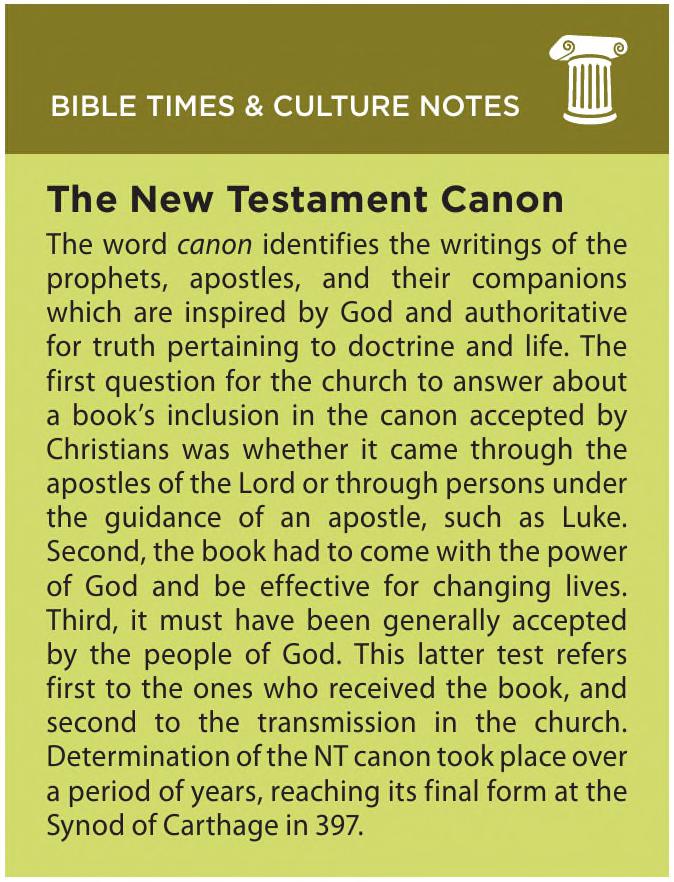
Bible Times & Culture Notes
The New Testament Canon
The word canon identifies the writings of the
prophets, apostles, and their companions
which are inspired by God and authoritative
for truth pertaining to doctrine and life. The
first question for the church to answer about
a book’s inclusion in the canon accepted by
Christians was whether it came through the
apostles of the Lord or through persons under
the guidance of an apostle, such as Luke.
Second, the book had to come with the power
of God and be effective for changing lives.
Third, it must have been generally accepted
by the people of God. This latter test refers
first to the ones who received the book, and
second to the transmission in the church.
Determination of the NT canon took place over
a period of years, reaching its final form at the
Synod of Carthage in 397.
Original illustrations
End of source page 1892