PRINTED PAGE 1827NKJV · STUDY EDITION
1 Corinthians INTRODUCTION 1827
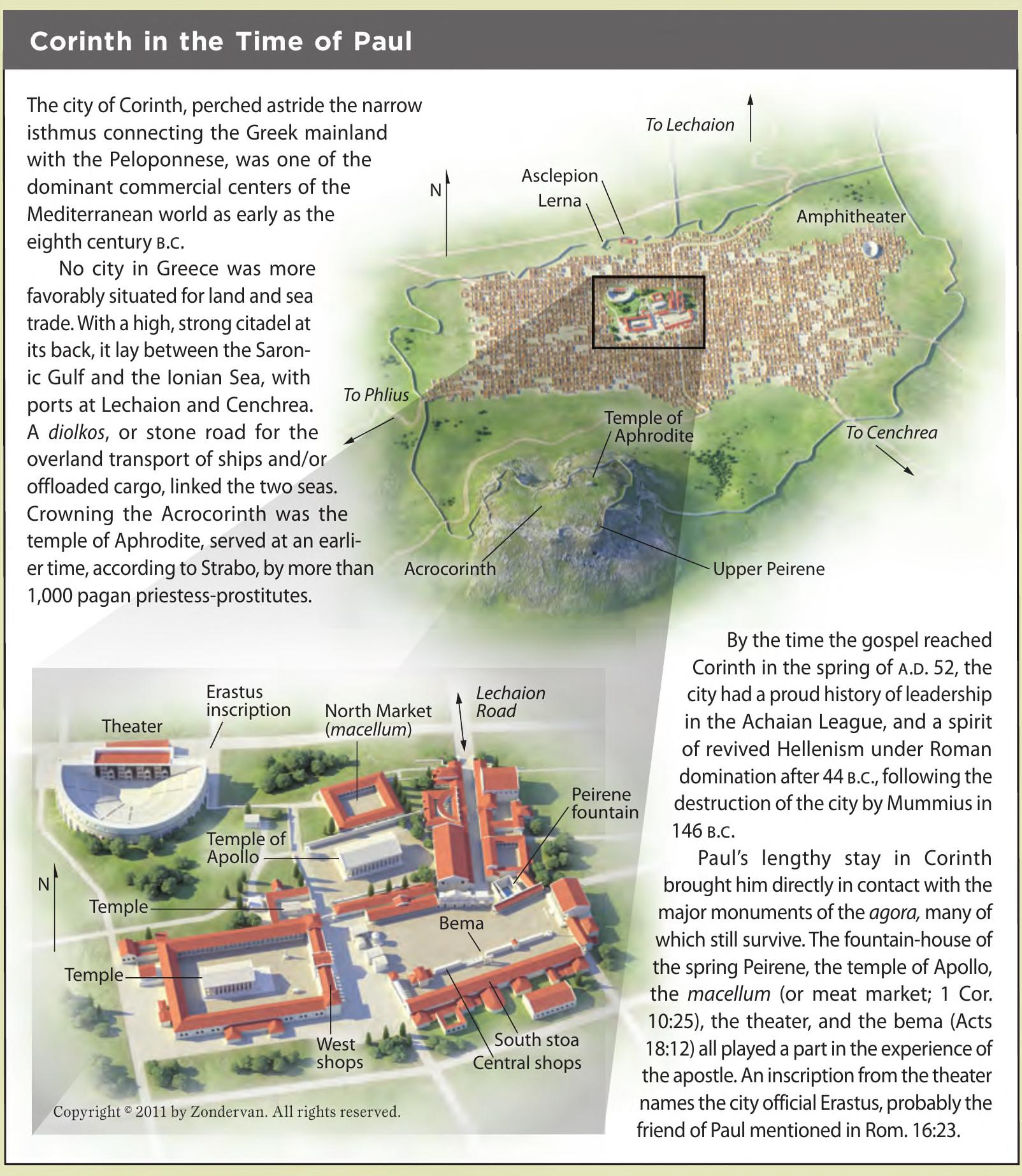
By the time the gospel reached
Corinth in the spring of a.d. 52, the
city had a proud history of leadership
in the Achaian League, and a spirit
of revived Hellenism under Roman
domination after 44 b.c., following the
destruction of the city by Mummius in
146 b.c.
Paul’s lengthy stay in Corinth
brought him directly in contact with the
major monuments of the agora, many of
which still survive. The fountain-house of
the spring Peirene, the temple of Apollo,
the macellum (or meat market; 1 Cor.
10:25), the theater, and the bema (Acts
18:12) all played a part in the experience of
the apostle. An inscription from the theater
names the city official Erastus, probably the
friend of Paul mentioned in Rom. 16:23.
Erastus
inscription
Temple of
Apollo
Temple
Temple
West
shops
Central shops
South stoa
Bema
Peirene
fountain
North Market
(macellum)
Theater
Lechaion
Road
N
Asclepion
Temple of
Aphrodite
Acrocorinth
Upper Peirene
Amphitheater
Lerna
To Lechaion
To Cenchrea
To Phlius
N
Corinth in the Time of Paul
The city of Corinth, perched astride the narrow
isthmus connecting the Greek mainland
with the Peloponnese, was one of the
dominant commercial centers of the
Mediterranean world as early as the
eighth century b.c.
No city in Greece was more
favorably situated for land and sea
trade. With a high, strong citadel at
its back, it lay between the Saron-
ic Gulf and the Ionian Sea, with
ports at Lechaion and Cenchrea.
A diolkos, or stone road for the
overland transport of ships and/or
offloaded cargo, linked the two seas.
Crowning the Acrocorinth was the
temple of Aphrodite, served at an earli-
er time, according to Strabo, by more than
1,000 pagan priestess-prostitutes.
Copyright © 2011 by Zondervan. All rights reserved.
Original illustrations
End of source page 1862