PRINTED PAGE 1822NKJV · STUDY EDITION
1822 | Romans 16:12
13 i 2 John 1
16 j 1 Cor. 16:20;
2 Cor. 13:12;
1 Thess. 5:26; 1 Pet.
5:14 3 NU All the
churches
17 k [Acts 15:1]
l [1 Cor. 5:9]
18 m Phil. 3:19 n Col.
2:4; 2 Pet. 2:3 4 NU,
M omit Jesus
19 o Rom. 1:8
p Jer. 4:22; Matt.
10:16; 1 Cor. 14:20
5 innocent
20 q Rom. 15:33
r Gen. 3:15 s 1 Cor.
16:23; 2 Cor. 13:14;
Gal. 6:18; Phil.
4:23; 1 Thess. 5:28;
2 Thess. 3:18; Rev.
22:21
21 t Acts 16:1; Heb.
13:23 u Acts 13:1
v Acts 17:5 w Acts
20:4
23 x 1 Cor. 1:14
y Acts 19:22; 2 Tim.
4:20
24 z 1 Thess. 5:28
6 NU omits v. 24.
25 a [Eph. 3:20;
Jude 24] 7 M puts
Rom. 16:25-27
after Rom. 14:23.
22 I, Tertius, who wrote this epistle,
greet you in the Lord.
23 x Gaius, my host and the host of the
whole church, greets you. y Erastus, the
treasurer of the city, greets you, and
Quartus, a brother. 24 z The 6 grace of our
Lord Jesus Christ be with you all. Amen.
Benediction
25 7 Now a to Him who is able to estab
12 Greet Tryphena and Tryphosa, who
have labored in the Lord. Greet the be
loved Persis, who labored much in the
Lord. 13 Greet Rufus, i chosen in the
Lord, and his mother and mine. 14 Greet
Asyncritus, Phlegon, Hermas, Patrobas,
Hermes, and the brethren who are with
them. 15 Greet Philologus and Julia, Ne
reus and his sister, and Olympas, and all
the saints who are with them.
16 j Greet one another with a holy kiss.
3 The churches of Christ greet you.
Avoid Divisive Persons
17 Now I urge you, brethren, note those
k who cause divisions and offenses, con
trary to the doctrine which you learned,
and l avoid them. 18 For those who are
such do not serve our Lord 4 Jesus Christ,
but m their own belly, and n by smooth
words and flattering speech deceive the
hearts of the simple. 19 For o your obedi
ence has become known to all. Therefore
I am glad on your behalf; but I want you
to be p wise in what is good, and 5 simple
concerning evil. 20 And q the God of peace
r will crush Satan under your feet shortly.
s The grace of our Lord Jesus Christ be
with you. Amen.
Greetings from Paul’s Friends
21 t Timothy, my fellow worker, and
u Lucius, v Jason, and w Sosipater, my
countrymen, greet you.
of that name who was put to death by Agrippa shortly after Nero
came to power.
16:12 Tryphena and Tryphosa are generally considered sisters.
16:13 Though a common name, this Rufus is often identified with
the one in Mark 15:21. Since chosen in the Lord is true of all believ-
ers, many interpret this phrase to mean “outstanding” or “eminent.”
But it is possible that just as some believers demonstrate God’s love
and others reflect God’s justice, so Rufus was an exceptional exam-
ple of God’s election.
16:16 holy kiss: This kiss on the cheek was practiced by the early
church as a symbol of the love and unity among the early Christians
(see 1 Cor. 16:20; 2 Cor. 13:12; 1 Thess. 5:26; 1 Pet. 5:14).
16:17 Cause divisions means “to stand apart” or “to cause dis-
sension.” In the NT it occurs only here and in Gal. 5:20. Strife and
rivalry cause dissension, which eventually leads to divisions in a
church (see 13:13; Gal. 5:20). Such dissension causes offenses—that
is, it becomes a snare or stumbling block to others (see 14:13 where
this word occurs). Contentious, divisive people can cause others
to stumble, so they should be avoided. Paul teaches this type of
church discipline in his other letters (see 1 Cor. 5:9–13; 2 Thess. 3:6;
2 Tim. 3:5; Titus 3:10).
16:20 Divisive people destroy the peace and unity of the church,
but God, who is the source of peace, will crush this work of Satan
through the wisdom and obedience of believers. Ultimately, God
will totally defeat Satan and bring peace to the whole church. Paul
closes with his customary prayer that the grace of the Lord Jesus
Christ would be with them.
16:21 Timothy worked with Paul and later received two letters from
him. Some think Lucius here is Luke, the author of the third Gospel
and Acts. But Paul includes this Luke among his countrymen, mean-
ing he was a Jew. Luke the author was a Gentile. Jason is mentioned
in Acts as Paul’s host on his first journey to Thessalonica (see Acts
17:5, 7, 9). Sosipater is likely the same person referred to in Acts 20:4.
16:22 Paul, the author of Romans, dictated the letter to a secretary
named Tertius, who actually wrote the words. Tertius here sends
his greetings to the Romans.
16:23 Gaius of Corinth (see 1 Cor. 1:14) not only gave Paul lodging,
but also offered his house as a meeting place for the church. In Acts
19:22 a man named Erastus was sent by Paul to Macedonia. This
may have been the same man.
16:25 The word establish is only used twice in Romans. At the
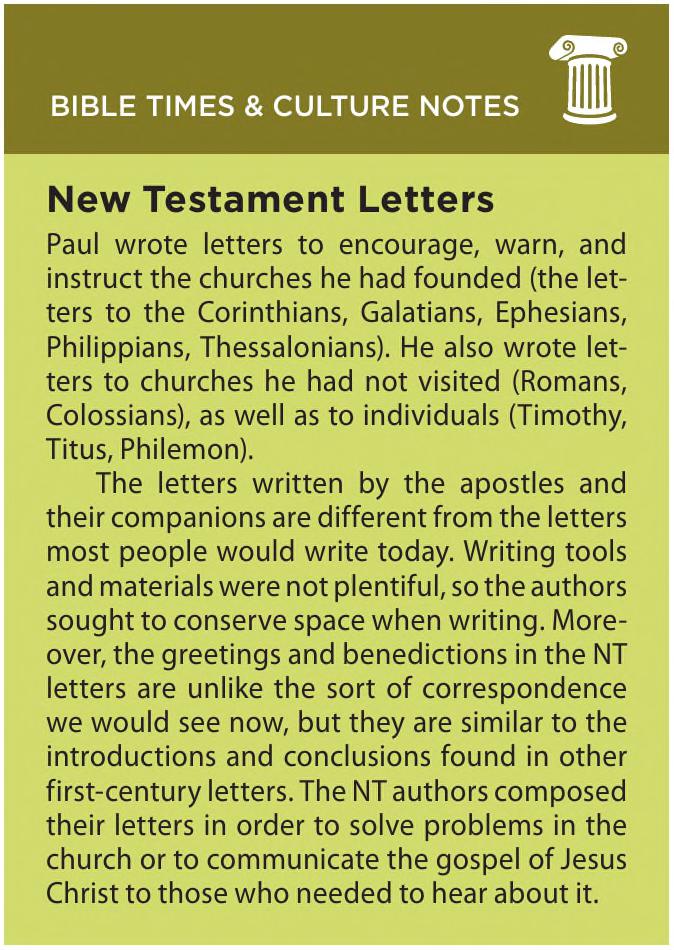
Bible Times & Culture Notes
New Testament Letters
Paul wrote letters to encourage, warn, and
instruct the churches he had founded (the let-
ters to the Corinthians, Galatians, Ephesians,
Philippians, Thessalonians). He also wrote let
ters to churches he had not visited (Romans,
Colossians), as well as to individuals (Timothy,
Titus, Philemon).
The letters written by the apostles and
their companions are different from the letters
most people would write today. Writing tools
and materials were not plentiful, so the authors
sought to conserve space when writing. More
over, the greetings and benedictions in the NT
letters are unlike the sort of correspondence
we would see now, but they are similar to the
introductions and conclusions found in other
first-century letters. The NT authors composed
their letters in order to solve problems in the
church or to communicate the gospel of Jesus
Christ to those who needed to hear about it.
revelation
(Gk. apokalupsis) (16:25; Eph. 1:17; 3:3; Rev. 1:1) Strong’s #602
Revelation is God’s communication to people concerning
Himself, His moral standards, and His plan of salvation. God
has made Himself known to all people everywhere in the
marvels of nature and in the human conscience, which is
able to distinguish right from wrong (1:18–20; 2:14, 15). The
message of salvation was seen dimly through OT sacrifices
and ceremonies. But the full and final revelation of God
has occurred in Jesus Christ (Heb. 1:1, 2). At the Cross, Jesus
revealed supremely God’s self-giving love (Rom. 5:8). The
good news is not complete until we hear that He rose again
triumphantly over sin, Satan, and the grave, and is alive
forevermore. The content of God’s special revelation con-
cerning salvation is found in “the words which were spoken
before by the holy prophets, and of the commandment of
. . . the apostles of the Lord and Savior” (2 Pet. 3:2).
Original illustrations
End of source page 1857