PRINTED PAGE 1817NKJV · STUDY EDITION
Romans 13:12 | 1817
19 h Lev. 19:18
i Deut. 32:35; Ps.
94:1; 1 Thess. 4:6;
Heb. 10:30
20 j 2 Kin. 6:22;
Prov. 25:21, 22;
[Matt. 5:44]; Luke
6:27
21 k [Rom. 12:1, 2]
CHAPTER 13
1 a Titus 3:1; 1 Pet.
2:13
2 b [Titus 3:1] 1 Lit.
receive
3 c 1 Pet. 2:14
5 d Eccl. 8:2 e Acts
24:16; [1 Pet.
2:13, 19]
7 f Matt. 22:21;
Mark 12:17; Luke
20:25
8 g [Matt. 7:12;
22:39; John 13:34;
Rom. 13:10; Gal.
5:13, 14; 1 Tim. 1:5;
James 2:8]
9 h Ex. 20:13-17;
Deut. 5:17-21; Matt.
19:18 i Lev. 19:18;
Mark 12:31; James
2:8 2 NU omits “You
shall not bear false
witness,”
10 j [Matt. 7:12;
22:39, 40; John
13:34]; Rom. 13:8;
Gal. 5:14; James 2:8
11 k Mark 13:37;
[1 Cor. 15:34; Eph.
5:14]; 1 Thess. 5:6
times peace is not within our control; this is why Paul limits the
command.
12:19 Believers are not to seek personal revenge, but rather to let
God punish.
12:20 Freed from vengeance, believers can give themselves to
mercy, even toward their enemies. By acts of kindness, the believ-
ers will heap coals of fire on the head of their enemies, perhaps
bringing shame and repentance to them. It is possible for an enemy
to become a friend. This is the phenomenal power of God’s love that
believers are connected to through Christ.
13:1 God, the supreme Sovereign, has ordained (see v. 2) that there
should be governing authorities. Every believer is to be subject
to these various authorities, even if these authorities
are as evil as Nero (a.d. 54–68), the emperor of Rome
who cruelly persecuted Christians. When Paul wrote this
letter, Nero was in power. Yet Paul exhorted the Roman
believers to submit to Nero’s authority, because that
authority was ordained by God Himself.
13:2 Judgment does not necessarily include eternal
punishment. God may judge people through the human
authorities He appoints.
13:4 The sword is an instrument of death. Government
has the right in the proper circumstances to impose cap-
ital punishment as well as to wage war. In Paul’s day, the
common method of capital punishment was decapita-
tion with a sword.
13:5 for conscience’ sake: Believers must obey gov-
ernment not only because it is their civic duty, but be-
cause it is their spiritual duty before God.
13:8 In the present context, owe no one anything
primarily means respect and honor (see v. 7). No doubt
money is also included, but this passage does not pro-
hibit borrowing (see Ps. 37:21; Matt. 5:42). except to
love: Love is a debt that is never paid in full.
13:9 as yourself: This verse is not a command to love ourselves.
It is a recognition that we do love ourselves, and commands us to
love others just as genuinely and sincerely as we love ourselves.
13:10 Love excludes murder, adultery, stealing, and lying (see v. 9).
Therefore when we love, we automatically fulfill the prohibitions of
the law. If we attempt to live by the law, we quickly discover that
we are breaking the law (7:5). But when we act in accordance with
God’s love, without being under the law, we fulfill it.
13:11 sleep: Believers are pictured as being asleep or inactive.
Salvation here refers to the future, when believers will be saved
from the presence of sin. Thus salvation here speaks of the imminent
return of Christ.
13:12, 13 Night is the present age during which we live in Satan’s
sake. 6 For because of this you also pay
taxes, for they are God’s ministers at
tending continually to this very thing.
7 f Render therefore to all their due: taxes
to whom taxes are due, customs to whom
customs, fear to whom fear, honor to
whom honor.
Love Your Neighbor
8 Owe no one anything except to love
one another, for g he who loves another
has fulfilled the law. 9 For the command
ments, h “You shall not commit adultery,”
“You shall not murder,” “You shall not
steal,” 2 “You shall not bear false witness,”
“You shall not covet,” and if there is any
other commandment, are all summed up
in this saying, namely, i “You shall love
your neighbor as yourself.” 10 Love does
no harm to a neighbor; therefore j love is
the fulfillment of the law.
Put on Christ
11 And do this, knowing the time, that
now it is high time k to awake out of sleep;
for now our salvation is nearer than
when we first believed. 12 The night is far
spent, the day is at hand. l Therefore let us
cast off the works of darkness, and m let
men. 19 Beloved, h do not avenge your
selves, but rather give place to wrath; for
it is written, i “Vengeance is Mine, I will
repay,” says the Lord. 20 Therefore
j“ If your enemy is hungry, feed him;
If he is thirsty, give him a drink;
For in so doing you will heap coals of
fire on his head.”
21 Do not be overcome by evil, but k over
come evil with good.
Submit to Government
13
Let every soul be a subject to the
governing authorities. For there is
no authority except from God, and the
authorities that exist are appointed by
God. 2 Therefore whoever resists b the au
thority resists the ordinance of God, and
those who resist will 1 bring judgment on
themselves. 3 For rulers are not a terror to
good works, but to evil. Do you want to
be unafraid of the authority? c Do what is
good, and you will have praise from the
same. 4 For he is God’s minister to you for
good. But if you do evil, be afraid; for he
does not bear the sword in vain; for he
is God’s minister, an avenger to execute
wrath on him who practices evil. 5 There
fore d you must be subject, not only be
cause of wrath e but also for conscience’
12 l Eph. 5:11 m [2 Cor. 6:7; 10:4; Eph. 6:11, 13; 1 Thess. 5:8]
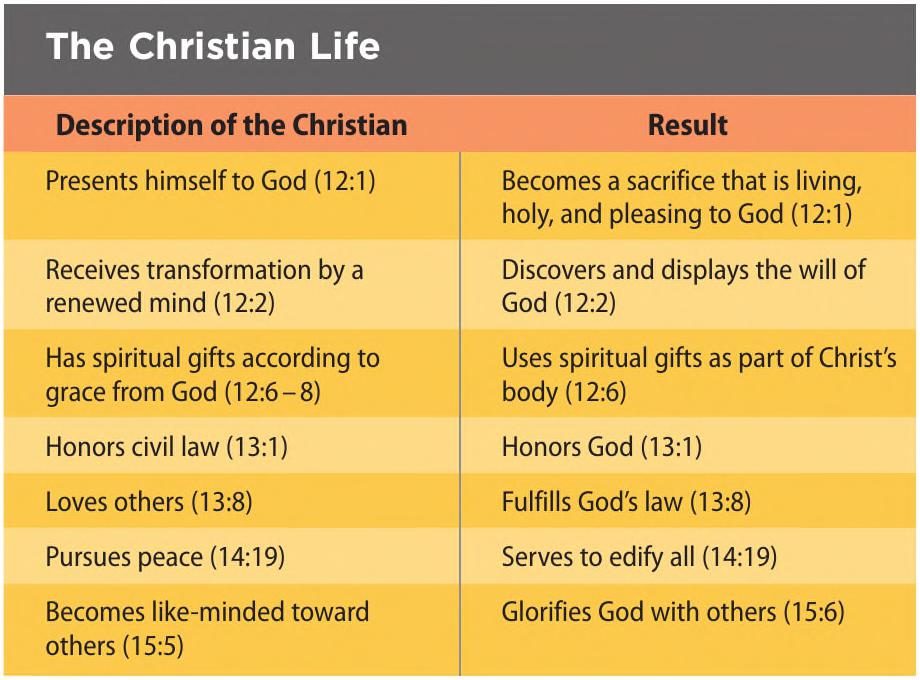
The Christian Life
Description of the Christian
Result
Presents himself to God (12:1)
Becomes a sacrifice that is living,
holy, and pleasing to God (12:1)
Receives transformation by a
renewed mind (12:2)
Discovers and displays the will of
God (12:2)
Has spiritual gifts according to
grace from God (12:6 – 8)
Uses spiritual gifts as part of Christ’s
body (12:6)
Honors civil law (13:1)
Honors God (13:1)
Loves others (13:8)
Fulfills God’s law (13:8)
Pursues peace (14:19)
Serves to edify all (14:19)
Becomes like-minded toward
others (15:5)
Glorifies God with others (15:6)
Original illustrations
End of source page 1852