PRINTED PAGE 1792NKJV · STUDY EDITION
Theater
of Pompey
Theater
of Balbus
Theater
of Marcellus
Circus
Maximus
Temple
of Jupiter
Aqua Appia
Imperial
Palaces
Servian Wall
Forum
Temple of Juno
Anio Vetus
Temple
of Isis and
Serapis
Aqua Marcia
Servian Wall
Aqua Virgo
Amphitheater
Baths of
Agrippa
To Circus of
Caligula and Nero
Baths of
Nero
Via Aurelia
Tiber River
To Ostian Way
Appian Way
Via Labicana
Palatine
Via Pinciana
Capitoline
Tiber Island
N
In terms of political importance, geographic position, and sheer magnificence, the superlative city of the empire
was Rome, the capital.
Located on a series of jutting foothills and low-lying eminences east of a bend in the Tiber River some
18 miles from the Mediterranean, Rome was celebrated for its impressive public buildings, aqueducts, baths,
theaters, and thoroughfares, many of which led from distant provinces. The city of the first Christian century
had spread far beyond its fourth-century b.c. Servian walls and lay unwalled, secure in its greatness.
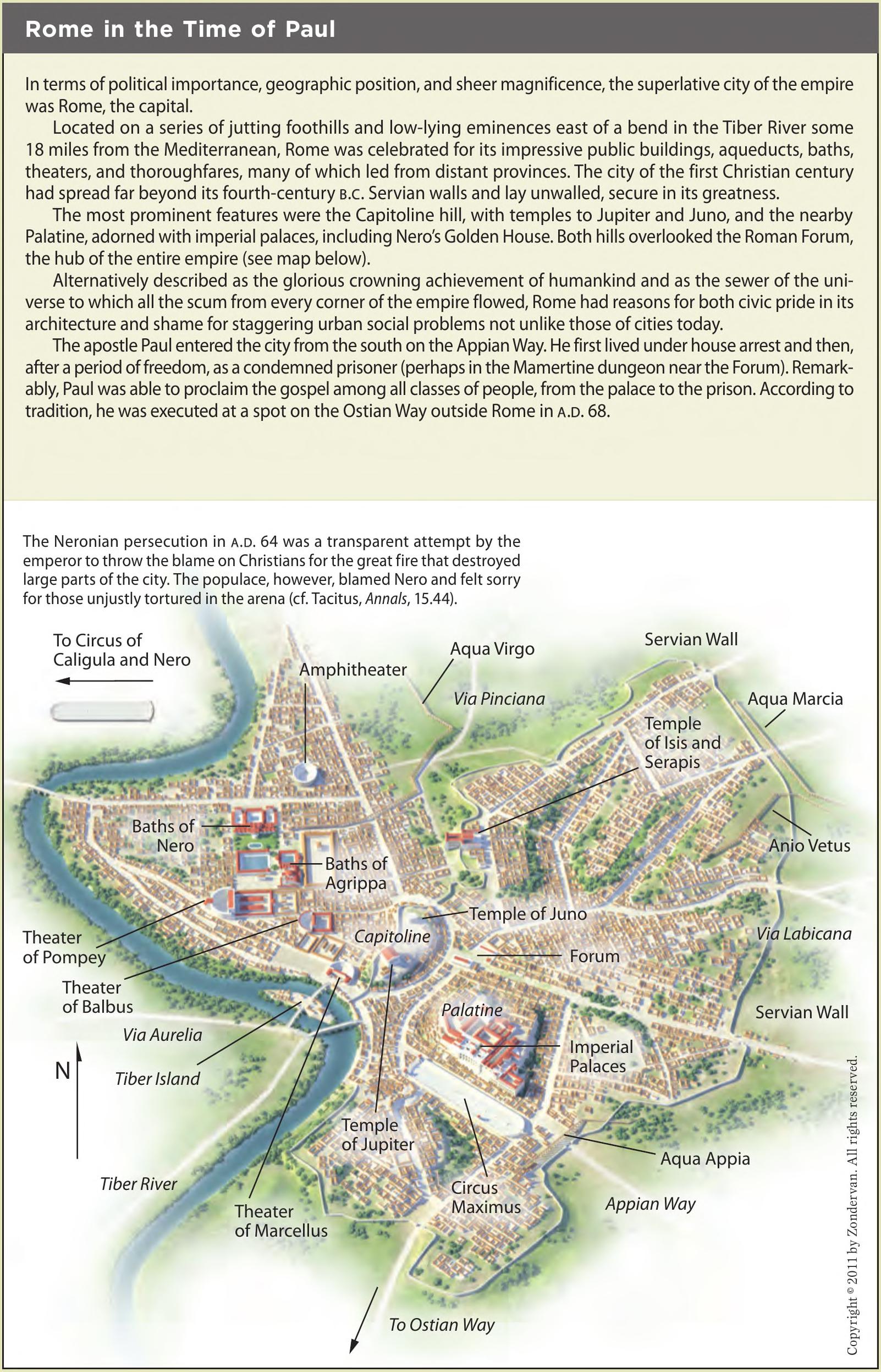
The most prominent features were the Capitoline hill, with temples to Jupiter and Juno, and the nearby
Palatine, adorned with imperial palaces, including Nero’s Golden House. Both hills overlooked the Roman Forum,
the hub of the entire empire (see map below).
Alternatively described as the glorious crowning achievement of humankind and as the sewer of the uni-
verse to which all the scum from every corner of the empire flowed, Rome had reasons for both civic pride in its
architecture and shame for staggering urban social problems not unlike those of cities today.
The apostle Paul entered the city from the south on the Appian Way. He first lived under house arrest and then,
after a period of freedom, as a condemned prisoner (perhaps in the Mamertine dungeon near the Forum). Remark-
ably, Paul was able to proclaim the gospel among all classes of people, from the palace to the prison. According to
tradition, he was executed at a spot on the Ostian Way outside Rome in a.d. 68.
Copyright © 2011 by Zondervan. All rights reserved.
The Neronian persecution in a.d. 64 was a transparent attempt by the
emperor to throw the blame on Christians for the great fire that destroyed
large parts of the city. The populace, however, blamed Nero and felt sorry
for those unjustly tortured in the arena (cf. Tacitus, Annals, 15.44).
Rome in the Time of Paul
Original illustrations
End of source page 1827