PRINTED PAGE 1779NKJV · STUDY EDITION
ACTS 21:10 | 1779
CHAPTER 21
4 a [Acts 20:23;
21:12] 1 NU the
disciples
5 b Luke 22:41; Acts
9:40; 20:36
6 c John 1:11
8 d Acts 8:40; 21:16
e Acts 8:5, 26, 40;
Eph. 4:11; 2 Tim.
4:5 f Acts 6:5 2 NU
omits who were
Paul’s companions
9 g Joel 2:28; Acts
2:17
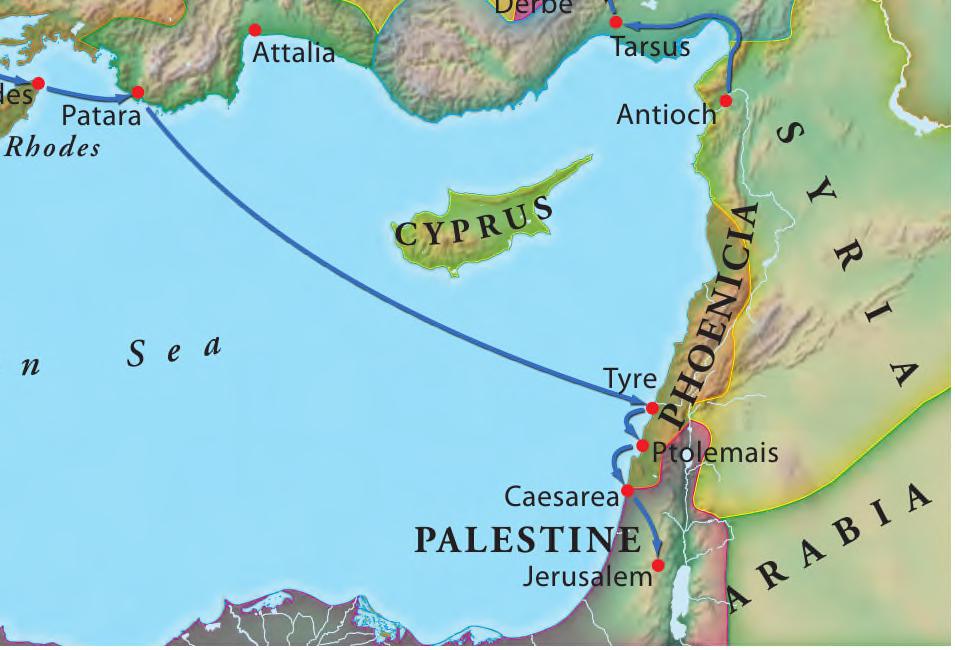
traveled about proclaiming the gospel. In Patara, a seaport, Paul
and his companions could find a larger ship that would sail the four
hundred miles directly to Phoenicia, with its ports at Tyre and Sidon.
In the summer months, the wind of the Aegean Sea blows from the
north, beginning very early in the morning. In the late afternoon
the wind dies away. Sunset brings a dead calm, and later a gentle
south breeze blows. If a ship was heading down the coast, it would
typically anchor at evening and wait for the winds of the morning.
21:2 finding a ship: Paul wasted no time because he wanted to get
to Jerusalem by Pentecost, which occurs just 50 days after Passover.
Paul had celebrated Passover with his friends in Philippi more than
three weeks earlier, so he had less than 30 days to reach Jerusalem
in time for the festival.
21:4 In this verse, a warning was being given by the Holy Spirit of
the danger that was waiting for Paul in Jerusalem. It is doubtful that
the warning meant that Paul was actually not supposed to go. The
warning did cause the disciples, who loved Paul and did not want
to see him hurt, to discourage Paul from continuing his journey. But
Paul had already demonstrated sensitivity to the leading of the Holy
Spirit (16:6). He had already said that he was “bound in the spirit”
to go to Jerusalem (20:22). Later Jesus Himself encouraged Paul
concerning his decision to go (23:11).
21:8 Some believe that Philip’s house was the place where the be-
lievers of Caesarea assembled to worship God.
21:9 four virgin daughters: Here we see a fulfillment of what Peter
said in ch. 2 about how young men and women both would be gift-
ed by the Spirit of God to prophesy and proclaim the truth of God.
21:10–14 Agabus had predicted in 11:27–30 the famine that would
b we knelt down on the shore and prayed.
6 When we had taken our leave of one
another, we boarded the ship, and they
returned c home.
7 And when we had finished our voyage
from Tyre, we came to Ptolemais, greeted
the brethren, and stayed with them one
day. 8 On the next day we 2 who were
Paul’s companions departed and came
to d Caesarea, and entered the house of
Philip e the evangelist, f who was one of
the seven, and stayed with him. 9 Now
this man had four virgin daughters g who
prophesied. 10 And as we stayed many
to Cos, the following day to Rhodes,
and from there to Patara. 2 And find
ing a ship sailing over to Phoenicia, we
went aboard and set sail. 3 When we had
sighted Cyprus, we passed it on the left,
sailed to Syria, and landed at Tyre; for
there the ship was to unload her cargo.
4 And finding 1 disciples, we stayed there
seven days. a They told Paul through the
Spirit not to go up to Jerusalem. 5 When
we had come to the end of those days,
we departed and went on our way; and
they all accompanied us, with wives and
children, till we were out of the city. And
0
100 miles
0
100 km.
Antioch
Derbe
Pisidian
Antioch
Iconium
Troas
Rhodes
Tarsus
Byzantium
Athens
Jerusalem
Caesarea
Thessalonica
Tyre
Berea
Corinth
Philippi
Assos
Patara
Attalia
Mitylene
Miletus
Ptolemais
Lystra
Ephesus
Laodicea
Rhodes
Cos
Patmos
Chios
Samos
Black Sea
Cilician
Gates
A
lt
er
n
at
iv
e
ro
ut
e
?
C
Y
P
R
U
S
PALESTINE
C R E T E
C A
P P
A D
O C
I A
G
A
L
A
T
I
A
B
I T
H
Y
N I
A
&
P
O
N
T
U S
P H
R Y
G
I
A
PH
OE
NI
CI
A
S
Y
R
I
A
A R
A B
I A
M
A
C
E
D
O
N I
A
A C
H A
I
A
T
H
R
A C
E
A
S
I
A
M e
d i t
e r r
a n
e a
n
S
e a
Paul’s Third Missionary Journey
c. a.d. 53 – 57 (Acts 18:23 — 21:17)
Original illustrations
End of source page 1814