PRINTED PAGE 1774NKJV · STUDY EDITION
1774 | ACTS 18:11
12 3 Gr. bema
15 n Acts 23:29;
25:19
17 o 1 Cor. 1:1 4 NU
they all
18 5 Lit. many days
18:12 In the spring of a.d. 52, a proconsul named Gallio was ap-
pointed by the Roman senate to govern the province of Achaia
(Greece). Gallio was a brother of the famous stoic philosopher Sen-
eca, who possessed great influence in Rome. The Jewish leaders
thought they would take advantage of the new governor and rid
themselves of Paul and the gospel of Jesus Christ. Bringing Paul
before the judgment seat of the governor was a momentous event.
If the Roman governor ruled Christianity illegal, it would set a prece-
dent and encourage immediate persecution of all Christians.
18:14 Paul did not even have to open his mouth to defend the faith.
God had already provided for Paul’s defense; he had prepared Gallio
to make the correct decision. No crime had been committed against
Rome. Gallio considered Christianity to be a Jewish sect. Because
Judaism was an established religion in the Roman Empire, this “sect”
was not in violation of Roman law. Gallio had his bailiffs drive the
accusers out of his presence. Once again the sovereign hand of God
preserved the life of His faithful servant.
18:18 Paul had his hair cut as part of a Nazirite vow he had made
(see Num. 6). Such a vow had to be fulfilled in Jerusalem, where the
hair would be presented to God. Vows were made either in gratitude
for God’s blessing (like Paul’s safekeeping in Corinth) or as part of
a petition for future blessing. The vow involved abstinence from
drinking wine and a commitment not to cut one’s hair for a period of
time. At the end of this set period, the hair was cut and then burned
along with other sacrifices as a symbol of offering oneself to God
(21:23–26). Paul redirected his entire travel schedule because he
wanted to get to Jerusalem in time to make this vow.
crimes, O Jews, there would be reason
why I should bear with you. 15 But if it is
a n question of words and names and your
own law, look to it yourselves; for I do
not want to be a judge of such matters.”
16 And he drove them from the judg
ment seat. 17 Then 4 all the Greeks took
o Sosthenes, the ruler of the synagogue,
and beat him before the judgment seat.
But Gallio took no notice of these things.
Paul Returns to Antioch
18 So Paul still remained 5 a good while.
Then he took leave of the brethren and
am with you, and no one will attack you
to hurt you; for I have many people in
this city.” 11 And he continued there a
year and six months, teaching the word
of God among them.
12 When Gallio was proconsul of
Achaia, the Jews with one accord rose
up against Paul and brought him to the
3 judgment seat, 13 saying, “This fellow
persuades men to worship God contrary
to the law.”
14 And when Paul was about to open
his mouth, Gallio said to the Jews, “If it
were a matter of wrongdoing or wicked
0
100 miles
0
100 km.
Antioch
Derbe
Pisidian
Antioch
Lystra
Iconium
Ephesus
Troas
Rhodes
Tarsus
Damascus
Byzantium
Seleucia
Pieria
Athens
Jerusalem
Caesarea
Thessalonica
Tyre
Nicaea
Prusa
Berea
Sidon
Corinth
Neapolis
Thyatira
Dorylaeum
Samothrace
Apollonia
Amphipolis
Cenchrea
Philippi
H
el
le
s
p
o
n
t
Aege
an
Se
a
Saronic
Gulf
Termaic
Gulf
B l a c k S e a
Or
ont
es
R.
Cilician
Gates
A m a n u
s M t
s .
C
Y
P
R
U
S
M Y S I A
PALESTINE
C
A
P
P
A
D
O
C
I
A
G A
L
A
T
I
A
B
I
T
H
Y
N
I
A
A
N
D
P
O
N
T U S
P H
R
Y
G
I
A
P H O E
N I C
I
A
S Y R I A
A R A
B I A
M
A
C
E
D
O
N I
A
A C
H A
I A
T H R A C E
C R E T E
C
I
L
I
C
I
A
A S I A
M e
d i t
e r
r a
n e
a
n
S e
a
P
a
ul
a
nd
S
i
l
a
s
B
a
r
n
a
b
a
s
a
n
d
M
a
r
k
Route of the Egnatian Way
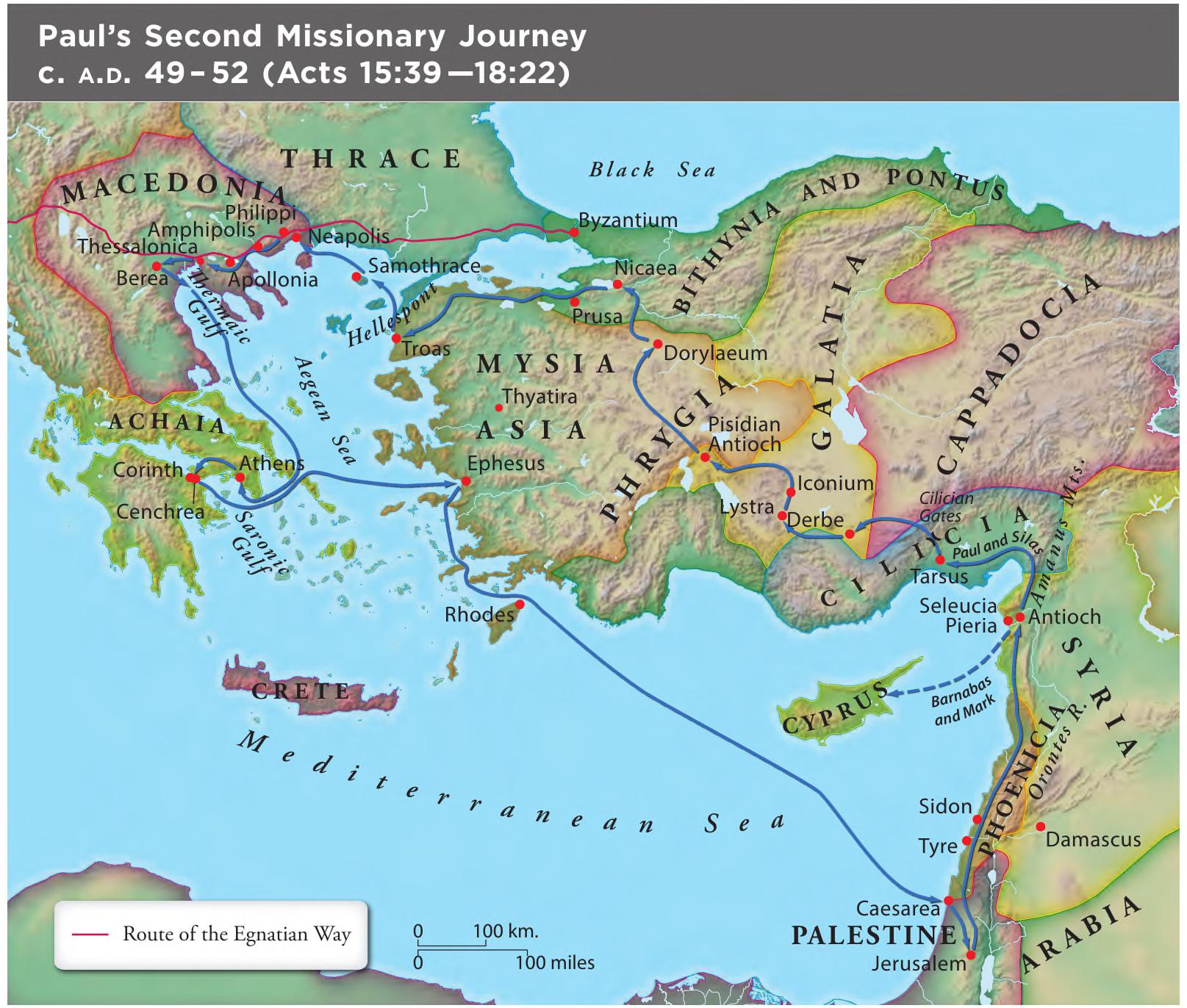
Paul’s Second Missionary Journey
c. a.d. 49 – 52 (Acts 15:39 —18:22)
Original illustrations
End of source page 1809