PRINTED PAGE 1767NKJV · STUDY EDITION
ACTS 15:7 | 1767
17 t Lev. 26:4; Deut.
11:14; [Matt. 5:45]
u Ps. 145:16
19 v Acts 13:45, 50;
14:2-5; 1 Thess. 2:14
w Acts 14:5; 2 Cor.
11:25; 2 Tim. 3:11
x [2 Cor. 12:1-4]
21 y Matt. 28:19
22 z Acts 11:23
a Matt. 10:38; Luke
22:28; [Rom. 8:17;
2 Tim. 2:12; 3:12]
23 b Matt. 9:15;
Mark 2:20; Luke
5:35; 2 Cor. 8:19;
Titus 1:5
27 c Acts 15:4,
12 d 1 Cor. 16:9;
2 Cor. 2:12; Col. 4:3;
Rev. 3:8
CHAPTER 15
1 a Gal. 2:12 b John
7:22; Acts 15:5; Gal.
5:2; Phil. 3:2; [Col.
2:8, 11, 16]
2 c Gal. 2:1
3 d Acts 20:38; 21:5;
Rom. 15:24; 1 Cor.
14:19 supposing him to be dead: The physician Luke may be
saying that Paul did not die here. However, some believe that the
text speaks of Paul’s resurrection.
14:23 appointed elders: It is difficult to know whether these elders
were appointed by Paul and Barnabas or by a vote of the people.
However, the process outlined in 6:1–7 for selecting the seven men
may provide a clue to the process used for selecting elders here. Both
the assembly and the apostles were involved in the selection process.
15:1–4 Later those who taught the need for circumcision among
new believers were known as Judaizers. They wanted the Chris-
tian faith to become a sect of Judaism. In other words, they wanted
Gentile believers to become Jewish proselytes. As proselytes, the
Gentile believers would need to be circumcised as a sign of coming
into the covenant of God along with the Jews.
15:5 some of the sect of the Pharisees: These people believed in
Jesus Christ but were still identified as Pharisees. Jews who became
followers of Christ could still be Pharisees. The same could not be
said for the Sadducees, for they denied that there was a resurrec-
tion, and thus could not believe that Jesus had been raised from
the dead. It is necessary to circumcise them: This statement
summarizes the problem. Is salvation granted through faith alone?
Or does a person have to have faith plus the works of the law in
order to be forgiven by God?
15:7 It was from the mouth of Peter that Cornelius and his Gentile
friends heard the gospel of Jesus Christ (10:11–43).
the faith, and saying, a “We must through
many tribulations enter the kingdom of
God.” 23 So when they had b appointed
elders in every church, and prayed
with fasting, they commended them to
the Lord in whom they had believed.
24 And after they had passed through
Pisidia, they came to Pamphylia. 25 Now
when they had preached the word in
Perga, they went down to Attalia. 26 From
there they sailed to Antioch, where they
had been commended to the grace of God
for the work which they had completed.
27 Now when they had come and gath
ered the church together, c they reported
all that God had done with them, and
that He had d opened the door of faith
to the Gentiles. 28 So they stayed there a
long time with the disciples.
Conflict over Circumcision
15
And a certain men came down
from Judea and taught the breth
ren, b “Unless you are circumcised ac
cording to the custom of Moses, you can
not be saved.” 2 Therefore, when Paul and
Barnabas had no small dissension and
dispute with them, they determined that
c Paul and Barnabas and certain others of
them should go up to Jerusalem, to the
apostles and elders, about this question.
3 So, d being sent on their way by the
church, they passed through Phoenicia
and Samaria, e describing the conversion
of the Gentiles; and they caused great joy
to all the brethren. 4 And when they had
come to Jerusalem, they were received
by the church and the apostles and the
elders; and they reported all things that
God had done with them. 5 But some of
the sect of the Pharisees who believed
rose up, saying, “It is necessary to cir
cumcise them, and to command them to
keep the law of Moses.”
The Jerusalem Council
6 Now the apostles and elders came to
gether to consider this matter. 7 And when
ness, in that He did good, t gave us rain
from heaven and fruitful seasons, filling
our hearts with u food and gladness.”
18 And with these sayings they could
scarcely restrain the multitudes from sac
rificing to them.
Stoning, Escape to Derbe
19 v Then Jews from Antioch and Ico
nium came there; and having persuaded
the multitudes, w they stoned Paul and
dragged him out of the city, supposing
him to be x dead. 20 However, when the
disciples gathered around him, he rose up
and went into the city. And the next day
he departed with Barnabas to Derbe.
Strengthening the Converts
21 And when they had preached the gos
pel to that city y and made many disciples,
they returned to Lystra, Iconium, and
Antioch, 22 strengthening the souls of the
disciples, z exhorting them to continue in
16:6, 11; 2 Cor. 1:16; Titus 3:13; 3 John 6 e Acts 14:27; 15:4, 12
0
50 miles
0
50 km.
Antioch
(Syrian)
Derbe
Pisidian
Antioch
Perga
Lystra
Paphos
Attalia
Iconium
Salamis
Issus
Aleppo
Tarsus
Seleucia
Pieria
Caesarea
(Mazaca)
Oro
nte
s R
.
Cilician
Gates
T
a
u
r
u
s
M
t
s
.
P
H
R
Y
G
I
A
P
I
S
I
D
I
A
L
Y
C
A
O
N
I
A
P
A
M
P
H
Y
L
I
A
P
H
O
E
NICIA
C
Y
P
R
U S
S Y R I A
C
I L I
C I
A
C
A
P P
A
D
O
C I
A
G A
L A
T I
A
A S I A
M e d
i t e r
r a n
e a n
S e
a
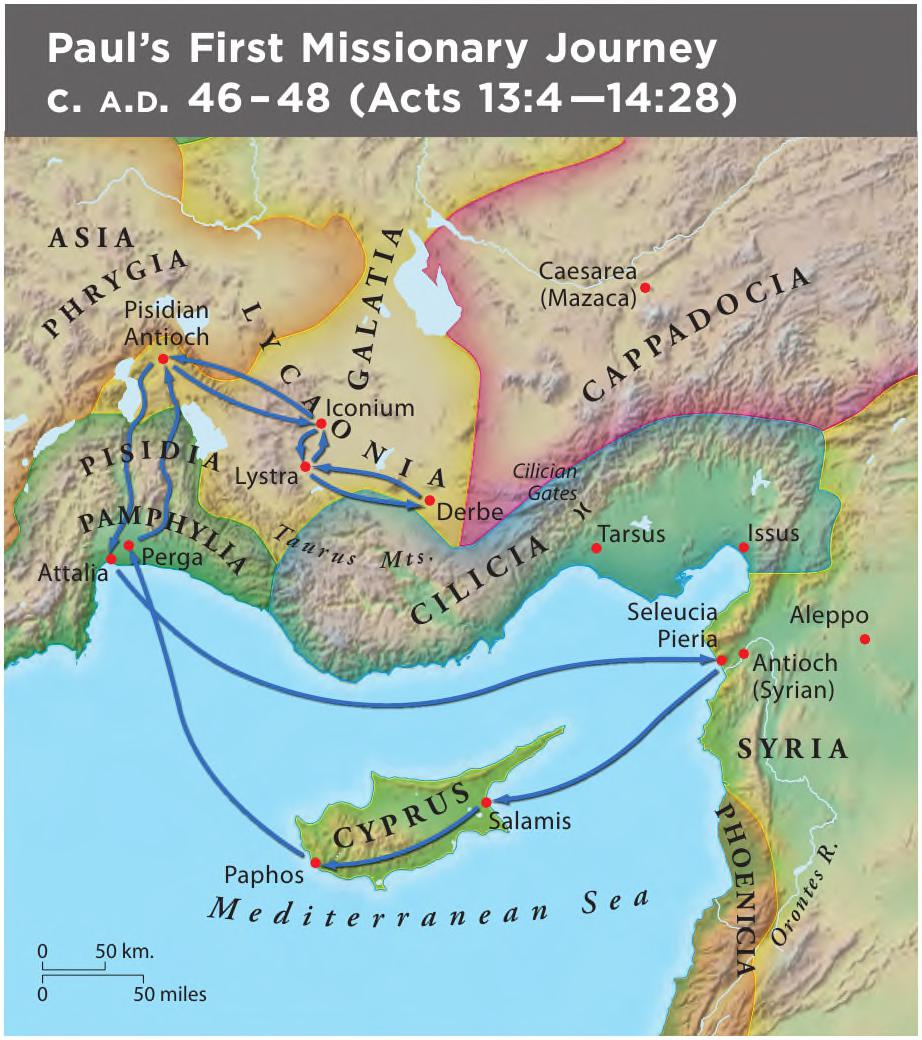
Paul’s First Missionary Journey
c. a.d. 46 – 48 (Acts 13:4 —14:28)
Original illustrations
End of source page 1802