PRINTED PAGE 1766NKJV · STUDY EDITION
1766 | ACTS 14:1
CHAPTER 14
1 a John 7:35; Acts
18:4; Rom. 1:14, 16;
1 Cor. 1:22
2 1 embittered 2 Lit.
souls
3 b Mark 16:20; Acts
4:29; 20:32; Heb.
2:4 c Acts 5:12
4 d Luke 12:51
e Acts 13:2, 3
5 f 2 Tim. 3:11
6 g Matt. 10:23
8 h Acts 3:2
9 3 Lit. Who
10 i [Is. 35:6]
11 j Acts 8:10; 28:6
12 4 Jupiter
5 Mercury
13 k Dan. 2:46
14 l Num. 14:6;
Matt. 26:65; Mark
14:63
15 m Acts 10:26
n James 5:17
o 1 Sam. 12:21;
Jer. 8:19; 14:22;
Amos 2:4; 1 Cor.
8:4 p 1 Thess. 1:9
q Gen. 1:1; Ex. 20:11;
Ps. 146:6; Acts 4:24;
17:24; Rev. 14:7
16 r Ps. 81:12; Mic.
4:5; 1 Pet. 4:3
17 s Acts 17:24-27;
Rom. 1:19, 20
14:1 Paul and Barnabas spoke with authority because they spoke
the truth. The power of God is not in the person who witnesses, but
in what is witnessed to.
14:8–13 The gods have come down: The Roman poet Ovid told
of an ancient legend in which Zeus and Hermes came to the Phry-
gian hill country disguised as mortals seeking lodging. After being
turned away from a thousand homes, they found refuge in the hum-
ble cottage of an elderly couple. In appreciation for the couple’s
hospitality, the gods transformed the cottage into a temple with a
golden roof and marble columns. All the houses of the inhospitable
people were then destroyed. This ancient legend may be the reason
that the people treated Paul and Barnabas as gods. After witness-
ing the healing of the cripple, they did not want to make the same
mistake as their ancestors.
14:14 tore their clothes: The tearing of robes was a Jewish expres-
sion of distress and grief.
14:15–17 The sermon by Paul in these three verses is a condensed
version of his sermon on the Areopagus in 17:22–31. These Gentiles
did not know or believe in the Scriptures, so Paul preached truths
that were self-evident to all and led his listeners to biblical truth.
walked. 9 This man heard Paul speaking.
3 Paul, observing him intently and seeing
that he had faith to be healed, 10 said with
a loud voice, i “Stand up straight on your
feet!” And he leaped and walked. 11 Now
when the people saw what Paul had
done, they raised their voices, saying in
the Lycaonian language, j “The gods have
come down to us in the likeness of men!”
12 And Barnabas they called 4 Zeus, and
Paul, 5 Hermes, because he was the chief
speaker. 13 Then the priest of Zeus, whose
temple was in front of their city, brought
oxen and garlands to the gates, k intend
ing to sacrifice with the multitudes.
14 But when the apostles Barnabas and
Paul heard this, l they tore their clothes
and ran in among the multitude, crying
out 15 and saying, “Men, m why are you
doing these things? n We also are men
with the same nature as you, and preach
to you that you should turn from o these
useless things p to the living God, q who
made the heaven, the earth, the sea, and
all things that are in them, 16 r who in by
gone generations allowed all nations to
walk in their own ways. 17 s Nevertheless
He did not leave Himself without wit
At Iconium
14
Now it happened in Iconium that
they went together to the syna
gogue of the Jews, and so spoke that a
great multitude both of the Jews and of
the a Greeks believed. 2 But the unbeliev
ing Jews stirred up the Gentiles and 1 poi
soned their 2 minds against the brethren.
3 Therefore they stayed there a long time,
speaking boldly in the Lord, b who was
bearing witness to the word of His grace,
granting signs and c wonders to be done
by their hands.
4 But the multitude of the city was d di
vided: part sided with the Jews, and part
with the e apostles. 5 And when a violent
attempt was made by both the Gentiles
and Jews, with their rulers, f to abuse and
stone them, 6 they became aware of it and
g fled to Lystra and Derbe, cities of Lycao
nia, and to the surrounding region. 7 And
they were preaching the gospel there.
Idolatry at Lystra
8 h And in Lystra a certain man without
strength in his feet was sitting, a cripple
from his mother’s womb, who had never
Bible Times & Culture Notes
The Origin of the Synagogue
In nearly every city in which we find Jesus or
Paul in the NT, we also find a synagogue. Most
scholars agree that the NT form of the syna-
gogue probably began taking shape after the
temple in Jerusalem had been destroyed and
during the Exile. With their people scattered
around the world, displaced Jews needed
meeting places where they could learn about
the faith and worship God.
By the time of Jesus and Paul, synagogues
served as local centers of worship, education,
and government in the Jewish community.
According to tradition, a synagogue was
established wherever there were as many
as ten Jewish men. The rebuilt temple in
Jerusalem remained the center for sacrificial
worship and the site at which to celebrate
appointed feasts. But the synagogue played
an ever-increasing role in the religious instruc-
tion of the Jews.
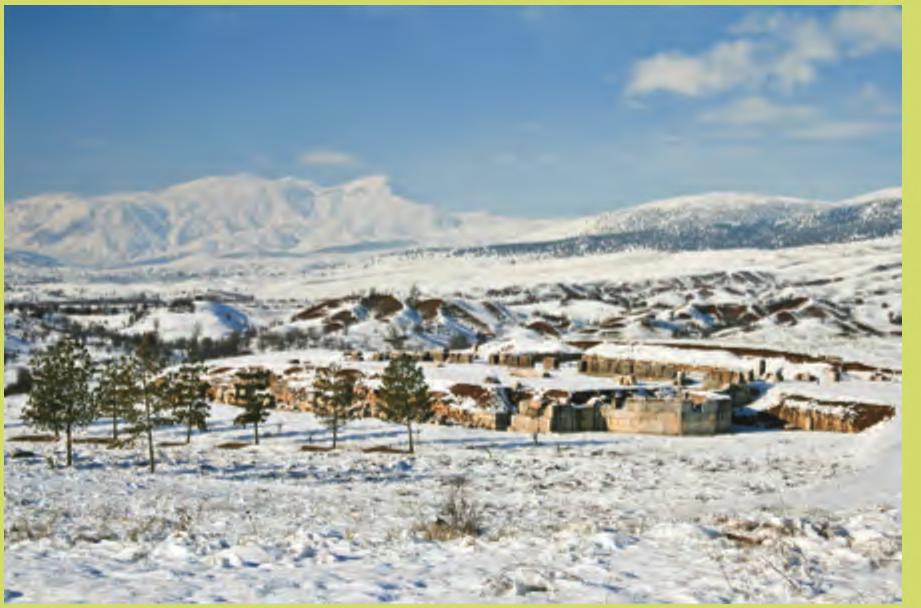
A fourth-century a.d. synagogue at Antioch
www.HolyLandPhotos.org
Original illustrations
End of source page 1801