PRINTED PAGE 1755NKJV · STUDY EDITION
ACTS 9:14 | 1755
5 1 NU, M omit the
rest of v. 5 and
begin v. 6 with But
arise and go
7 e Dan. 10:7; John
12:29; [Acts 22:9;
26:13]
10 f Acts 22:12
11 g Acts 21:39; 22:3
13 h Acts 9:1 2 bad
things
9:10 Not an apostle but a layman, a certain disciple . . . named
Ananias was ready and available to be used by God. He did not
know that God would send him to Saul, the man who had been
vigorously persecuting the Christians.
9:11 In ancient Damascus, the street called Straight went from
one end of the city to the other.
9:13 So far in Acts, Christians have been called “disciples,” “be-
lievers,” and those belonging to “the Way” (5:14; 6:1; 9:2). Here the
word saints is used. It means those set apart by God for use in
His service.
Ananias Baptizes Saul
10 Now there was a certain disciple at
Damascus f named Ananias; and to him
the Lord said in a vision, “Ananias.”
And he said, “Here I am, Lord.”
11 So the Lord said to him, “Arise and go
to the street called Straight, and inquire
at the house of Judas for one called Saul
g of Tarsus, for behold, he is praying.
12 And in a vision he has seen a man
named Ananias coming in and putting
his hand on him, so that he might receive
his sight.”
13 Then Ananias answered, “Lord, I
have heard from many about this man,
h how much 2 harm he has done to Your
saints in Jerusalem. 14 And here he has
5 And he said, “Who are You, Lord?”
Then the Lord said, “I am Jesus, whom
you are persecuting. 1 It is hard for you to
kick against the goads.”
6 So he, trembling and astonished, said,
“Lord, what do You want me to do?”
Then the Lord said to him, “Arise and
go into the city, and you will be told what
you must do.”
7 And e the men who journeyed with
him stood speechless, hearing a voice but
seeing no one. 8 Then Saul arose from the
ground, and when his eyes were opened
he saw no one. But they led him by the
hand and brought him into Damascus.
9 And he was three days without sight,
and neither ate nor drank.
Roman
Aqueduct
Temple
of Jupiter
Agora
Governor’s
Residence
Theater
City Wall
Traditional
Site of
House of
Ananias
East Gate
Abana (Barada) River
To Aleppo
Straight Street
To Jerusalem
N
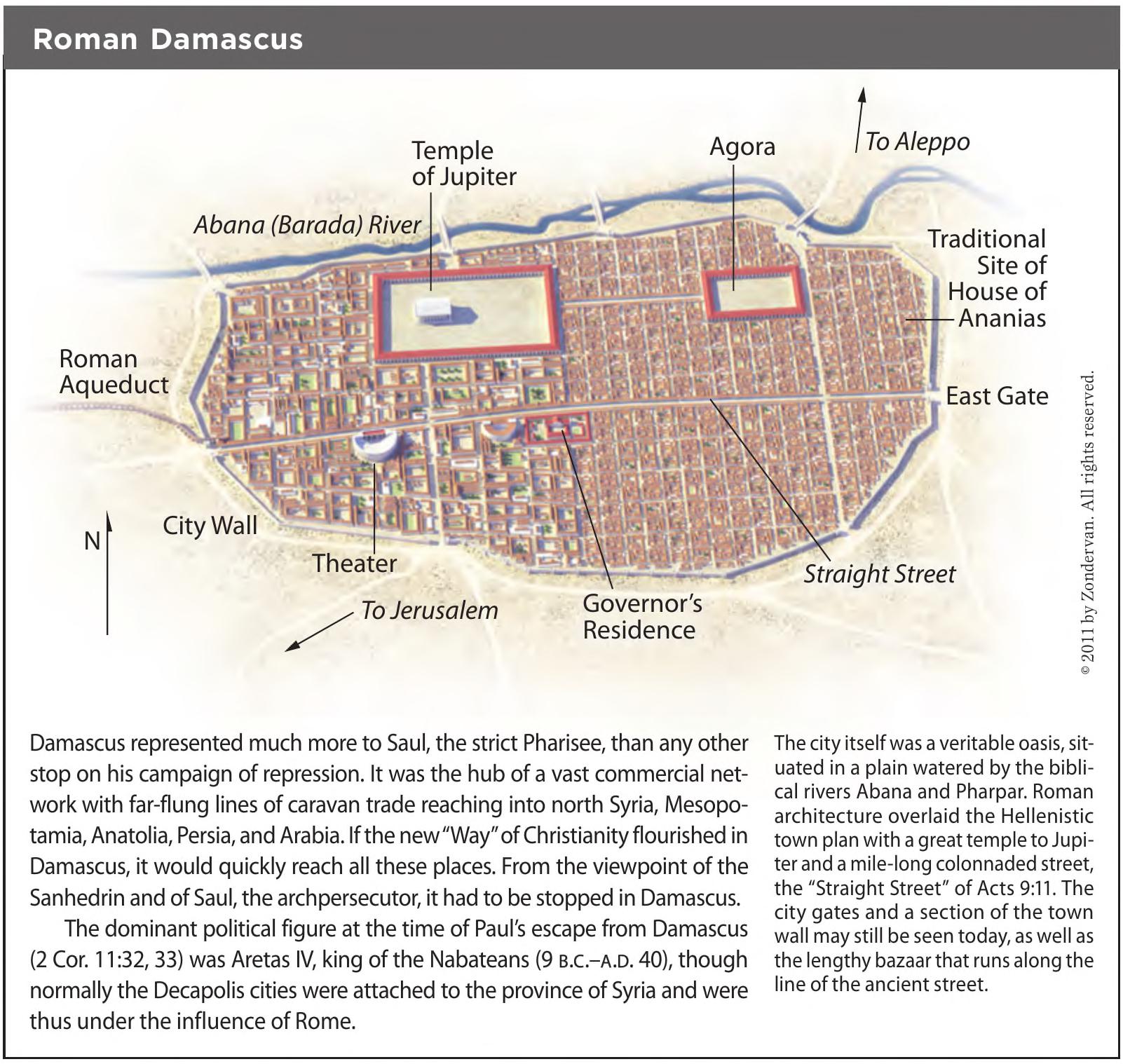
Damascus represented much more to Saul, the strict Pharisee, than any other
stop on his campaign of repression. It was the hub of a vast commercial net-
work with far-flung lines of caravan trade reaching into north Syria, Mesopo
tamia, Anatolia, Persia, and Arabia. If the new “Way” of Christianity flourished in
Damascus, it would quickly reach all these places. From the viewpoint of the
Sanhedrin and of Saul, the archpersecutor, it had to be stopped in Damascus.
The dominant political figure at the time of Paul’s escape from Damascus
(2 Cor. 11:32, 33) was Aretas IV, king of the Nabateans (9 b.c.–a.d. 40), though
normally the Decapolis cities were attached to the province of Syria and were
thus under the influence of Rome.
The city itself was a veritable oasis, sit-
uated in a plain watered by the bibli-
cal rivers Abana and Pharpar. Roman
architecture overlaid the Hellenistic
town plan with a great temple to Jupi-
ter and a mile-long colonnaded street,
the “Straight Street” of Acts 9:11. The
city gates and a section of the town
wall may still be seen today, as well as
the lengthy bazaar that runs along the
line of the ancient street.
Roman Damascus
© 2011 by Zondervan. All rights reserved.
Original illustrations
End of source page 1790