PRINTED PAGE 1754NKJV · STUDY EDITION
1754 | ACTS 8:34
35 c Luke 24:27;
Acts 17:2; 18:28;
28:23
36 d Acts 10:47;
16:33
37 e Matt. 28:19;
[Mark 16:16; Rom.
10:9, 10] f Matt.
16:16; John 6:69;
9:35, 38; 11:27
6 NU, M omit v. 37.
It is found in
Western texts,
including the Latin
tradition.
39 g 1 Kin. 18:12;
2 Kin. 2:16; Ezek.
3:12, 14; 2 Cor. 12:2
40 h Acts 21:8
7 Same as Heb.
Ashdod
CHAPTER 9
1 a Acts 7:57; 8:1, 3;
26:10, 11; Gal. 1:13;
1 Tim. 1:13
2 b Acts 22:5
8:35 preached Jesus to him: First-century Jews did not speak
much about a suffering Messiah. The Jewish people, facing the yoke
of Roman rule, believed that the Messiah would come as the Lion of
Judah, a delivering King, not a weak lamb. They believed and taught
that the suffering One spoken of by Isaiah was the suffering nation
of Israel. Most likely this eunuch had heard the “official” teaching
of this passage in Jerusalem but still had some questions. Philip
showed him that suffering One was Jesus. He had to suffer on the
Cross for the sins of all of humanity.
8:36 What hinders me from being baptized: Having heard the
message of Christ’s sacrifice for sin, the eunuch responded to the
conviction of the Holy Spirit. Irenaeus, an early church father who
lived between a.d. 130 and 202, wrote that the eunuch returned to
Ethiopia and became a missionary to his own people.
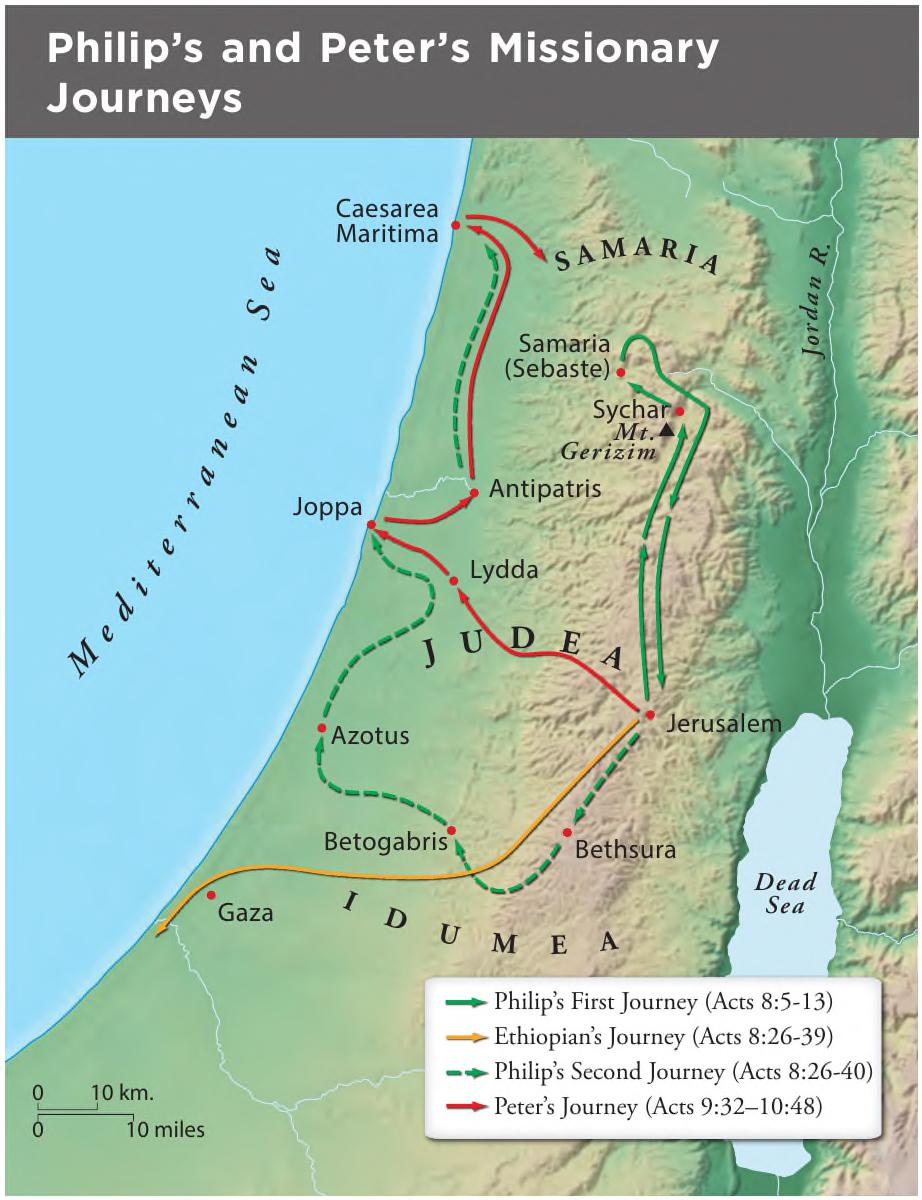
8:39, 40 caught Philip away . . . Philip was found: The Greek
word translated caught here is also used in 1 Thess. 4:17 for the
catching away of the church into the air. Though this passage may
say only that Philip went from the desert to Azotus, most likely the
terminology indicates a miraculous transportation.
9:1 Saul was still restless in his zeal to defend his Jewish faith from
the new, supposedly dangerous Jewish messianic sect
(8:3). the disciples: Christians were originally referred
to as “disciples” and “belonging to the Way.” Jesus Him-
self had used both of these titles (see Matt. 28:19; John
14:6). Disciple means a follower, an imitator, one who
has a master.
9:2 The letters were documents authorizing Saul to ar-
rest Christians in Damascus, 140 miles northeast of Jeru-
salem. Rome permitted the Jewish Sanhedrin to control
Jewish affairs. At this time the new church was a Jewish
affair. synagogues: The early Jewish believers in Jesus
were still attending the synagogues. The synagogues in
Damascus had to cooperate with anyone who had the
authorization that Saul possessed. Saul planned to take
the followers of Jesus who had escaped to Damascus
back to Jerusalem to stand trial before the Sanhedrin
(26:9–11), and probably to face a death sentence. The
Way was a title for the followers of Jesus (see 19:9, 23;
22:4; 24:14, 22; John 14:6).
9:3–9 A light shone that was brighter than the sun and
continued to shine around Saul (26:13). The light was so
intense and penetrating that Saul fell to the ground,
as did everyone who was with him (26:14). persecuting
Me: In persecuting the church, Saul was persecuting
the body of Christ whose individual members are in
Christ (see 1 Cor. 12:27). The arguments of Stephen in
his final speech, the spread of the gospel, and the ex-
traordinary response of believers to the gospel were like
goads to Saul, but Saul in his fury continued to resist
such promptings from the Holy Spirit. hearing a voice
but seeing no one: The men with Saul stood speech-
less, hearing the voice but not seeing the individual
speaking. In ch. 22, Paul indicates that those with him
saw the light but did not understand the voice, even
though they heard the sound of it. when his eyes were
opened he saw no one: Ironically while Saul was blind,
he would see his own spiritual blindness.
way rejoicing. 40 But Philip was found
at 7 Azotus. And passing through, he
preached in all the cities till he came to
h Caesarea.
The Damascus Road: Saul Converted
9
Then a Saul, still breathing threats
and murder against the disciples of
the Lord, went to the high priest 2 and
asked b letters from him to the synagogues
of Damascus, so that if he found any who
were of the Way, whether men or women,
he might bring them bound to Jerusalem.
3 c As he journeyed he came near Da
mascus, and suddenly a light shone
around him from heaven. 4 Then he fell
to the ground, and heard a voice saying
to him, “Saul, Saul, d why are you perse
cuting Me?”
34 So the eunuch answered Philip
and said, “I ask you, of whom does the
prophet say this, of himself or of some
other man?” 35 Then Philip opened his
mouth, c and beginning at this Scripture,
preached Jesus to him. 36 Now as they
went down the road, they came to some
water. And the eunuch said, “See, here
is water. d What hinders me from being
baptized?”
37 6 Then Philip said, e “If you believe
with all your heart, you may.”
And he answered and said, f “I believe
that Jesus Christ is the Son of God.”
38 So he commanded the chariot to
stand still. And both Philip and the eu
nuch went down into the water, and he
baptized him. 39 Now when they came up
out of the water, g the Spirit of the Lord
caught Philip away, so that the eunuch
saw him no more; and he went on his
0
10 miles
0
10 km.
Jerusalem
Bethsura
Betogabris
Gaza
Caesarea
Maritima
Joppa
Lydda
Antipatris
Samaria
(Sebaste)
Sychar
Azotus
Dead
Sea
Jo
r
d
a
n
R.
J
U
D
E
A
S
A
M
A
R
I
A
I
D
U
M
E
A
M e
d i
t e
r r
a n
e a
n
S e
a
Mt.
Gerizim
Philip’s First Journey (Acts 8:5-13)
Ethiopian’s Journey (Acts 8:26-39)
Philip’s Second Journey (Acts 8:26-40)
Peter’s Journey (Acts 9:32–10:48)
Philip’s and Peter’s Missionary
Journeys
3 c Acts 22:6; 26:12, 13; 1 Cor. 15:8 4 d [Matt. 25:40]
Original illustrations
End of source page 1789