PRINTED PAGE 143NKJV · STUDY EDITION
Exodus 30:13 | 143
10 g Lev. 16:3-34 12 h Ex. 38:25, 26; Num. 1:2; 26:2; 2 Sam.
24:2 i Num. 31:50; [Matt. 20:28; 1 Pet. 1:18, 19] j 2 Sam. 24:15
3 the price of a life 13 k Matt. 17:24
44 y Lev. 21:15
45 z Ex. 25:8; Lev.
26:12; Num. 5:3;
Deut. 12:11; Zech.
2:10; [John 14:17,
23; Rev. 21:3] a Gen.
17:8; Lev. 11:45
46 b Ex. 16:12; 20:2;
Deut. 4:35 c Lev.
11:45
CHAPTER 30
1 a Ex. 37:25-29
3 1 border
6 b Ex. 26:31-35
c Ex. 25:21, 22
7 d Ex. 30:34; 1 Sam.
2:28; 1 Chr. 23:13;
Luke 1:9 e Ex.
27:20, 21
8 2 Lit. between the
two evenings
9 f Lev. 10:1
make atonement upon its horns once a
year with the blood of the sin offering
of atonement; once a year he shall make
atonement upon it throughout your gen-
erations. It is most holy to the LORD.”
The Ransom Money
11 Then the LORD spoke to Moses, say-
ing: 12 h “When you take the census of the
children of Israel for their number, then
every man shall give i a 3 ransom for him-
self to the LORD, when you number them,
that there may be no j plague among
them when you number them. 13 k This
is what everyone among those who are
the tabernacle of meeting and the altar.
I will also y consecrate both Aaron and
his sons to minister to Me as priests. 45 z I
will dwell among the children of Israel
and will a be their God. 46 And they shall
know that b I am the LORD their God,
who c brought them up out of the land of
Egypt, that I may dwell among them. I
am the LORD their God.
The Altar of Incense
30
“You shall make a an altar to
burn incense on; you shall make
it of acacia wood. 2 A cubit shall be its
length and a cubit its width—it shall
be square—and two cubits shall be its
height. Its horns shall be of one piece
with it. 3 And you shall overlay its top, its
sides all around, and its horns with pure
gold; and you shall make for it a 1 mold
ing of gold all around. 4 Two gold rings
you shall make for it, under the molding
on both its sides. You shall place them on
its two sides, and they will be holders
for the poles with which to bear it. 5 You
shall make the poles of acacia wood, and
overlay them with gold. 6 And you shall
put it before the b veil that is before the
ark of the Testimony, before the c mercy
seat that is over the Testimony, where I
will meet with you.
7 “Aaron shall burn on it d sweet in-
cense every morning; when e he tends the
lamps, he shall burn incense on it. 8 And
when Aaron lights the lamps 2 at twilight,
he shall burn incense on it, a perpetual
incense before the LORD throughout your
generations. 9 You shall not offer f strange
incense on it, or a burnt offering, or
a grain offering; nor shall you pour a
drink offering on it. 10 And g Aaron shall
29:46 I am the Lord their God: Using His personal name, God
declared to the Israelites that He was their God. He had redeemed
them and delivered them in order that they might become His peo-
ple and He in turn their God (see 15:2).
30:1, 2 This smaller altar was a stand used for burning the
sweet-smelling incense. As with the ark of the covenant (25:10), the
table of the showbread (25:23), and the altar of burnt offering (27:1),
this altar was made of acacia wood (25:10). It was 18 inches square
and three feet high.
30:3 Like the larger altar, the smaller was overlaid with gold. The
horns were a decorative copy of those on the altar of burnt offering
(see 27:2).
30:4, 5 Rings and poles were used to carry the altar, signaling again
the great respect that was demanded in the transportation of these
holy furnishings.
30:6 The altar was situated within the holy place near the veil that
divided it from the Most Holy Place. The mention of the ark of the
Testimony reminds us of the most significant furnishing in the
tabernacle.
30:7, 8 Aaron was directed to burn sweet incense each morn-
ing and at twilight, along with his tending of the lamps (27:20, 21).
Why, we might ask, was the high priest charged with carrying out
such a simple act? Burning incense actually was a privilege, for it
was restricted to those who were allowed to approach God. The
Hebrew expression for twilight may be rendered “between the
two evenings.” Later rabbis sometimes defined twilight as the point
when natural light was no longer enough to easily distinguish a
black thread from a white thread.
30:9 Strange may mean “foreign” or perhaps “common” (that is,
unsanctified) incense. No other kinds of offerings were to be made
on this altar.
30:10 once a year: This Day of Atonement was later specified in
Lev. 16. The “atoning” of objects such as this was a ritual cleansing
to make these objects holy before the Lord. Since man was sinful,
the things he came in contact with were associated with his sinful-
ness. Once a year, everything in the tabernacle that man touched
had to be ceremonially cleansed. The phrase translated it is most
holy is literally “holy of holies,” the same Hebrew construction used
in 26:34. Here the phrase describes not the Most Holy Place, but
the supreme holiness of the articles of worship before the Lord
(see v. 29).
30:12, 13 The term ransom is related to the words for atonement
and propitiation (see v. 10 and 29:36, 37). The idea is to pay a price
for one’s life. The Israelites had to acknowledge that their lives were
from God and governed by Him by giving Him an offering of money.
A half-shekel was about one-fifth of an ounce (see 21:32; 38:26).
Bible Times & Culture Notes
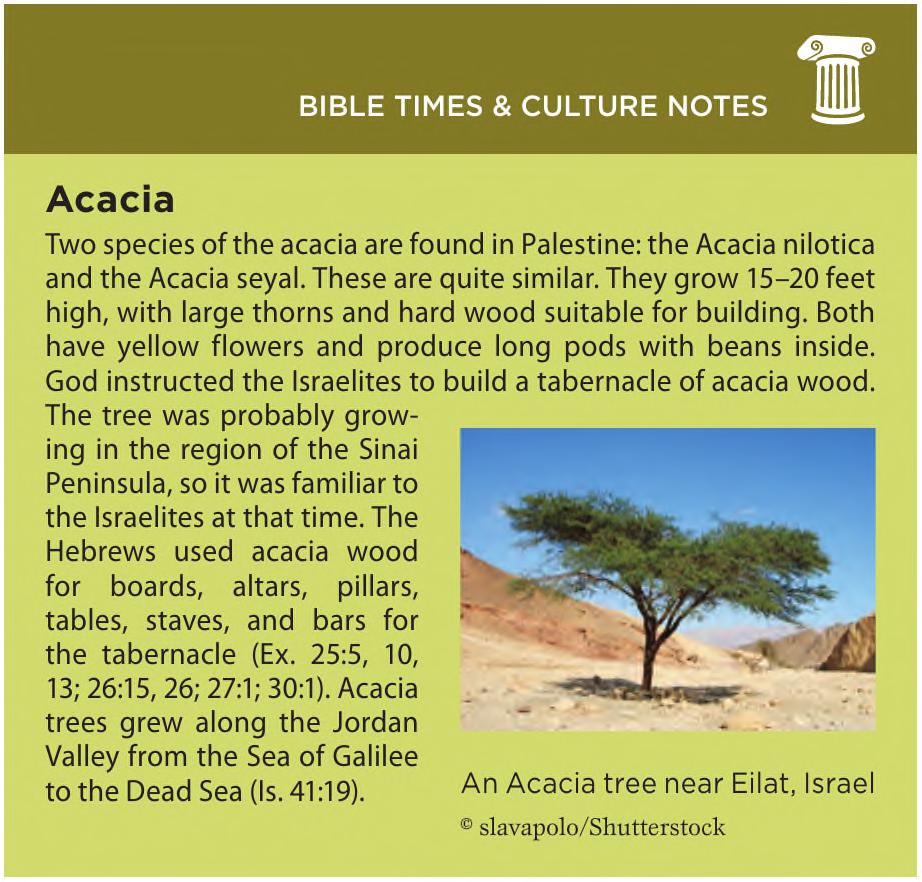
Acacia
Two species of the acacia are found in Palestine: the Acacia nilotica
and the Acacia seyal. These are quite similar. They grow 15–20 feet
high, with large thorns and hard wood suitable for building. Both
have yellow flowers and produce long pods with beans inside.
God instructed the Israelites to build a tabernacle of acacia wood.
The tree was probably grow-
ing in the region of the Sinai
Peninsula, so it was familiar to
the Israelites at that time. The
Hebrews used acacia wood
for boards, altars, pillars,
tables, staves, and bars for
the tabernacle (Ex. 25:5, 10,
13; 26:15, 26; 27:1; 30:1). Acacia
trees grew along the Jordan
Valley from the Sea of Galilee
to the Dead Sea (Is. 41:19).
An Acacia tree near Eilat, Israel
© slavapolo/Shutterstock
Original illustrations
End of source page 178