PRINTED PAGE 1741NKJV · STUDY EDITION
ACTS 2:43 | 1741
40 3 crooked
41 4 NU omits
gladly
42 l Acts 1:14;
Rom. 12:12; Eph.
6:18; Col. 4:2;
Heb. 10:25
5 teaching
2:40–43 three thousand souls: The response to Peter’s sermon
was tremendous. Such impressive growth in the number of believers
created additional needs and responsibilities. The apostles had the
duty of training this large group and bringing them into fellowship
with the other believers. This was a four-step process: (1) The new
believers were to be trained in the apostles’ doctrine. Uniformi-
ty of belief concerning the person of Jesus Christ—based on the
eyewitness testimony of His followers—was essential. (2) The new
believers were to be trained in the fellowship of the church. The
Greek word translated fellowship means sharing in the lives of other
believers. (3) The new believers were to be trained in the breaking
of bread, probably a reference to the Lord’s Supper (see 1 Cor. 11:23,
24). Some believe this is a broader reference to the “love feast,” a
meal of fellowship in the early church. (4) The new believers were
to be trained in the discipline of prayer. Corporate prayers were
viewed as an essential part of the spiritual growth of the church.
Wonders and signs apparently were given by the Lord to the
apostles to validate their divinely ordained position and to verify
the truthfulness of their witness in the establishment of the early
church (see Heb. 2:3, 4).
42 l And they continued steadfastly in the
apostles’ 5 doctrine and fellowship, in the
breaking of bread, and in prayers. 43 Then
fear came upon every soul, and m many
wonders and signs were done through the
A Vital Church Grows
40 And with many other words he tes
tified and exhorted them, saying, “Be
saved from this 3 perverse generation.”
41 Then those who 4 gladly received his
word were baptized; and that day about
three thousand souls were added to them.
43 m Mark 16:17; Acts 2:22
persevere
(Gk. proskartereō, proskarterēsis) (2:42, 46; Rom. 12:12; 13:6)
Strong’s #4342; 4343
The NT makes it clear that faith alone can save. But it makes
it equally clear that perseverance in doing good works is
the greatest indication that an individual’s faith is genuine
(James 2:14–26). Indeed, perseverance springs from a faith-
ful trust that God has been steadfast toward His people.
Through persevering in God’s work, Christians prove their
deep appreciation for God’s saving grace (1 Cor. 15:57, 58).
As a result of perseverance, the Christian can expect not
only to enhance the strength of the church, but also to
build up strength of character (Rom. 5:3, 4). In short, Chris-
tians can expect to become closer to God. They learn that
they can persevere primarily because God is intimately
related to them (Rom. 8:25–27) and especially because they
have the assurance of a final reward in heaven (1 John 5:13).
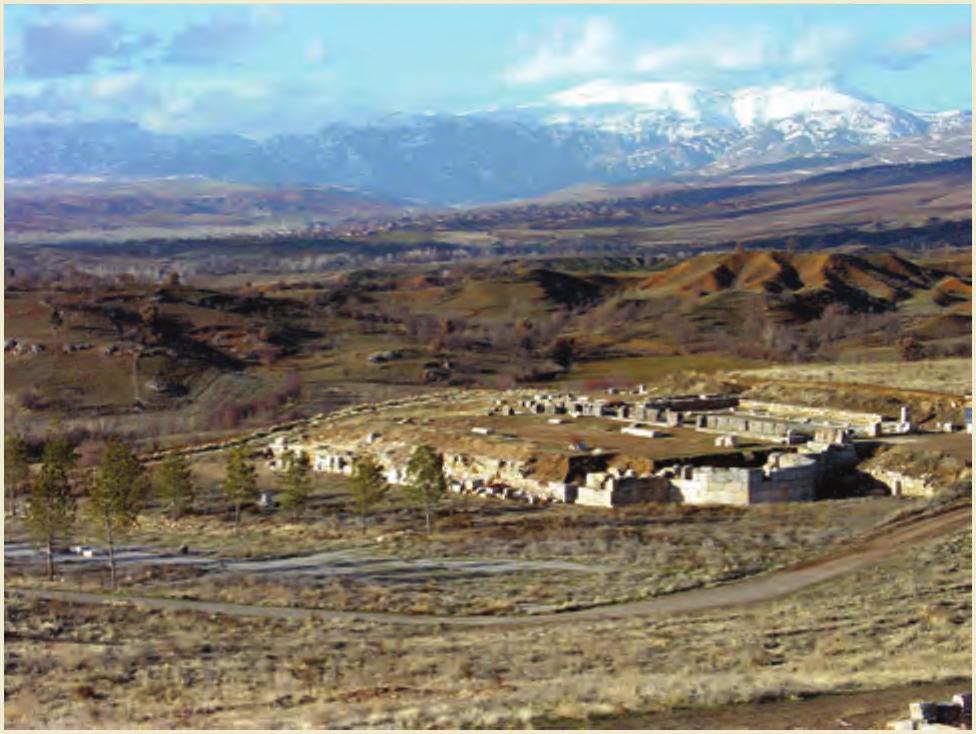
A fourth-century a.d. synagogue at Antioch
www.HolyLandPhotos.org
Missionary Efforts
Christ had established His church at the crossroads of the ancient world. Trade routes brought merchants and ambassa-
dors through Palestine where they came into contact with the gospel. Thus in the Book of Acts we see the conversion of
officials from Rome (10:1–48), Ethiopia (8:26–40), and other lands.
Soon after Stephen’s death, the church began a systematic effort to carry the gospel to other nations. Peter visited
the major cities of Palestine, preaching to both Jews and Gentiles. Others went to Phoenicia, Cyprus, and Antioch of Syria.
Hearing that the gospel was well received in these areas, the church in Jerusalem sent Barnabas to encourage the new
Christians in Antioch (11:22, 23). Barnabas then went to Tarsus to find the young convert named Saul. Barnabas took Saul
back to Antioch, where they taught in the church for over a year (11:26).
A prophet named Agabus predicted that the Roman Empire would suffer a great famine under Emperor Claudius.
Herod Agrippa was persecuting the church in Jerusalem; he had already executed James the brother of Jesus, and had
thrown Peter into prison (12:1–4). So the
Christians in Antioch collected money to
send to their friends in Jerusalem, and they
dispatched Barnabas and Saul with the relief.
Barnabas and Saul returned from Jerusalem
with a young man named John Mark (12:25).
By this time, several evangelists had
emerged within the church at Antioch so
the congregation sent Barnabas and Saul on
a missionary trip to Asia Minor (chs. 13–14).
This was the first of three great missionary
journeys that Saul (later known as Paul) made
to carry the gospel to the far reaches of the
Roman Empire.
The early Christian missionaries focused
their teachings upon the Person and work
of Jesus Christ. They declared that He was
the sinless Servant and Son of God who had
given His life to atone for the sins of all peo-
ple who put their trust in Him (Rom. 5:8–10).
He was the One whom God raised from the
dead to defeat the powers of sin (Rom. 4:24,
25; 1 Cor. 15:17).
Original illustrations
End of source page 1776