PRINTED PAGE 1709NKJV · STUDY EDITION
John 10:32 | 1709
ernacles, which fell in the middle of October. The Feast of Ded-
ication was celebrated for eight days in December; thus there
was a period of about two months between vv. 21 and 22. In
167 b.c., Antiochus Epiphanes desecrated the temple in Jerusalem,
as prophesied in Dan. 11:31. The Maccabeans restored and puri-
fied the temple. In commemoration of the restoration, the Feast
of Dedication was instituted. Today it is also known as the Feast of
Lights or Hanukkah. John notes that the events of 10:22 occurred
in winter to explain why the Lord chose a sheltered spot in which
to teach (v. 23).
10:23 A pavilion surrounded the temple. Solomon’s porch was a
long, covered cloister or colonnade in the temple court, probably
on the east side.
10:25 Jesus answered: Jesus reminded the Jewish leaders of His
words and works. Jesus was the Messiah and said so. He told the
woman at the well that He was the Messiah (4:25, 26), as well as
the man born blind (9:35–37). His works include all the miracles He
performed as signs pointing to His messiahship (see 20:31).
10:26 as I said to you: At the Feast of Tabernacles, Jesus had told
the leaders that they were not among His sheep (see vv. 14, 15;
8:42–44, 47).
10:27–29 Jesus described three characteristics of His sheep: (1) They
hear His voice (v. 4). He knows them (see Rom. 8:29). (2) They fol-
low Him. The following of the sheep is a metaphor for faith. Other
metaphors for faith in this Gospel include drinking water (4:14), eat-
ing bread (6:50, 51), eating flesh and drinking blood (6:54). (3) They
shall never perish; their eternal life can never be taken away. The
Father’s hand is more powerful than that of any enemy.
10:30 I and My Father are one: The Jewish opponents understood
that Jesus was claiming to be God (vv. 31, 33).
10:31 again: This was not the first time that the Jewish leaders took
up stones against Jesus (see 8:59).
10:32, 33 The Jewish antagonizers revealed the reason for their
23 t Acts 3:11; 5:12
24 4 Suspense
25 u John 5:36;
10:38 v Matt. 11:4;
John 2:11; 20:30
26 w [John 8:47]
5 NU omits as I said
to you
27 x John 10:4, 14
29 y John 14:28
z [John 17:2, 6, 12, 24]
30 a John 17:11,
21-24
31 b John 8:59
said to you. 27 x My sheep hear My voice,
and I know them, and they follow Me.
28 And I give them eternal life, and they
shall never perish; neither shall anyone
snatch them out of My hand. 29 y My Fa
ther, z who has given them to Me, is great
er than all; and no one is able to snatch
them out of My Father’s hand. 30 a I and
My Father are one.”
31 Then b the Jews took up stones
again to stone Him. 32 Jesus answered
in Jerusalem, and it was winter. 23 And
Jesus walked in the temple, t in Solomon’s
porch. 24 Then the Jews surrounded Him
and said to Him, “How long do You keep
us in 4 doubt? If You are the Christ, tell
us plainly.”
25 Jesus answered them, “I told you,
and you do not believe. u The works that
I do in My Father’s name, they v bear wit
ness of Me. 26 But w you do not believe,
because you are not of My sheep, 5 as I
Bible Times & Culture Notes
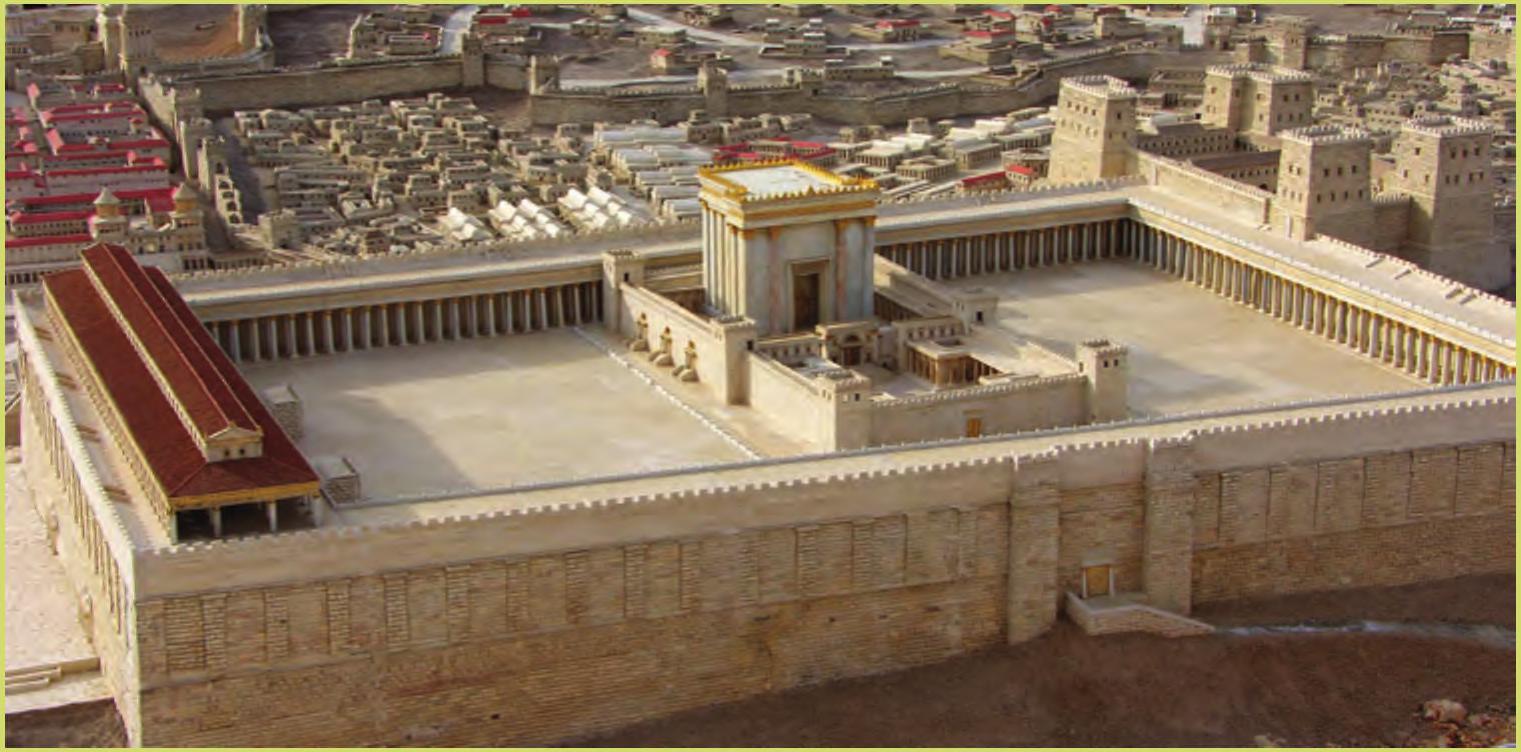
Herod’s Temple
King Herod sought to appease his Jewish subjects by constructing an enormous, ornate, cream-colored temple of stone
and gold. Building began in 19 b.c. The main building was finished by 9 b.c., but the entire structure was not completed
until a.d. 64. The temple building occupied an area that measured about 490 yards from north to south and 325 yards from
east to west. The entire temple complex was enclosed by a massive stone wall, the southeast corner of which stood about
50 yards above the floor of the Kidron ravine. The parapet above this corner may have been the “pinnacle of the temple”
referred to in Matt. 4:5. In a.d. 70, the Romans destroyed the temple and burned it to the ground. All that currently remains
is the Western Wall, also called the Wailing Wall, where Jews still gather to pray.
A model of Herod’s temple
Wikimedia Commons
Original illustrations
End of source page 1744