PRINTED PAGE 1706NKJV · STUDY EDITION
1706 | John 9:8
9:7 Siloam: Hezekiah had a tunnel cut through solid rock to
transport water from Gihon (the “Virgin’s Fountain”) into the city of
Jerusalem, to the Pool of Siloam (see 2 Kin. 20:20; 2 Chr. 32:30). John
emphasizes that the name Siloam means “Sent,” because Jesus had
just announced that He had been sent by God (v. 4).
7 g Neh. 3:15; Is. 8:6;
Luke 13:4; John 9:11
h 2 Kin. 5:14
8 2 NU a beggar
9 3 NU “No, but he is
like him.”
11 i John 9:6, 7
4 NU omits the
pool of
He said, “I am he.”
10 Therefore they said to him, “How
were your eyes opened?”
11 He answered and said, i “A Man
called Jesus made clay and anointed my
eyes and said to me, ‘Go to 4 the pool of
Siloam and wash.’ So I went and washed,
and I received sight.”
12 Then they said to him, “Where is He?”
to him, “Go, wash g in the pool of Siloam”
(which is translated, Sent). So h he went
and washed, and came back seeing.
8 Therefore the neighbors and those
who previously had seen that he was
2 blind said, “Is not this he who sat and
begged?”
9 Some said, “This is he.” Others said,
3 “He is like him.”
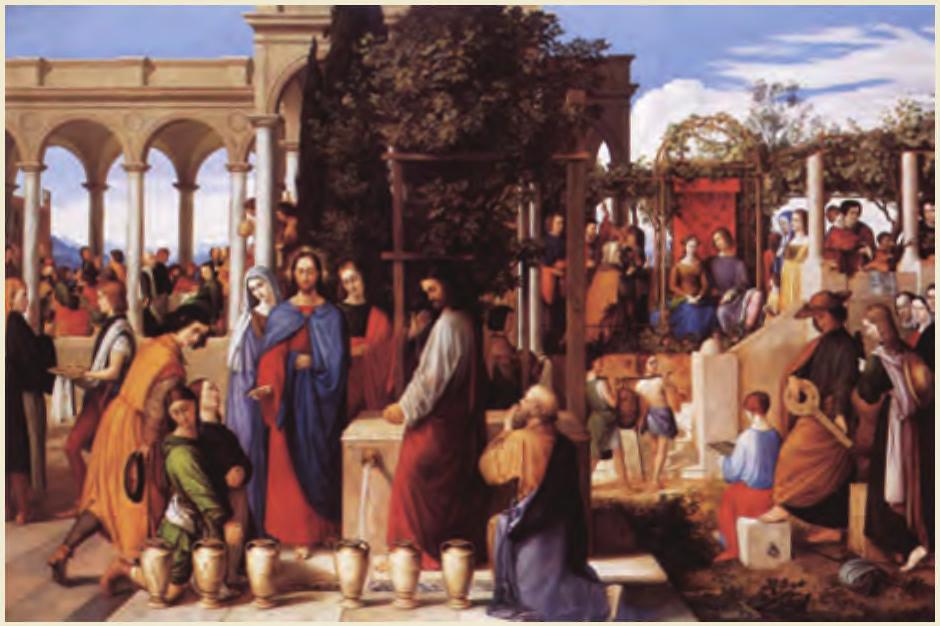
The wedding at Cana; the first “sign” of Jesus
Wikimedia Commons
The Signs of Jesus in the Gospel of John
A blind man sees; a lame man walks. Everywhere Jesus went, people were amazed at His miraculous powers. John uses
Jesus’ miracles as an organizing principle in his Gospel. He calls them all semeia, or “signs,” indicating that each miracle
was a concrete demonstration of Jesus’ divinity and messiahship. Their purpose was to engender belief as they did for the
disciples (2:11) and the nobleman’s household (4:52). But these same miracles would incite some to anger and violence
(11:45–52). John records seven specific “signs.” The first was Jesus’ miracle of turning water into wine in Cana (2:1–11). In
2:11, John specifically mentions that this sign signified Christ’s glory, that is, His deity. With this sign Jesus demonstrated
His creative power over nature, and His disciples appropriately placed their faith in Him (2:11).
The second sign was Jesus’ healing of the nobleman’s son (4:46–54). Although the son was in Capernaum and Jesus
was in Cana, He told the boy’s father, “Your son lives” (4:50). This sign indicated that Jesus was more than a mere mortal;
He possessed the power not only to defeat disease, but to transcend space. Jesus did not have to be physically present
to heal. Once again, the sign produced belief (4:52).
But with the third sign, another reaction to Jesus’ miracles can be seen. A man at the pool of Bethesda had been sick
for a long time. When Jesus told him, “Rise, take up your bed and walk” (5:8), immediately he was well. But this healing took
place on the Sabbath. Instead of rejoicing with the healed man, the Jewish leaders reprimanded him for carrying his bed
on the Sabbath. The Jewish leaders’ traditions and ideas kept them from believing in the clear signs of Jesus.
The fourth sign was Jesus’ miraculous feeding of the five thousand (6:1–15). By creating a great quantity of food out
of five loaves and two fishes, Jesus was again demonstrating His deity, for only God can create. But the crowd, instead of
submitting to Jesus’ teaching and following Him, wanted to make Him their king. They sought out Jesus for the food for
their stomachs, and not for the spiritual food that would give them eternal life (6:26, 27).
The fifth sign was Jesus’ walking on the water (6:16–21). After the feeding of the five thousand, the disciples took a
boat to cross the Sea of Galilee on their way to Capernaum. When they were three or four miles out, they saw Jesus walk-
ing on the water toward them. This time, Jesus demonstrated His complete control of nature, from the winds above to
the water below. This was another sign of His deity, and another reason for the disciples to place complete trust in Him.
Jesus’ sixth sign highlights the different responses to Jesus’ miraculous works. In this account, the Pharisees’ spiritual
blindness is clearly contrasted with the vibrant faith of the blind man. After being healed, this man told others about
Jesus and correctly concluded that He was from God. The blind man saw clearly what Jesus’ sign meant, and believed
(9:38). But the Pharisees refused to believe. They ridiculed the man’s faith and arrogantly questioned Jesus (9:34, 40, 41).
The seventh sign was Jesus’ raising of
Lazarus from the dead (11:1–44). Lazarus had
been buried for four days when Jesus arrived in
Bethany. With the simple words “Lazarus, come
out,” Jesus restored to life the brother of Mary
and Martha. This last sign was the greatest: Jesus
at once demonstrated His power over the grave
and pointed to His own resurrection. Not even
death could limit Him, for He was truly God.
These seven signs certainly should have
been enough to convince anyone that Jesus was
the promised Messiah. Yet the miracles singled
out by John were no more than “samples” of the
enormous scope of Jesus’ signs and wonders
(21:25). For John, all these signs pointed to the
two miracles that are the greatest of all: Jesus’
incarnation (1:14) and resurrection (20:1–18).
Jesus is God’s only Son become man. Although
He died for our sins, He was raised from the
dead. Today, He still lives and intercedes for all
who believe in Him.
Original illustrations
End of source page 1741