PRINTED PAGE 1704NKJV · STUDY EDITION
1704 | John 8:25
religious leaders at this time. Later, Jesus’ claim to be the “I AM”
(v. 58) prompted the Jewish leaders to seek His life (v. 59).
8:28 Lift up is a reference to the Crucifixion.
8:30 The Greek phrase translated believed in occurs almost ex-
clusively in John’s Gospel (1:12; 2:11; 3:15, 16, 18, 36; 6:29, 35, 40, 47;
7:38, 39; 9:35, 36; 10:42; 11:25, 26, 45; 12:44, 46). The phrase describes
faith in Jesus’ message (see 1 Cor. 1:21), which results in eternal life.
8:31 Abide means to remain, to continue. A believer who continues
to obey the Word is a disciple, a learner.
8:32 One who abides in the Word of God knows the truth (v. 31;
17:17). The word free refers to freedom from the bondage of sin.
Obedience to the Lord means fellowship with Him, protection from
sin, and experiencing His love.
8:33 They answered Him: Throughout this chapter, Jesus was
engaged in an exchange with His antagonists, the Pharisees (v. 13).
They are also designated by the term Jews (vv. 22, 48, 52, 57) and
the pronoun they (vv. 19, 25, 27, 33, 39, 41, 59). We . . . have never
been in bondage: The Pharisees’ objection is startling. In their
past, the Israelites had been in bondage to the Egyptians, the Assyr-
ians, and the Babylonians. At the time they spoke, Israel was under
the power of Rome.
8:34 slave of sin: Jesus was speaking of spiritual slavery. Such a
slave cannot break away from his bondage. He must have someone
else set him free (see Rom. 8:34).
8:35 A slave was not a permanent resident of a house. A son re-
mained a family member with family privileges forever. This pro-
verbial saying is applied in v. 36. The application proves that the
“Son” here is Jesus Christ (see “the Son of Man” in v. 28). As a family
member, the Son can bestow family privileges on others.
8:37 Abraham’s descendants may have been physical heirs of
Abraham, but they were not his spiritual descendants unless they
had faith. But instead of trusting Christ to forgive their sins, the reli-
gious leaders wanted to kill Him. They heard the word, but did not
believe it. Thus they could not experience its truth.
8:39 Abraham is our father: The Pharisees believed that being a
descendant of Abraham guaranteed them a place in heaven. The
works of Abraham included paying honor to those who spoke in
the name of God (see Gen. 14; 18).
8:41 We were not born of fornication: From ancient times,
this has been interpreted as a sneer, as if to say, “We are not ille-
gitimate children, but You are.” Apparently gossip had followed
Jesus for many years, alleging that He had been conceived out of
wedlock.
8:44 your father: Jesus knew what was in the hearts of people
25 c John 4:26
26 d John 7:28
e John 3:32; 15:15
28 f Matt. 27:35;
Mark 15:24; Luke
23:33; John 3:14;
12:32; 19:18 g [Rom.
1:4] h John 5:19, 30
i Deut. 18:15, 18, 19;
John 3:11 4 Crucify
29 j John 14:10
k John 8:16; 16:32
l John 4:34; 5:30;
6:38
30 m John 7:31;
10:42; 11:45
31 n [John 14:15, 23]
32 o [John 1:14, 17;
14:6] p [Rom. 6:14,
18, 22; James 1:25;
2:12]
33 q Lev. 25:42;
[Matt. 3:9]; Luke 3:8
34 r Prov. 5:22;
Rom. 6:16; 2 Pet.
2:19
35 s Gen. 21:10;
Gal. 4:30
36 t [Rom. 8:2;
2 Cor. 3:17]; Gal. 5:1
37 u John 7:19
38 v [John 3:32;
5:19, 30; 14:10, 24]
5 NU heard from
39 w Matt. 3:9; John
8:37 x [Rom. 2:28;
Gal. 3:7, 29]
40 y John 8:37
z John 8:26
41 a Deut. 32:6; Is.
63:16; Mal. 1:6
42 b 1 John 5:1
c John 16:27; 17:8,
25 d John 5:43;
Gal. 4:4
43 e [John 7:17]
44 f Matt. 13:38;
1 John 3:8
things that please Him.” 30 As He spoke
these words, m many believed in Him.
31 Then Jesus said to those Jews who
believed Him, “If you n abide in My word,
you are My disciples indeed. 32 And you
shall know the o truth, and p the truth
shall make you free.”
33 They answered Him, q “We are Abra
ham’s descendants, and have never been
in bondage to anyone. How can You say,
‘You will be made free’?”
34 Jesus answered them, “Most assur
edly, I say to you, r whoever commits
sin is a slave of sin. 35 And s a slave does
not abide in the house forever, but a son
abides forever. 36 t Therefore if the Son
makes you free, you shall be free indeed.
37 “I know that you are Abraham’s de
scendants, but u you seek to kill Me, be
cause My word has no place in you. 38 v I
speak what I have seen with My Father,
and you do what you have 5 seen with
your father.”
39 They answered and said to Him,
w “Abraham is our father.”
Jesus said to them, x “If you were Abra
ham’s children, you would do the works
of Abraham. 40 y But now you seek to kill
Me, a Man who has told you the truth
z which I heard from God. Abraham did
not do this. 41 You do the deeds of your
father.”
Then they said to Him, “We were
not born of fornication; a we have one
Father—God.”
42 Jesus said to them, b “If God were your
Father, you would love Me, for c I proceeded
forth and came from God; d nor have I
come of Myself, but He sent Me. 43 e Why
do you not understand My speech? Be
cause you are not able to listen to My
word. 44 f You are of your father the devil,
25 Then they said to Him, “Who are
You?”
And Jesus said to them, “Just what I
c have been saying to you from the begin
ning. 26 I have many things to say and to
judge concerning you, but d He who sent
Me is true; and e I speak to the world
those things which I heard from Him.”
27 They did not understand that He
spoke to them of the Father.
28 Then Jesus said to them, “When you
f lift 4 up the Son of Man, g then you will
know that I am He, and h that I do noth
ing of Myself; but i as My Father taught
Me, I speak these things. 29 And j He who
sent Me is with Me. k The Father has
not left Me alone, l for I always do those
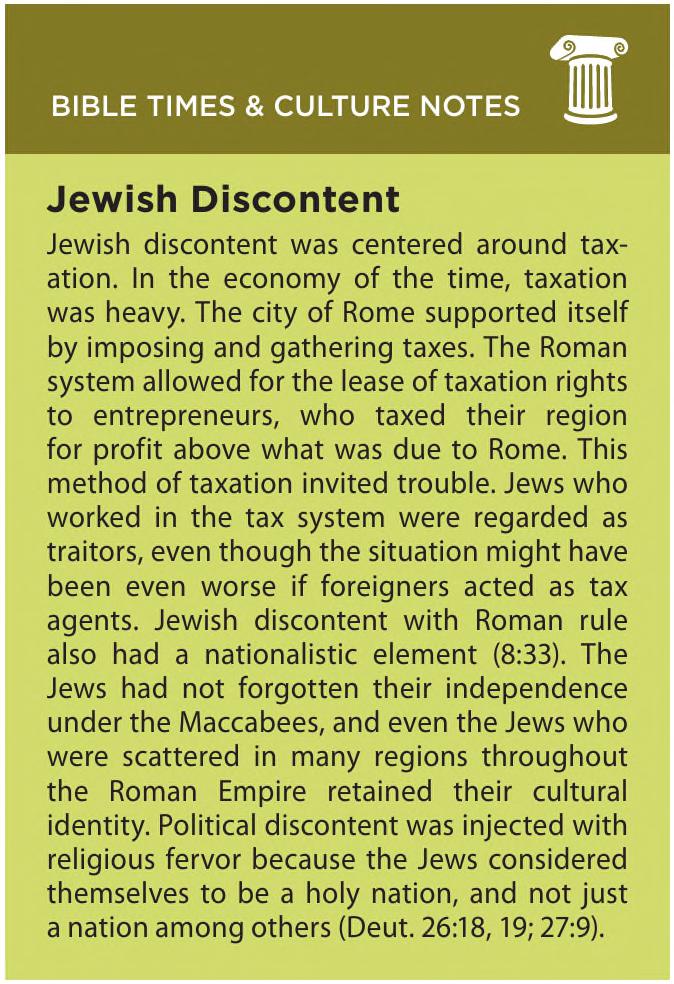
Bible Times & Culture Notes
Jewish Discontent
Jewish discontent was centered around tax-
ation. In the economy of the time, taxation
was heavy. The city of Rome supported itself
by imposing and gathering taxes. The Roman
system allowed for the lease of taxation rights
to entrepreneurs, who taxed their region
for profit above what was due to Rome. This
method of taxation invited trouble. Jews who
worked in the tax system were regarded as
traitors, even though the situation might have
been even worse if foreigners acted as tax
agents. Jewish discontent with Roman rule
also had a nationalistic element (8:33). The
Jews had not forgotten their independence
under the Maccabees, and even the Jews who
were scattered in many regions throughout
the Roman Empire retained their cultural
identity. Political discontent was injected with
religious fervor because the Jews considered
themselves to be a holy nation, and not just
a nation among others (Deut. 26:18, 19; 27:9).
Original illustrations
End of source page 1739