PRINTED PAGE 1686NKJV · STUDY EDITION
1686 | John 1:43
1:43 From this verse, it might appear that Philip followed Jesus
without being evangelized by another disciple, but there are several
indications that Philip was approached by Andrew and Peter before
he actually met the Lord. Verse 44 says that Andrew and Peter were
from the same city as Philip, suggesting that they had talked to him.
Furthermore, when Philip told Nathanael what had happened, he
said “we” have found the Messiah (v. 45).
1:45 Nathanael is not mentioned in the synoptic Gospels. But in
every list of the apostles in Matthew, Mark, and Luke, the name Bar-
tholomew is listed with Philip, as Nathanael is linked with Philip here.
It is likely that Nathanael and Bartholomew were the same person.
son of Joseph: Philip did not have knowledge of the virgin birth at
this time. However, soon all of the disciples would recognize Christ
as the Son of God (v. 49).
1:46 Nazareth: Nathanael knew that the OT prophets had pre-
dicted that the Messiah would be born in Bethlehem. Furthermore,
Nazareth was an obscure village. Nathanael simply could not fathom
that such a significant person as the Messiah could come from such
an insignificant place as Nazareth.
1:47 an Israelite indeed: In his younger life Jacob, the first Israelite,
was a cunning, scheming fellow full of deceit. Nathanael was an
Israelite, a descendant of Jacob, but he was genuine and sincere.
Jesus read Nathanael’s character like an open book (2:24).
1:48, 49 under the fig tree: In the OT, this expression often sug-
gests being safe and at leisure (see 1 Kin. 4:25; Mic. 4:4; Zech. 3:10).
Nathanael may have been meditating under the tree about the
dream of Jacob referred to in vv. 50, 51. I saw you: Jesus manifest-
ed His supernatural knowledge. Apparently, this incident convinced
Philip and Nathanael Follow Christ
43 The following day Jesus wanted to
go to Galilee, and He found z Philip and
said to him, “Follow Me.” 44 Now a Philip
was from Bethsaida, the city of Andrew
and Peter. 45 Philip found b Nathanael
and said to him, “We have found Him
of whom c Moses in the law, and also the
d prophets, wrote—Jesus e of Nazareth,
the f son of Joseph.”
46 And Nathanael said to him, g “Can
anything good come out of Nazareth?”
Philip said to him, “Come and see.”
47 Jesus saw Nathanael coming toward
Him, and said of him, “Behold, h an Isra
elite indeed, in whom is no deceit!”
48 Nathanael said to Him, “How do You
know me?”
Jesus answered and said to him, “Be
fore Philip called you, when you were
under the fig tree, I saw you.”
49 Nathanael answered and said to
Him, “Rabbi, i You are the Son of God!
You are j the King of Israel!”
43 z Matt. 10:3;
John 6:5; 12:21, 22;
14:8, 9
44 a John 12:21
45 b John 21:2
c [Gen. 3:15; Deut.
18:18]; Luke 24:27
d [Is. 4:2; 7:14; 9:6;
Mic. 5:2; Zech. 6:12];
Luke 24:27 e [Matt.
2:23]; Luke 2:4
f Luke 3:23
46 g John 7:41,
42, 52
47 h Ps. 32:2; 73:1
49 i Ps. 2:7 ;
Matt. 14:33; Luke 1:35 j Matt. 21:5
Bible Times & Culture Notes
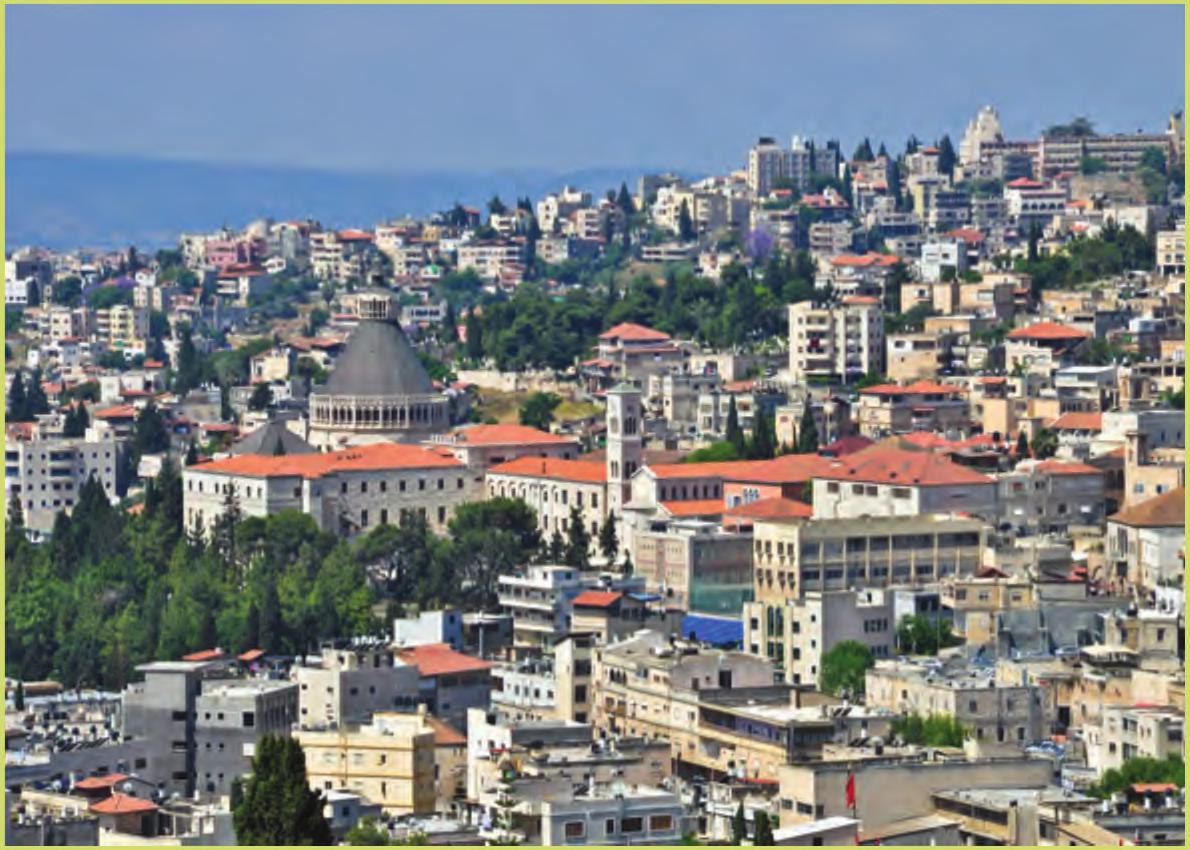
Nazareth
Nazareth is a beautifully secluded town nestled in the southernmost hills of the Lebanon mountain range. The city lay
close to the important trade routes of Palestine. It overlooked the Plain of Esdraelon through which caravans passed as
they traveled from Gilead to the south and west. North of the city was the main road from Ptolemais to the Decapolis,
a road over which the Roman legions frequently traveled. This fact may account for the possible source of the name
Nazareth in the Aramaic word meaning “watchtower.” This, coupled with a rather bad reputation in morals and religion
and a certain crudeness in the Galilean dialect prompted Nathanael, when he first learned of Jesus of Nazareth, to ask,
“Can anything good come out of Nazareth?” (1:46).
A view of modern
Nazareth with
the Church of
Annunciation (left)
www.HolyLandPhotos.org
Original illustrations
End of source page 1721