PRINTED PAGE 134NKJV · STUDY EDITION
134 | Exodus 25:19
20 l 1 Kin. 8:7; 1 Chr.
28:18; Heb. 9:5
21 m Ex. 26:34;
40:20 n Ex. 25:16
22 o Ex. 29:42, 43;
30:6, 36; Lev. 16:2;
Num. 17:4 p Num.
7:89; 1 Sam. 4:4;
2 Sam. 6:2; 2 Kin.
19:15; Ps. 80:1; Is.
37:16
23 q Ex. 37:10-16;
1 Kin. 7:48; 2 Chr.
4:8; Heb. 9:2
29 r Ex. 37:16;
Num. 4:7
The Table for the Showbread
23 q “You shall also make a table of aca-
cia wood; two cubits shall be its length, a
cubit its width, and a cubit and a half its
height. 24 And you shall overlay it with
pure gold, and make a molding of gold all
around. 25 You shall make for it a frame
of a handbreadth all around, and you
shall make a gold molding for the frame
all around. 26 And you shall make for it
four rings of gold, and put the rings on
the four corners that are at its four legs.
27 The rings shall be close to the frame,
as holders for the poles to bear the table.
28 And you shall make the poles of aca-
cia wood, and overlay them with gold,
that the table may be carried with them.
29 You shall make r its dishes, its pans, its
pitchers, and its bowls for pouring. You
shall make them of pure gold. 30 And you
shall make them at the two ends of the
mercy seat. 19 Make one cherub at one
end, and the other cherub at the other
end; you shall make the cherubim at
the two ends of it of one piece with the
mercy seat. 20 And l the cherubim shall
stretch out their wings above, covering
the mercy seat with their wings, and
they shall face one another; the faces of
the cherubim shall be toward the mercy
seat. 21 m You shall put the mercy seat on
top of the ark, and n in the ark you shall
put the Testimony that I will give you.
22 And o there I will meet with you, and
I will speak with you from above the
mercy seat, from p between the two cher-
ubim which are on the ark of the Testi-
mony, about everything which I will give
you in commandment to the children of
Israel.
25:22 The Lord promised Moses that He would meet with him at
the mercy seat. The verb carries a specific meaning, “to meet at an
appointed place.” The Lord would also meet with Moses at the tent
of meeting (see Ex. 29:42, 43; 30:36). Some have thought that the
mercy seat and the cherubim were something of a throne for the
Lord, with the extended wings of the cherubs forming an exquisite
seat for Him, or perhaps a footstool (1 Chr. 28:2).
25:23 The table was used to display 12 loaves of bread in the pres-
ence of the Lord. It was approximately three feet long, 18 inches
wide, and 27 inches high.
25:24, 25 Like the ark, the table was to be overlaid with gold and
was to have a decorative molding of gold (see v. 11). The frame
was a decorative element that kept objects on the table from being
disturbed.
25:26–28 The table was to have rings and poles so that it could
be transported properly. The poles protected the holy object from
being touched by human hands.
25:29 pure gold: All of the implements for making bread were also
to be costly and wonderfully designed to physically represent their
holiness. They were “set apart” to God.
25:30 The showbread itself is described more fully in Lev. 24:5–9.
Twelve loaves representing the twelve tribes were placed in two
A few desert shrines have been found in Sinai (notably at
Serabit el-Khadem) and at Timnah in the Negev. They show
marked Egyptian influence.
Specific cultural antecedents to portable shrines car-
ried on poles and covered with thin sheets of gold can
be found in ancient Egypt as early as the Old Kingdom
(2800 – 2250 b.c.), but they were especially prominent in
the Eighteenth and Nineteenth Dynasties (1570 – 1180).
The best examples come from the fabulous tomb of Tut-
ankhamun, c. 1300 b.c.
Comparisons of construction details in the text of Ex.
25 – 40 with the frames, shrines, poles, sheathing, draped
fabric covers, gilt rosettes, and winged protective fig-
ures from the shrine of Tutankhamun are instructive. The
period, the Late Bronze Age, is equivalent in all dating
systems to the era of Moses and the Exodus.
The new religious observances taught by Moses in the wilderness centered on rituals connected with the taber-
nacle and amplified Israel’s sense of separateness, purity, and oneness under the lordship of Yahweh.
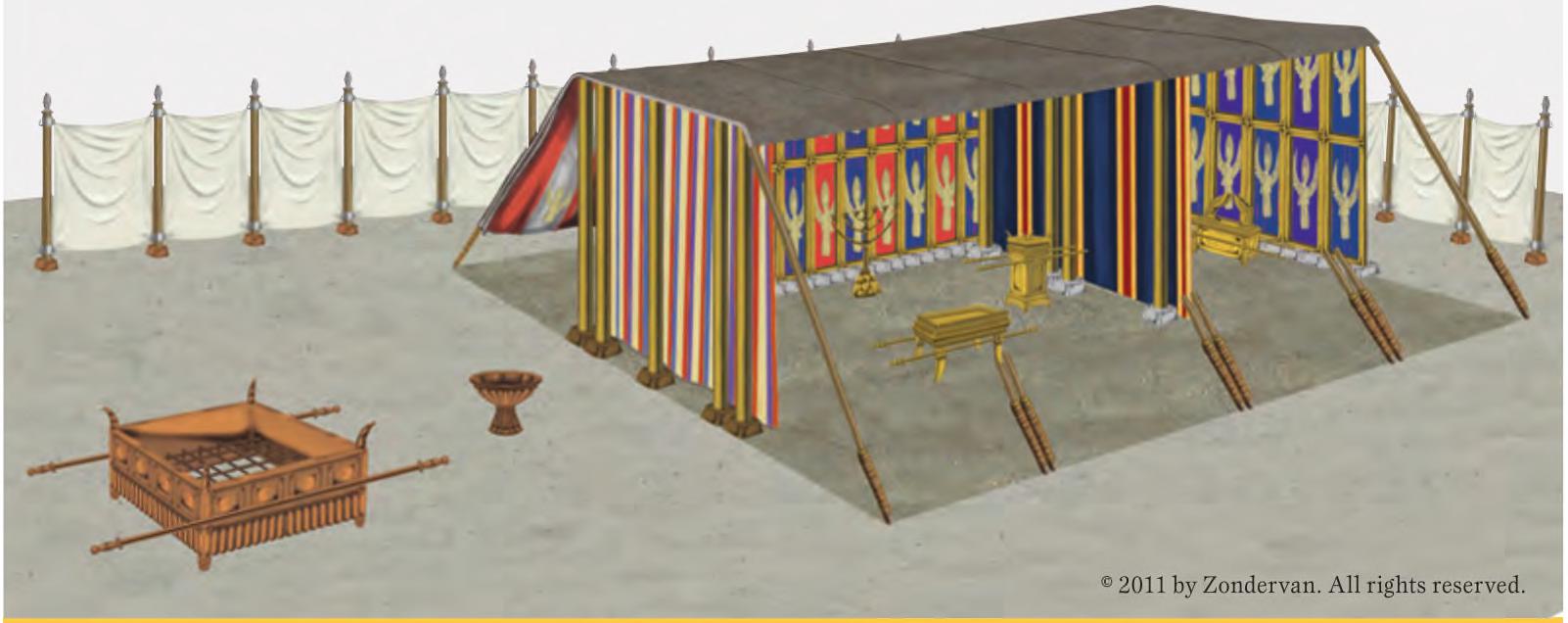
The Tabernacle
© 2011 by Zondervan. All rights reserved.
Original illustrations
End of source page 169