PRINTED PAGE 1637NKJV · STUDY EDITION
Luke 8:3 | 1637
of the kingdom of God. And the twelve
were with Him, 2 and a certain women who
had been healed of evil spirits and 2 in
firmities—Mary called Magdalene, b out
of whom had come seven demons, 3 and
Joanna the wife of Chuza, Herod’s stew
ard, and Susanna, and many others who
provided for 3 Him from their 4 substance.
with her tears, and wiped them with the
hair of her head; and she kissed His feet
and anointed them with the fragrant oil.
39 Now when the Pharisee who had in
vited Him saw this, he spoke to himself,
saying, g “This Man, if He were a proph
et, would know who and what manner of
woman this is who is touching Him, for
she is a sinner.”
The Parable of the Two Debtors
40 And Jesus answered and said to him,
“Simon, I have something to say to you.”
So he said, “Teacher, say it.”
41 “There was a certain creditor who
had two debtors. One owed five hundred
h denarii, and the other fifty. 42 And when
they had nothing with which to repay, he
freely forgave them both. Tell Me, there
fore, which of them will love him more?”
43 Simon answered and said, “I sup
pose the one whom he forgave more.”
And He said to him, “You have rightly
judged.” 44 Then He turned to the woman
and said to Simon, “Do you see this
woman? I entered your house; you gave
Me no i water for My feet, but she has
washed My feet with her tears and wiped
them with the hair of her head. 45 You
gave Me no j kiss, but this woman has
not ceased to kiss My feet since the time
I came in. 46 k You did not anoint My head
with oil, but this woman has anointed
My feet with fragrant oil. 47 l Therefore I
say to you, her sins, which are many, are
forgiven, for she loved much. But to whom
little is forgiven, the same loves little.”
48 Then He said to her, m “Your sins are
forgiven.”
49 And those who sat at the table with
Him began to say to themselves, n “Who
is this who even forgives sins?”
50 Then He said to the woman, o “Your
faith has saved you. Go in peace.”
Certain Women Minister to Christ
8
Now it came to pass, afterward, that
He went through every city and village,
preaching and 1 bringing the glad tidings
50 o Matt. 9:22; Mark 5:34; 10:52; Luke 8:48; 18:42
CHAPTER 8 1 1 proclaiming the good news 2 a Matt.
27:55; Mark 15:40, 41; Luke 23:49, 55 b Matt. 27:56; Mark 16:9
2 sicknesses 3 3 NU, M them 4 possessions
39 g Luke 15:2
41 h Matt. 18:28;
Mark 6:37
44 i Gen. 18:4; 19:2;
43:24; Judg. 19:21;
1 Tim. 5:10
45 j Rom. 16:16
46 k 2 Sam. 12:20;
Ps. 23:5; Eccl. 9:8;
Dan. 10:3
47 l [1 Tim. 1:14]
48 m Matt. 9:2;
Mark 2:5
49 n Matt. 9:3;
[Mark 2:7]; Luke
5:21
7:39 if He were a prophet: The Pharisee doubted Jesus’ creden-
tials because He associated so openly with sinners. Jesus’ associ-
ation with sinners is a prominent theme in Luke (v. 34; 5:8, 30, 32;
13:2; 15:1, 2, 7, 10; 18:13; 19:7; 24:7). A Pharisee would reject such
associations.
7:40 I have something to say: Jesus’ reply indicates that He knew
the reputation of the woman, but was more interested in what the
woman could become through the grace of God.
7:41 Jesus often compared sin to a monetary debt. A denarius was
a day’s wage for a basic laborer, so five hundred denarii was ap-
proximately the wages of one and a half years.
7:42 which of them will love him more: Jesus’ point is that the
amount of love showered on the Savior will be in direct proportion
with one’s sense of the gravity of the sins that the Savior has forgiv-
en. The woman knew she had been forgiven much, and as a result
she would love much.
7:44–46 Jesus contrasted the actions of the woman with the actions
of the Pharisee Simon, implying that the woman knew more about
forgiveness than Simon (v. 47).
7:47 her sins . . . are forgiven: Jesus confirmed that the love of
the woman, which was visible in her actions toward Jesus, had come
from being forgiven.
7:49 Who is this: The grumbling over Jesus’ declaration concern-
ing forgiveness indicates that at least some people in the audience
rejected His authority.
7:50 Faith is the human channel for receiving God’s gifts (see Eph.
2:8, 9).
8:1–3 The fact that Mary called Magdalene is introduced here
Bible Times & Culture Notes
The Underclass
Nearly every society and every city in biblical times had a large
underclass. Tending to congregate in the cities, the underclass
included the poor, the sick, the disabled, the lepers, the blind, the
insane, the demon-possessed, widows, orphans, and refugees.
Lacking resources to provide for even their basic needs, many
turned to begging, stealing, menial labor, slavery, or prostitution.
Few cultures made provision for these desperate, destitute wan-
derers, and so they remained largely powerless to change their
condition. Yet it was to the underclass that Jesus intentionally
directed much of His life and ministry.
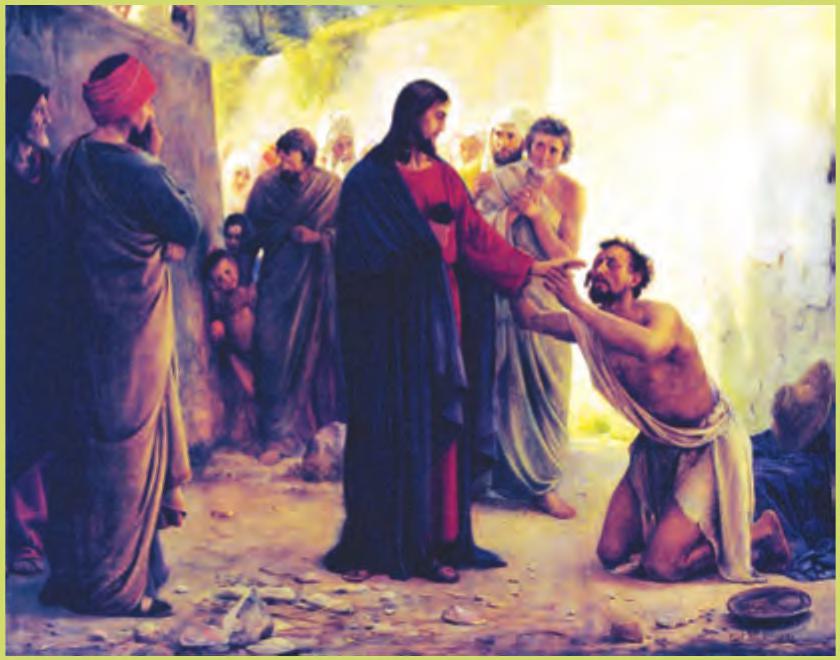
Jesus healing the blind man (Luke 9)
Wikimedia Commons
Original illustrations
End of source page 1672