PRINTED PAGE 1629NKJV · STUDY EDITION
Luke 5:1 | 1629
also, because for this purpose I have been
sent.” 44 w And He was preaching in the
synagogues of 9 Galilee.
The First Disciples Are Called
5
So a it was, as the multitude pressed
about Him to b hear the word of God,
that He stood by the Lake of Gennesaret,
out of many, crying out and saying, s “You
are 7 the Christ, the Son of God!”
And He, t rebuking them, did not allow
them to 8 speak, for they knew that He
was the Christ.
42 u Now when it was day, He depart
ed and went into a deserted place. And
the crowd sought Him and came to Him,
and tried to keep Him from leaving them;
43 but He said to them, “I must v preach
the kingdom of God to the other cities
CHAPTER 5 1 a Matt. 4:18-22; Mark 1:16-20; John 1:40-42
b Acts 13:44
41 s Mark 8:29
t Mark 1:25, 34; 3:11;
Luke 4:34, 35 7 NU
omits the Christ
8 Or say that they
knew
42 u Mark 1:35-38;
Luke 9:10
43 v Mark 1:14;
[John 9:4]
44 w Matt. 4:23;
9:35; Mark 1:39
9 NU Judea
4:43 The kingdom is referred to 30 times in Luke and six times in
Acts. Jesus announced the rule of God through His person, in deal-
ing with sin (24:47), in distributing the Spirit as He mediates blessing
from God’s side (24:49), and in reigning with His followers according
to the OT promise (see Ps. 2:7–12; Acts 3:18–22).
4:44 Galilee probably refers to the whole of Palestine in this con-
text (see 23:5; Acts 10:37).
5:1 The Lake of Gennesaret is also known as the Sea of Galilee
and the Sea of Tiberias.
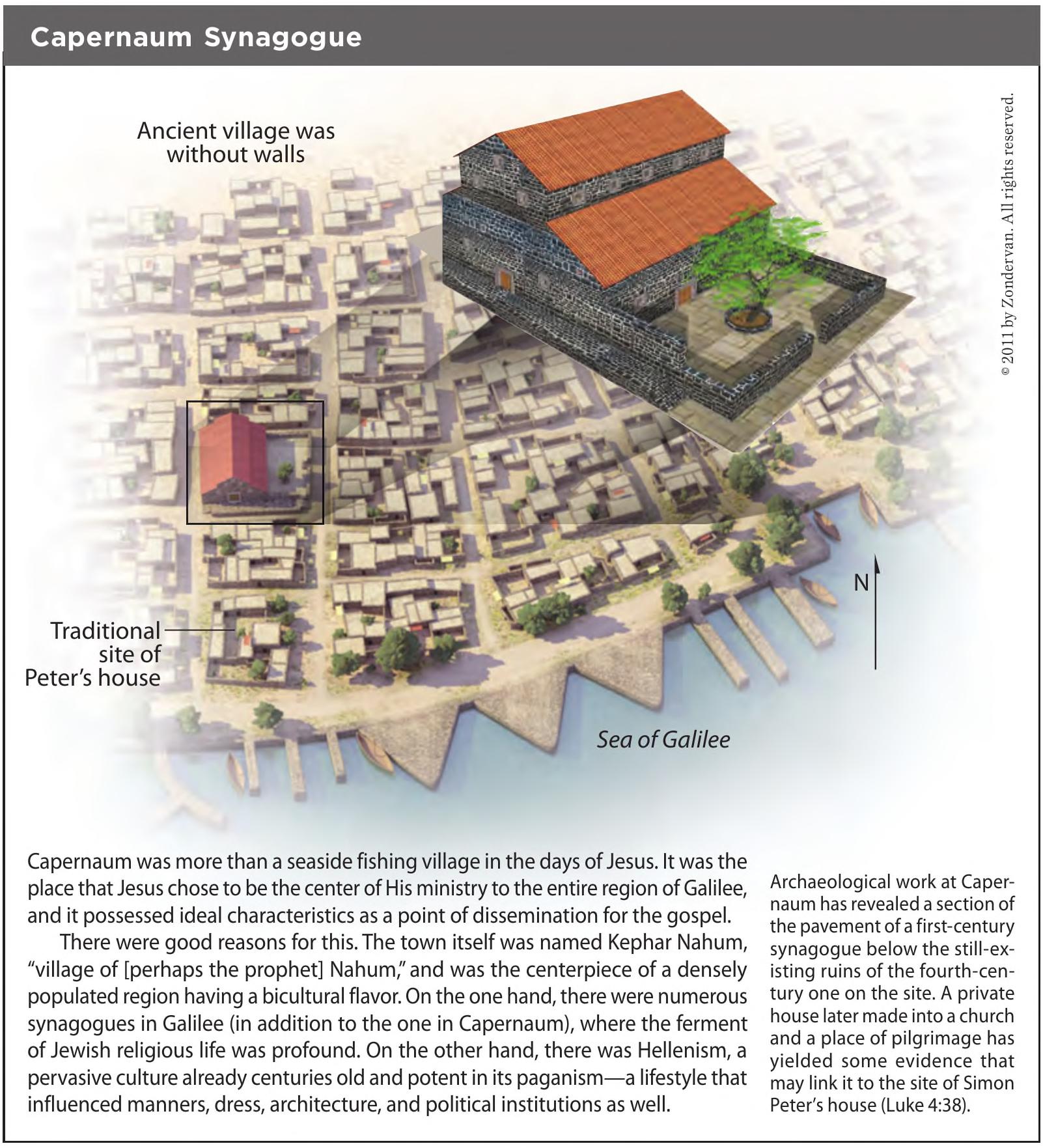
Traditional
site of
Peter’s house
Ancient village was
without walls
Sea of Galilee
N
Archaeological work at Caper-
naum has revealed a section of
the pavement of a first-century
synagogue below the still-ex-
isting ruins of the fourth-cen-
tury one on the site. A private
house later made into a church
and a place of pilgrimage has
yielded some evidence that
may link it to the site of Simon
Peter’s house (Luke 4:38).
Capernaum was more than a seaside fishing village in the days of Jesus. It was the
place that Jesus chose to be the center of His ministry to the entire region of Galilee,
and it possessed ideal characteristics as a point of dissemination for the gospel.
There were good reasons for this. The town itself was named Kephar Nahum,
“village of [perhaps the prophet] Nahum,” and was the centerpiece of a densely
populated region having a bicultural flavor. On the one hand, there were numerous
synagogues in Galilee (in addition to the one in Capernaum), where the ferment
of Jewish religious life was profound. On the other hand, there was Hellenism, a
pervasive culture already centuries old and potent in its paganism—a lifestyle that
influenced manners, dress, architecture, and political institutions as well.
© 2011 by Zondervan. All rights reserved.
Capernaum Synagogue
Original illustrations
End of source page 1664