PRINTED PAGE 1627NKJV · STUDY EDITION
Luke 4:20 | 1627
et Isaiah. And when He had opened the
book, He found the place where it was
written:
18 “ The u Spirit of the LORD is upon Me,
Because He has anointed Me
To preach the gospel to the poor;
He has sent Me 9 to heal the
brokenhearted,
To proclaim liberty to the captives
And recovery of sight to the blind,
To v set at liberty those who are
1 oppressed;
19 To proclaim the acceptable year of
the LORD.”
20 Then He closed the book, and gave it
back to the attendant and sat down. And
8 And Jesus answered and said to him,
5 “Get behind Me, Satan! 6 For it is writ
ten, g ‘You shall worship the LORD your
God, and Him only you shall serve.’ ”
9 h Then he brought Him to Jerusalem,
set Him on the pinnacle of the temple,
and said to Him, “If You are the Son of
God, throw Yourself down from here.
10 For it is written:
i‘ He shall give His angels charge over
you,
To keep you,’
11 and,
j‘ In their hands they shall bear you up,
Lest you dash your foot against a
stone.’ ”
12 And Jesus answered and said to him,
“It has been said, k ‘You shall not 7 tempt
the LORD your God.’ ”
13 Now when the devil had ended every
8 temptation, he departed from Him l un
til an opportune time.
Acceptance Throughout Galilee
Matt. 4:12; Mark 1:14
14 m Then Jesus returned n in the power
of the Spirit to o Galilee, and p news of
Him went out through all the surround
ing region. 15 And He q taught in their
synagogues, r being glorified by all.
Rejection at Nazareth
16 So He came to s Nazareth, where He
had been brought up. And as His custom
was, t He went into the synagogue on the
Sabbath day, and stood up to read. 17 And
He was handed the book of the proph
8 g Deut. 6:13;
10:20; Matt. 4:10
5 NU omits Get
behind Me, Satan
6 NU, M omit For
9 h Matt. 4:5-7
10 i Ps. 91:11
11 j Ps. 91:12
12 k Deut. 6:16
7 test
13 l [John 14:30;
Heb. 4:15; James
4:7] 8 testing
14 m Matt. 4:12
n John 4:43 o Acts
10:37 p Matt. 4:24
15 q Ps. 22:22; Matt.
4:23 r Is. 52:13
16 s Matt. 2:23;
13:54; Mark 6:1
t Mark 1:21; John
18:20; Acts 13:14-
16; 17:2
18 u Is. 49:8, 9;
61:1, 2; Matt. 11:5;
12:18; John 3:34
v [Dan. 9:24] 9 NU
omits to heal the
brokenhearted
1 downtrodden
4:8 Get behind Me, Satan: Later, Jesus makes the same statement
to Peter when he becomes a channel for Satan’s message (see Matt.
16:23). In response to Satan’s second temptation, Jesus cited Deut.
6:13. Jesus knew that only God is worthy of worship, that only God
is to be served.
4:9 The pinnacle of the temple may refer either to the high tem-
ple gate or to the southeast corner of the temple that loomed over
a cliff some 450 feet high.
4:10, 11 He shall give His angels charge over you: Satan cited Ps.
91:11, 12, reminding Jesus of God’s promise of protection. However,
the mere use of biblical words does not always reveal God’s will,
particularly if they are placed in the wrong context.
4:12 You shall not tempt the Lord: In response to Satan’s third
temptation, Jesus cited Deut. 6:16. God is to be trusted, not tested.
The Deuteronomy passage refers to Israel’s attempt to test God at
Meribah (see Ex. 17:1–7). Jesus would not repeat the nation’s error
of unfaithfulness to God.
4:13 until an opportune time: This was but the first of several
encounters Jesus had with Satan and his forces (11:14–23).
4:16, 17 Most synagogue services had a reading from the Law
and one from the Prophets, with an exposition that tied the texts
together. Jesus expounded from Is. 61. The scroll was kept in the
synagogue and handed to Jesus by an attendant.
4:18, 19 By citing Is. 61, Jesus was claiming to be a royal figure and to
have a prophetic mission (v. 24). Jesus healed the brokenhearted,
referring to those who were discouraged because of their plight in
life. Jesus proclaimed liberty to the captives. In the OT, captivity
refers to Israel’s exile (1:68–74); here captivity refers to sin (see 1:77;
7:47; 24:47; Acts 2:38; 5:31; 10:43; 13:38; 26:18). Jesus gave sight to
the blind, a reference to His miraculous works (7:22), though not
without spiritual overtones (1:78, 79; 10:23, 24; 18:41–43). Jesus set
at liberty the oppressed. This was originally the call of Israel, but
the nation had failed in its assignment (see Is. 58:6). What Israel had
failed to do, Jesus does. The image here addresses both physical
and spiritual realities. Jesus proclaimed the acceptable year of
the Lord, an allusion to Jubilee. This was every fiftieth year, in
which all debt was forgiven, slaves were given their freedom, and
ancestral lands were given back to its original family. The Year of
Jubilee allowed for a new start (see Lev. 25:10). Jesus offers a total
cancellation of spiritual debt and a new beginning to those who
respond to His message.
4:20 Jesus closed the book in the middle of the sentence (see Is.
61:2). He did not continue because the next phrase—“the day of
vengeance of our God”—was not being fulfilled then.
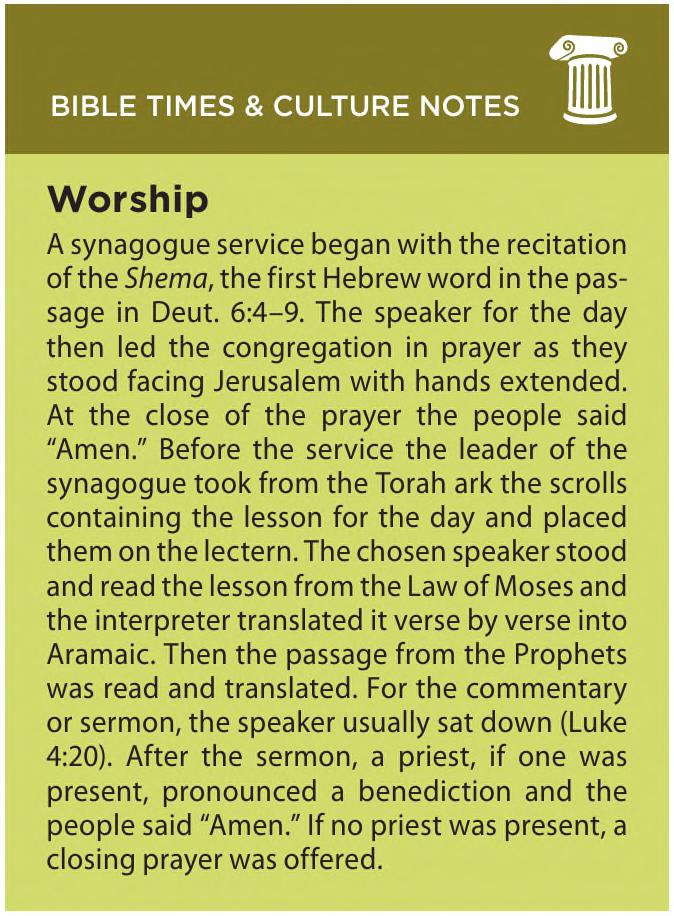
Bible Times & Culture Notes
Worship
A synagogue service began with the recitation
of the Shema, the first Hebrew word in the pas-
sage in Deut. 6:4–9. The speaker for the day
then led the congregation in prayer as they
stood facing Jerusalem with hands extended.
At the close of the prayer the people said
“Amen.” Before the service the leader of the
synagogue took from the Torah ark the scrolls
containing the lesson for the day and placed
them on the lectern. The chosen speaker stood
and read the lesson from the Law of Moses and
the interpreter translated it verse by verse into
Aramaic. Then the passage from the Prophets
was read and translated. For the commentary
or sermon, the speaker usually sat down (Luke
4:20). After the sermon, a priest, if one was
present, pronounced a benediction and the
people said “Amen.” If no priest was present, a
closing prayer was offered.
Original illustrations
End of source page 1662