PRINTED PAGE 1626NKJV · STUDY EDITION
1626 | Luke 3:23
34 the son of Jacob, the son of Isaac, the son
of Abraham, c the son of Terah, the son of
Nahor, 35 the son of Serug, the son of Reu,
the son of Peleg, the son of Eber, the son of
Shelah, 36 d the son of Cainan, the son of
e Arphaxad, f the son of Shem, the son
of Noah, the son of Lamech, 37 the son of
Methuselah, the son of Enoch, the son of
Jared, the son of Mahalalel, the son of Ca
inan, 38 the son of Enosh, the son of Seth,
the son of Adam, g the son of God.
The Temptation of Christ
Matt. 4:1-11; Mark 1:12, 13
4
Then a Jesus, being filled with the
Holy Spirit, returned from the Jordan
and b was led by the Spirit 1 into the wil
derness, 2 being 2 tempted for forty days
by the devil. And c in those days He ate
nothing, and afterward, when they had
ended, He was hungry.
3 And the devil said to Him, “If You are
d the Son of God, command this stone to
become bread.”
4 But Jesus answered him, saying, “It
is written, e ‘Man shall not live by bread
alone, 3 but by every word of God.’ ”
5 4 Then the devil, taking Him up on a
high mountain, showed Him all the king
doms of the world in a moment of time.
6 And the devil said to Him, “All this au
thority I will give You, and their glory; for
f this has been delivered to me, and I give
it to whomever I wish. 7 Therefore, if You
will worship before me, all will be Yours.”
descended in bodily form like a dove
upon Him, and a voice came from heaven
which said, “You are My beloved Son; in
You I am v well pleased.”
The Genealogy of Christ
Through Mary
Gen. 5:1-32; 11:10-26; Ruth 4:18-22;
1 Chr. 1:1-4, 24-27, 34; 2:1-15; Matt. 1:2-6
23 Now Jesus Himself began His minis
try at w about thirty years of age, being (as
was supposed) x the son of Joseph, the son
of Heli, 24 the son of Matthat, the son of
Levi, the son of Melchi, the son of Janna,
the son of Joseph, 25 the son of Mattathiah,
the son of Amos, the son of Nahum, the
son of Esli, the son of Naggai, 26 the son of
Maath, the son of Mattathiah, the son of
Semei, the son of Joseph, the son of Judah,
27 the son of Joannas, the son of Rhesa, the
son of y Zerubbabel, the son of Shealtiel,
the son of Neri, 28 the son of Melchi, the
son of Addi, the son of Cosam, the son of
Elmodam, the son of Er, 29 the son of Jose,
the son of Eliezer, the son of Jorim, the son
of Matthat, the son of Levi, 30 the son of
Simeon, the son of Judah, the son of Jo
seph, the son of Jonan, the son of Eliakim,
31 the son of Melea, the son of Menan, the
son of Mattathah, the son of z Nathan,
a the son of David, 32 b the son of Jesse, the
son of Obed, the son of Boaz, the son of
Salmon, the son of Nahshon, 33 the son
of Amminadab, the son of Ram, the son of
Hezron, the son of Perez, the son of Judah,
22 v Ps. 2:7; [Is.
42:1]; Matt. 3:17;
17:5; Mark 1:11;
Luke 1:35; 9:35;
2 Pet. 1:17
23 w [Num. 4:3, 35,
39, 43, 47] x Matt.
13:55; John 6:42
27 y Ezra 2:2; 3:8
31 z Zech. 12:12
a 2 Sam. 5:14; 7:12;
1 Chr. 3:5; 17:11; Is.
9:7 ; Jer. 23:5
32 b Ruth 4:18-22;
1 Chr. 2:10-12; Is.
11:1, 10
34 c Gen. 11:24,
26-30; 12:3; Num.
24:17; 1 Chr. 1:24-27
36 d Gen. 11:12
e Gen. 10:22, 24;
11:10-13; 1 Chr. 1:17,
18 f Gen. 5:6-32;
9:27; 11:10
38 g Gen. 5:1, 2
CHAPTER 4
1 a [Is. 11:2; 61:1];
Matt. 4:1-11; Mark
1:12, 13 b Ezek. 3:12;
Luke 2:27 1 NU in
2 c Ex. 34:28; 1 Kin.
19:8 2 tested
3 d Mark 3:11; John
20:31
4 e Deut. 8:3 3 NU
omits but by every
word of God
5 4 NU And taking
Him up, he showed
Him
6 f [John 12:31;
14:30; Rev. 13:2, 7]
psalm about God’s chosen King. The idea of God’s pleasure comes
from the image of the Servant in Is. 42:1. This image depicts Jesus’
election by God, and the special favor He enjoyed. The fact that
Jesus is both King and Servant is fundamental to Jesus’ identity.
3:23–38 as was supposed: People naturally assumed that Jesus
was the physical son of both Joseph and Mary. Luke corrected this
misunderstanding by emphasizing that Jesus was only apparent-
ly Joseph’s physical son. Luke’s genealogy is unlike Matthew’s,
although both go back to David and Abraham. Luke traces Jesus’
line all the way back to Adam, showing Jesus’ significance for
all people. Matthew provides the legal lineage from
David through Joseph to Jesus, while Luke provides
the physical lineage from David through Mary to
Jesus.
4:1, 2 The order of the temptations differs between
Matthew and Luke. Luke has the temptation about
Jerusalem last, probably because Jerusalem is the
place Jesus is headed for His decisive confrontation
with Satan (13:32–35). In His temptation, Jesus demon-
strated not only His ability to resist the devil, but also
His allegiance to God. What Adam could not do, Jesus
did. Where Israel had failed in the wilderness, Jesus
succeeded.
4:3 If You are the Son of God: This is a condition-
al statement. In other words, Satan was saying: “Let’s
assume for the sake of argument that You are the Son
of God.” In fact, Satan was challenging Jesus’ identity
and authority.
4:4 It is written: Jesus responded to Satan’s temp-
tation by quoting Deut. 8:3. Jesus refused to operate
independently of God. The Spirit had led Him into the wilderness to
prepare Him for His ministry, so eating at Satan’s instruction would
have shown a lack of dependence on the Father.
4:5 all the kingdoms of the world: This temptation was an at-
tempt to offer Jesus power by the wrong means. Satan’s method
involved a detour around the Cross, an inducement to “take the
easy way” to power.
4:6 this has been delivered to me: Satan’s claim here is exagger-
ated. He has great authority over the earth (see John 12:31; 14:30;
16:11; 2 Cor. 4:4; Eph. 2:2), but not the authority to deliver kingdoms.
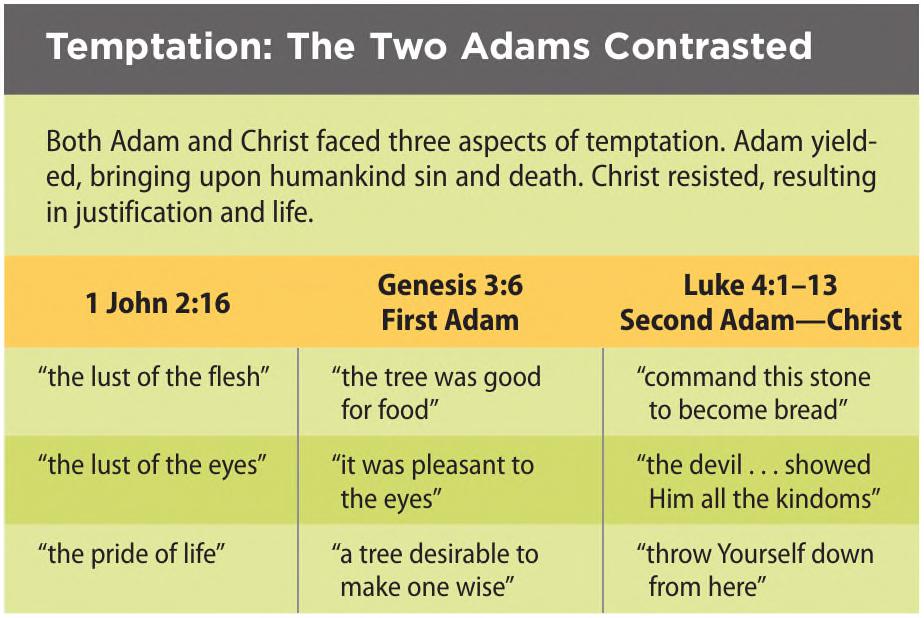
Temptation: The Two Adams Contrasted
Both Adam and Christ faced three aspects of temptation. Adam yield-
ed, bringing upon humankind sin and death. Christ resisted, resulting
in justification and life.
1 John 2:16
Genesis 3:6
First Adam
Luke 4:1–13
Second Adam—Christ
“the lust of the flesh”
“the tree was good
for food”
“command this stone
to become bread”
“the lust of the eyes”
“it was pleasant to
the eyes”
“the devil . . . showed
Him all the kindoms”
“the pride of life”
“a tree desirable to
make one wise”
“throw Yourself down
from here”
Original illustrations
End of source page 1661