PRINTED PAGE 127NKJV · STUDY EDITION
Exodus 21:6 | 127
4 cause My name to be remembered 25 o Deut. 27:5 p Josh.
8:30, 31 26 q Ex. 28:42, 43
CHAPTER 21 1 a Ex. 24:3, 4; Deut. 4:14; 6:1 1 ordinances
2 b Lev. 25:39-43; Deut. 15:12-18; Jer. 34:14 5 c Deut. 15:16, 17
6 d Ex. 12:12; 22:8, 9
19 d Deut. 5:5,
23-27
20 e Ex. 14:13; [Is.
41:10, 13] f Ex. 15:25;
[Deut. 13:3] g Deut.
4:10; 6:24; Prov. 3:7;
16:6; Is. 8:13
21 h Ex. 19:16; Deut.
5:22
22 i Deut. 4:36; 5:24,
26; Neh. 9:13
23 j Ex. 32:1, 2, 4;
Deut. 29:17
24 k Ex. 20:25; 27:1-8
l Ex. 24:5; Lev. 1:2
m Deut. 12:5; 16:6,
11; 1 Kin. 9:3; 2 Chr.
6:6 n Gen. 12:2
has given him a wife, and she has borne
him sons or daughters, the wife and her
children shall be her master’s, and he
shall go out by himself. 5 c But if the ser-
vant plainly says, ‘I love my master, my
wife, and my children; I will not go out
free,’ 6 then his master shall bring him
to the d judges. He shall also bring him
to the door, or to the doorpost, and his
and we will hear; but d let not God speak
with us, lest we die.”
20 And Moses said to the people, e “Do
not fear; f for God has come to test you,
and g that His fear may be before you, so
that you may not sin.” 21 So the people
stood afar off, but Moses drew near h the
thick darkness where God was.
The Law of the Altar
22 Then the LORD said to Moses, “Thus
you shall say to the children of Israel:
‘You have seen that I have talked with
you i from heaven. 23 You shall not make
anything to be j with Me—gods of silver
or gods of gold you shall not make for
yourselves. 24 An altar of k earth you shall
make for Me, and you shall sacrifice on
it your burnt offerings and your peace
offerings, l your sheep and your oxen. In
every m place where I 4 record My name I
will come to you, and I will n bless you.
25 And o if you make Me an altar of stone,
you shall not build it of hewn stone; for
if you p use your tool on it, you have pro-
faned it. 26 Nor shall you go up by steps to
My altar, that your q nakedness may not
be exposed on it.’
The Law Concerning Servants
21
“Now these are the 1 judgments
which you shall a set before them:
2 b If you buy a Hebrew servant, he shall
serve six years; and in the seventh he
shall go out free and pay nothing. 3 If he
comes in by himself, he shall go out by
himself; if he comes in married, then his
wife shall go out with him. 4 If his master
20:20 The response of Moses in this verse forms one of the most
significant concepts in the first five books of the Bible. Note the in-
terchange between the words do not fear and His fear. Moses told
the people to stop being afraid; God was not going to hurt them.
Yet they were very much afraid of the Lord (see 19:16; compare also
20:18, 19). God did not want His people to live in terror of Him, as
though He were an irrational, uncontrolled, violent force ready to
be unleashed on innocent people without provocation. Rather, God
wanted His people to respect the obvious hazards of wanton sin.
Appropriate fear of God in this sense would make them circumspect,
reverent, obedient, and worshipful, so that they might not sin.
20:21 God remained in thick darkness—a symbol of His elusive
presence (see Ps. 97:2). Only Moses could come near.
20:24 Israel was forbidden to make any altar more elaborate than
an altar of earth. These individual altars would be used only until
the selection of the central place for the worship of God (later in
Jerusalem, see Deut. 12). See Ex. 24:4 for an example of an altar built
by Moses at Mt. Sinai. See also 1 Kin. 18:31, 32 for an altar built by
Elijah on Mt. Carmel. Where I record My name can mean “where
I cause My name to be remembered.”
20:26 your nakedness: The worship of the gods of Canaan in-
volved sexually perverse acts. Nothing obscene or unseemly was
permitted in the pure worship of the living God.
21:1 The word translated here the judgments is one of several
Hebrew words that describe the Law (the Torah). This word describes
God’s response to a specific action, something like an umpire’s call.
Laws that appear in this section are responses to specific cases
among the Israelites. Often the people would present critical or
difficult disputes to Moses (see ch. 18). When Moses had to render
a decision on an issue that he was not sure about, he would ask
the Lord. The decisions that he gave became known as case law
or casuistic law. Such laws differed from the Ten Commandments
(20:1–17), known as apodictic law. The Ten Commandments were
general laws not based on specific cases. It is believed by some
that among the nations of the ancient world, only Israel had both
casuistic and apodictic law.
21:2 if you buy a Hebrew servant: Indebtedness or other crises
might force a person to be sold into slavery. But what was to be done
if that slave were a member of the Hebrew community? Moses ruled
that the period of enslavement was not to exceed six years, and in
the seventh he shall go out free. Perpetual slavery of Hebrew
men and women was prohibited.
21:2–5 Other rulings followed: (1) A slave who was married at the
time of his enslavement would keep his wife. (2) If the marriage took
place during the period of slavery, the wife and children belonged
to the master.
21:6 If the slave being freed did not wish to leave his family behind,
he was allowed to make a commitment of lifelong servitude. The
slave would be taken before judges, where he would be given the
opportunity to declare his intentions. pierce his ear: A sign of vol-
untary, lifelong servitude.
Bible Times & Culture Notes
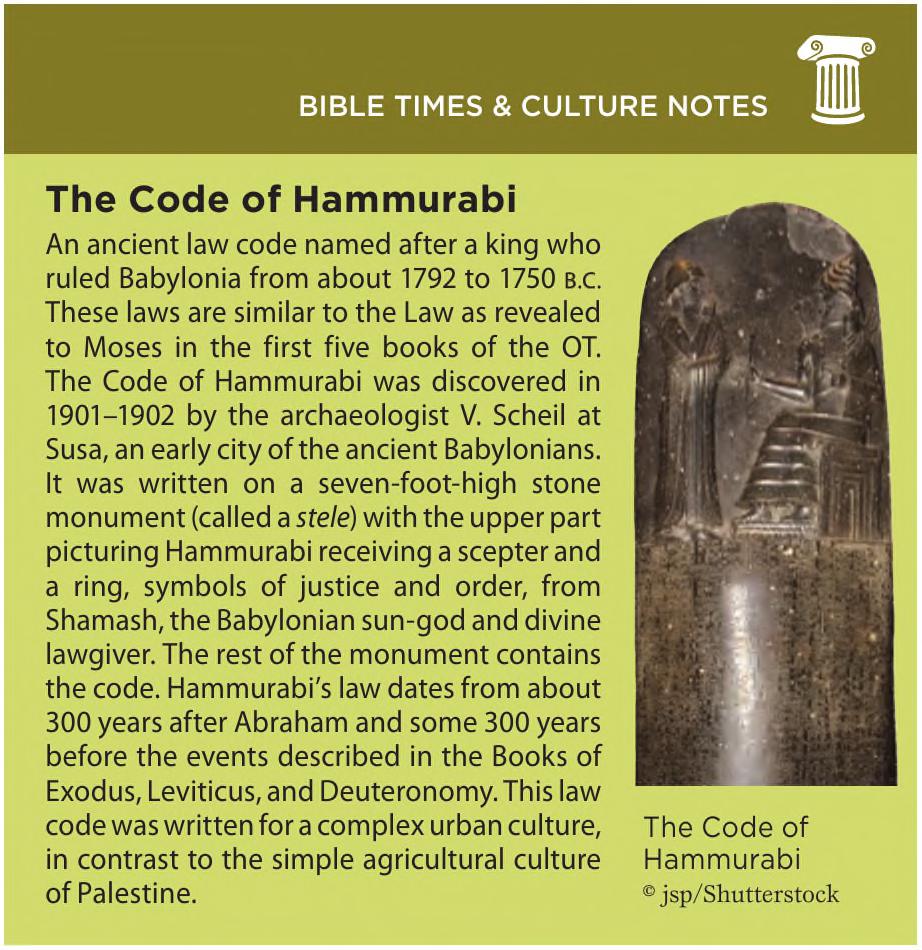
The Code of Hammurabi
An ancient law code named after a king who
ruled Babylonia from about 1792 to 1750 b.c.
These laws are similar to the Law as revealed
to Moses in the first five books of the OT.
The Code of Hammurabi was discovered in
1901–1902 by the archaeologist V. Scheil at
Susa, an early city of the ancient Babylonians.
It was written on a seven-foot-high stone
monument (called a stele) with the upper part
picturing Hammurabi receiving a scepter and
a ring, symbols of justice and order, from
Shamash, the Babylonian sun-god and divine
lawgiver. The rest of the monument contains
the code. Hammurabi’s law dates from about
300 years after Abraham and some 300 years
before the events described in the Books of
Exodus, Leviticus, and Deuteronomy. This law
code was written for a complex urban culture,
in contrast to the simple agricultural culture
of Palestine.
The Code of
Hammurabi
© jsp/Shutterstock
Original illustrations
End of source page 162