PRINTED PAGE 1584NKJV · STUDY EDITION
1584 | Mark 6:4
6:4 A prophet is not without honor except in his own country
is a maxim still repeated and still true today. Perhaps others were
jealous of Jesus’ popularity and huge following. Their envy even
took the form of violence against Christ (see Luke 4:29).
6:8–10 These instructions accompanied the Twelve on their as-
signed journey, the results of which are reported in Mark 6:30. These
rules made for easier travel and encouraged the disciples to trust
God for their food and shelter, which faithful Jewish hearers who
heeded their teaching would provide.
6:12 That people should repent was part of the apostles’ pri-
mary message. Repentance was necessary to cultivate the new life
Christ offered.
6:13 Casting out demons and healing the sick would add authority
to the apostles’ message (2 Cor. 12:12; Heb. 2:3, 4).
6:14–29 These verses break from the narrative to describe the death
of John the Baptist. So alarming was Jesus’ sudden fame that Herod
feared that John had risen from the dead. The disciples Jesus had
sent out (6:7–13) undoubtedly added to Herod’s worry. It appears
that one of Mark’s purposes in describing John’s death was to fore-
shadow the violent death of Christ Himself and even of some who
would follow Him.
6:14 King Herod is Herod Antipas, one of the sons of Herod the
Great, the king who tried to kill the baby Jesus (see Matt. 2:1–18).
After Herod the Great’s death in 4 b.c., his kingdom was divided be-
tween Archelaus, who received Judea and Samaria; Philip, who ruled
Iturea and Trachonitis, north and east of Galilee; and Antipas, who
controlled Galilee and Perea from 4 b.c. to a.d. 39. Jesus ministered
largely in the territory ruled by Antipas.
6:15 This verse demonstrates the contrast in expectations that Israel
had for its coming Messiah. It is clear that many did not recognize
the divine mission that Jesus was fulfilling.
6:17 The prison where John was kept was at Machaerus, in the hills
which overlook the Dead Sea. A complete palace and fortress occu-
pied that site. Herodias was a granddaughter of Herod the Great
and the sister of Herod Agrippa I (Acts 12:1–23). She was married to
Philip, a half brother of Herod Antipas, but not the Philip of Luke
3:1. Herodias’s first husband was never a ruler. She divorced this
Philip in order to marry Herod Antipas. Herod likewise divorced his
first wife, the daughter of Aretas IV, king of Arabia (see 2 Cor. 11:32).
6:18 John’s message to Herod was that his divorce was not lawful
as grounds for remarriage. John’s declaration could be based on
Jesus’ stern words about divorce (10:11, 12) or on Lev. 20:21, which
prohibits a man from taking his brother’s wife.
1 NU whatever place 2 NU omits the rest of v. 11. 13 p [James
5:14] 14 q Matt. 14:1-12; Mark 6:14-16; Luke 9:7-9 r Luke
19:37 15 s Matt. 16:14; Mark 8:28; Luke 9:19 t Matt. 21:11
3 NU, M a prophet, like one 16 u Matt. 14:2; Luke 3:19
4 f Matt. 13:57; Luke
4:24; John 4:44
5 g Gen. 19:22;
32:25; Matt. 13:58;
[Mark 9:23]
6 h Is. 59:16; Matt.
17:17, 20; [Heb. 3:18,
19; 4:2] i Matt. 9:35;
Luke 13:22; Acts
10:38; Eph. 2:17
7 j Matt. 10:1; 28:19,
20; Mark 3:13, 14;
Luke 9:1 k [Eccl.
4:9, 10]
9 l [Eph. 6:15]
10 m Matt. 10:11;
Luke 9:4; 10:7, 8
11 n Matt. 10:14;
Luke 10:10 o Acts
13:51; 18:6
its. 8 He commanded them to take noth
ing for the journey except a staff—no
bag, no bread, no copper in their money
belts— 9 but l to wear sandals, and not to
put on two tunics.
10 m Also He said to them, “In what
ever place you enter a house, stay there
till you depart from that place. 11 n And
1 whoever will not receive you nor hear
you, when you depart from there, o shake
off the dust under your feet as a testimo
ny against them. 2 Assuredly, I say to you,
it will be more tolerable for Sodom and
Gomorrah in the day of judgment than
for that city!”
12 So they went out and preached that
people should repent. 13 And they cast out
many demons, p and anointed with oil
many who were sick, and healed them.
John the Baptist Is Murdered
Matt. 14:1-12; Luke 9:7-9
14 q Now King Herod heard of Him, for
His name had become well known. And
he said, “John the Baptist is risen from
the dead, and therefore r these powers are
at work in him.”
15 s Others said, “It is Elijah.”
And others said, “It is 3 the Prophet,
t or like one of the prophets.”
16 u But when Herod heard, he said,
“This is John, whom I beheaded; he has
been raised from the dead!” 17 For Herod
himself had sent and laid hold of John,
and bound him in prison for the sake of
Herodias, his brother Philip’s wife; for
he had married her. 18 Because John had
4 But Jesus said to them, f “A prophet
is not without honor except in his own
country, among his own relatives, and
in his own house.” 5 g Now He could do
no mighty work there, except that He
laid His hands on a few sick people and
healed them. 6 And h He marveled because
of their unbelief. i Then He went about
the villages in a circuit, teaching.
Twelve Are Sent to Serve
Matt. 10:1-42; Luke 9:1-6
7 j And He called the twelve to Himself,
and began to send them out k two by two,
and gave them power over unclean spir
Bible Times & Culture Notes
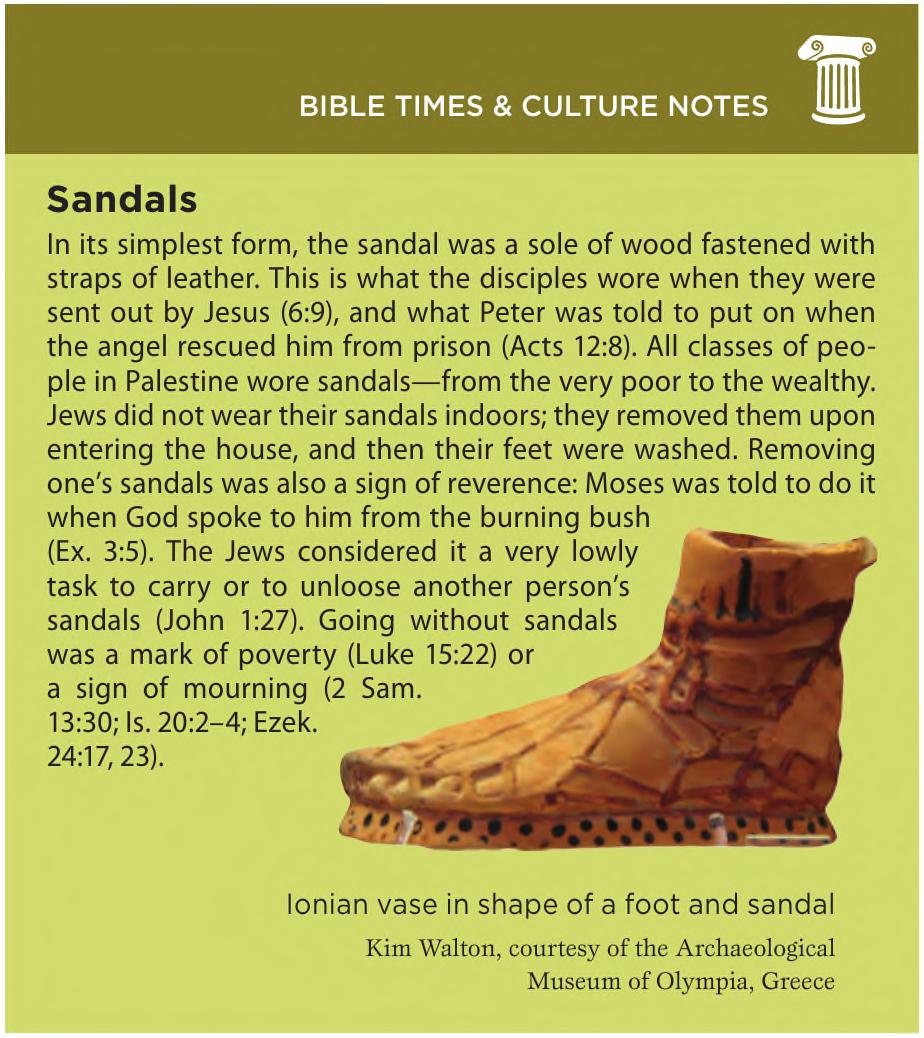
Sandals
In its simplest form, the sandal was a sole of wood fastened with
straps of leather. This is what the disciples wore when they were
sent out by Jesus (6:9), and what Peter was told to put on when
the angel rescued him from prison (Acts 12:8). All classes of peo-
ple in Palestine wore sandals—from the very poor to the wealthy.
Jews did not wear their sandals indoors; they removed them upon
entering the house, and then their feet were washed. Removing
one’s sandals was also a sign of reverence: Moses was told to do it
when God spoke to him from the burning bush
(Ex. 3:5). The Jews considered it a very lowly
task to carry or to unloose another person’s
sandals (John 1:27). Going without sandals
was a mark of poverty (Luke 15:22) or
a sign of mourning (2 Sam.
13:30; Is. 20:2–4; Ezek.
24:17, 23).
Ionian vase in shape of a foot and sandal
Kim Walton, courtesy of the Archaeological
Museum of Olympia, Greece
Original illustrations
End of source page 1619