PRINTED PAGE 1577NKJV · STUDY EDITION
Mark 3:17 | 1577
3:11, 12 Some unfortunate persons who met Christ were possessed
by unclean spirits, or demons. These spirit beings have no bodily
existence but frequently seek to inhabit humans or even animals.
Mark says they fell down before Him, most likely by forcing to
the ground the person they possessed. Jesus rebuked the demons
who proclaimed You are the Son of God not because the demons
incorrectly identified Jesus, but because their testimony was un-
trustworthy.
3:13 Jesus had a large group of followers. John 6:66 indicates that
even after the Twelve were appointed, He still had a large and con-
tinual following. Luke 10:1 notes that later Jesus sent out an addi-
tional 70 disciples.
3:14 These twelve were Jesus’ apostles—a chosen group sent out
to fulfill a particular mission.
3:15 Christ gave power or authority to these twelve apostles (Matt.
10:1–4). The apostle Paul called this authority “the signs of an apos-
tle” (2 Cor. 12:12). Christ and the apostles authenticated their ministry
through signs, miracles, and wonders (Heb. 2:3, 4).
3:16–19 Jesus gave Peter a new name because it was the Jewish
custom to rename someone who had experienced a life-changing
event. This renaming of the disciples has similarities to the renaming
of Abram (Gen. 17:3–5) and of Saul (Acts 9). Jesus no doubt sent out
His apostles in pairs as He did the 70 disciples (6:7–13; Matt. 10:5–15;
Luke 9:1–6). This explains the listing of the apostles’ names in groups
of two. The coupling is especially evident in Matt. 10:1–4: Peter and
Andrew, James and John, Philip and Bartholomew (Nathanael),
Matthew and Thomas, James (son of Alphaeus) and Thaddaeus,
and Simon the Cananite and Judas. Even though Judas Iscariot had
a close partner in the work for three years, no one yet suspected he
would be the one who also betrayed Him.
8 h Mark 5:19 i Mark
5:29, 34; Luke 7:21
10 j Matt. 9:21;
14:36; Mark 6:56;
8:22
11 k Mark 1:23,
24; Luke 4:41
l Matt. 8:29; 14:33;
Mark 1:1; 5:7; Luke
8:28
12 m Matt. 12:16;
Mark 1:25, 34
13 n Matt. 10:1;
Mark 6:7; Luke 9:1
14 4 NU adds whom
He also named
apostles
15 5 authority
Selection of the Twelve
Luke 6:12-16
13 n And He went up on the mountain
and called to Him those He Himself
wanted. And they came to Him. 14 Then
He appointed twelve, 4 that they might be
with Him and that He might send them
out to preach, 15 and to have 5 power 6 to
heal sicknesses and to cast out demons:
16 7 Simon, o to whom He gave the name
Peter; 17 James the son of Zebedee and
and Sidon, a great multitude, when they
heard how h many things He was doing,
came to Him. 9 So He told His disciples
that a small boat should be kept ready
for Him because of the multitude, lest
they should crush Him. 10 For He healed
i many, so that as many as had afflic
tions pressed about Him to j touch Him.
11 k And the unclean spirits, whenever
they saw Him, fell down before Him
and cried out, saying, l “You are the Son
of God.” 12 But m He sternly warned
them that they should not make Him
known.
6 NU omits to heal sicknesses and 16 o Matt. 16:18; John 1:42
7 NU and He appointed the twelve: Simon . . .
The Twelve Apostles
Jesus fulfilled hundreds of Old Testament prophecies. Many of these prophecies involved the circumstances surrounding His
birth. Below is a list of several such prophecies. Note the irrefutable similarities between the Old Testament predictions and their
New Testament fulfillment.
Matthew 10:2–4
Mark 3:16–19
Luke 6:14–16
Acts 1:13
Simon Peter
Simon Peter
Simon Peter
Simon Peter
Andrew
James
Andrew
John
James
John
James
James
John
Andrew
John
Andrew
Philip
Philip
Philip
Philip
Bartholomew
Bartholomew
Bartholomew
Thomas
Thomas
Matthew
Matthew
Bartholomew
Matthew
Thomas
Thomas
Matthew
James (of Alphaeus)
James (of Alphaeus)
James (of Alphaeus)
James (of Alphaeus)
Thaddaeus1
Thaddaeus
Simon (the Zealot)
Simon (the Zealot)
Simon (the Cananite)2
Simon (the Cananite)
Judas (of James)
Judas (of James)
Judas Iscariot
Judas Iscariot
Judas Iscariot
………………
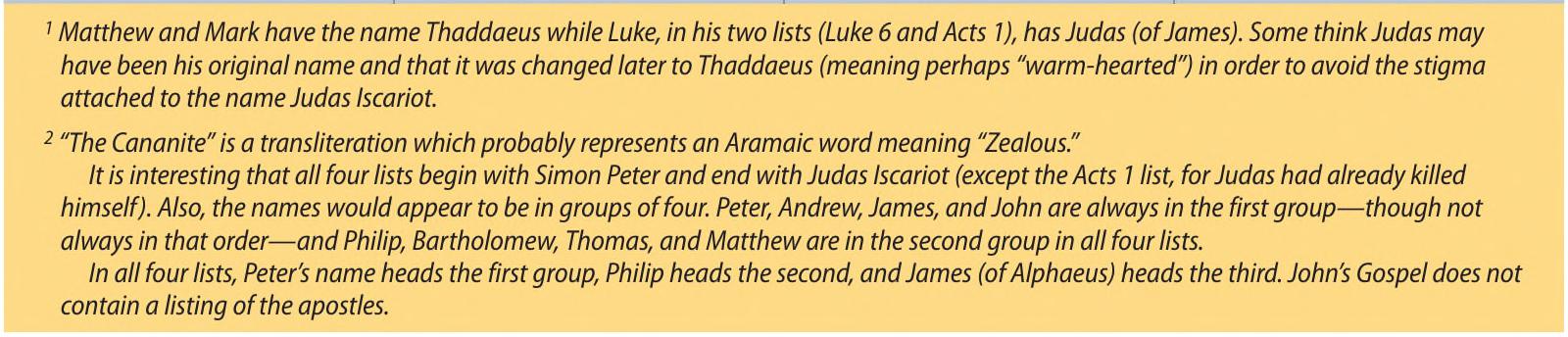
1 Matthew and Mark have the name Thaddaeus while Luke, in his two lists (Luke 6 and Acts 1), has Judas (of James). Some think Judas may
have been his original name and that it was changed later to Thaddaeus (meaning perhaps “warm-hearted”) in order to avoid the stigma
attached to the name Judas Iscariot.
2 “The Cananite” is a transliteration which probably represents an Aramaic word meaning “Zealous.”
It is interesting that all four lists begin with Simon Peter and end with Judas Iscariot (except the Acts 1 list, for Judas had already killed
himself). Also, the names would appear to be in groups of four. Peter, Andrew, James, and John are always in the first group—though not
always in that order—and Philip, Bartholomew, Thomas, and Matthew are in the second group in all four lists.
In all four lists, Peter’s name heads the first group, Philip heads the second, and James (of Alphaeus) heads the third. John’s Gospel does not
contain a listing of the apostles.
Original illustrations
End of source page 1612