PRINTED PAGE 125NKJV · STUDY EDITION
Exodus 20:4 | 125
23 h Ex. 19:12
CHAPTER 20
1 a Deut. 5:22
2 b Hos. 13:4 c Ex.
13:3; Deut. 7:8
1 slaves
3 d Deut. 6:14; 2 Kin.
17:35; Jer. 25:6; 35:15
4 e Lev. 19:4; 26:1;
Deut. 4:15-19; 27:15
The Ten Commandments
20
And God spoke a all these words,
saying:
2 b “ I am the LORD your God, who brought
you out of the land of Egypt, c out
of the house of 1 bondage.
3 d “ You shall have no other gods before Me.
4 e “ You shall not make for yourself a
carved image—any likeness of
for You warned us, saying, h ‘Set bounds
around the mountain and consecrate it.’ ”
24 Then the LORD said to him, “Away!
Get down and then come up, you and
Aaron with you. But do not let the priests
and the people break through to come up
to the LORD, lest He break out against
them.” 25 So Moses went down to the
people and spoke to them.
20:1–17 This passage conforms to the pattern of ancient Middle
Eastern treaties between a king and his vassals or servants. The
Great King presented to His servants, the Israelites, the duties and
obligations of the covenant He made with them.
20:1 And God spoke: The following words of God are known as
the Law of Moses. However, Moses was merely a reluctant prophet,
a mouthpiece for God’s words. This law is really the Law of God.
20:2 I am the Lord your God: First, the Great King identified Him-
self by speaking His name (see 3:14, 15). who brought you out:
Then, God reminded the Israelites of His gracious actions on their
behalf (see chs. 12–15). In ancient treaties, a king would describe
the history of relations between his kingdom and the one being
contracted. In this treaty between the Lord and the Israelites, God
described His gracious deliverance of Israelites from cruel slavery.
20:3 no other gods: God was not to be viewed by Israel as one
God among many nor as the best of the gods. He was and is the
only living God. He and He alone was to be worshiped, obeyed, and
adored by the Israelites.
20:4 not make . . . a carved image: Peoples in the ancient world
produced many kinds of idols, images, and other substitutes for
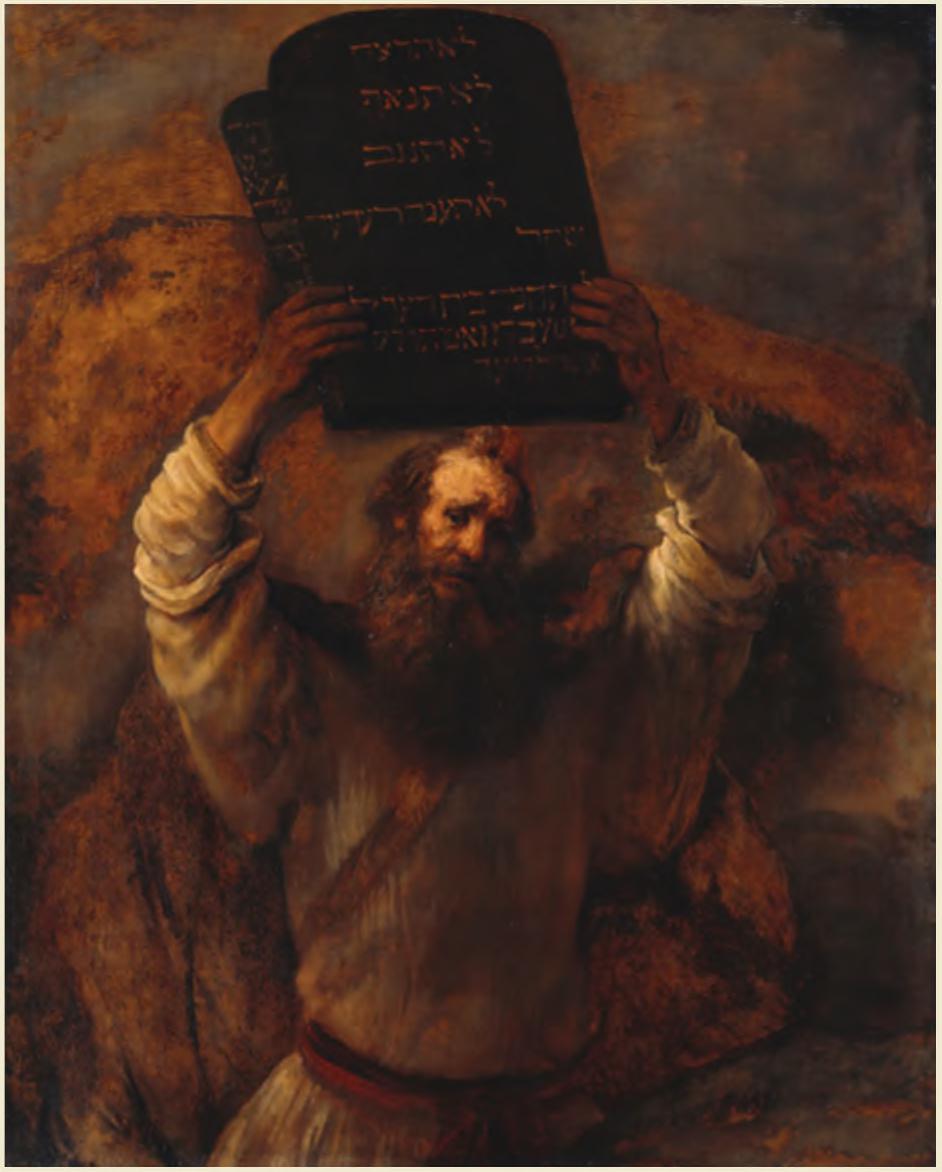
As part of the Mosaic covenant, God instructed the Israelites on how
they should live.
Wikimedia Commons
The Mosaic Covenant
Encamped before Mount Sinai, the Israelites encountered their God, who had recently delivered them from Egyptian
slavery (Gen. 12:1–3; Ex. 12; 13). At this mountain for the first time, God made a covenant with the entire nation of Israel
(chs. 19–24), usually referred to as the Mosaic covenant, the covenant with the people as given to Moses. God formalized His
relationship with the Israelites with a suzerain-vassal (ruler-subject) treaty. That is, God came to the Israelites as the Great
King and presented to them a binding treaty in which He would make certain promises to them and they would have cer-
tain obligations as His servants. This was not a
treaty between equals; it was a treaty between
the superior King and His inferior servants.
In this treaty, God first reminded the Isra-
elites of who He was and how He had acted in
their behalf. He was their Savior—the One who
had snatched them from their oppressors (19:4).
If they covenanted with Him, God promised to
make the Israelites His “special treasure” (19:5).
He would lavish special attention on them and
make them “a kingdom of priests and a holy
nation” (19:6). On the one hand, Israel would
become holy—or distinct and separate from
all other nations—because of its special rela-
tionship with God. But on the other hand, Israel,
in its separation, was to be the means by which
the other nations would learn of the living God.
This nation of priests would lead others to a cor-
rect worship of the true God (Ps. 117).
As part of this treaty, God graciously
instructed the Israelites on how they should
live (ch. 20). As a people who had a relationship
with the living God, the Israelites had to act a
certain way—God’s way. The Law was benevo-
lent instruction from God Himself. It was God’s
direction, like an outstretched hand pointing
out the way one should take on the road of life.
The Israelites were in a most enviable position.
God had demonstrated His love for them by
saving them. He had shown His faithfulness
to His promises to their parents, Abraham and
Sarah. He had formalized His relationship with
them in a treaty and promised to make them
His special people. Finally He even gave them
instructions for how to live. They were at peace
with their Creator.
Original illustrations
End of source page 160