PRINTED PAGE 1550NKJV · STUDY EDITION
1550 | Matthew 22:11
22:11 did not have on a wedding garment: Like the others, this
visitor had been invited to the wedding, but he failed to prepare
himself for it (see Rev. 3:18). In Revelation, the garment of fine linen
worn by the bride of the Lamb is said to be the righteous deeds
of the saints (Rev. 19:8). The man had ignored a basic obligation
placed on him when he accepted the king’s gracious invitation to
the feast—he was supposed to wear clean clothes. To come to a
wedding banquet unprepared or in soiled clothing would have been
insulting. In this parable, the garment may refer to the righteousness
of Christ graciously provided for us through His death. To refuse to
put it on would mean a refusal of Christ’s sacrifice or arrogance in
believing that the “garment” was somehow not needed. If we want
to enter Christ’s banquet, we must “put on” the righteousness He
gives us (Eph. 4:24; Col. 3:10). Because this man was unprepared, the
king declared him unworthy. His refusal resulted in the man being
sent out of the banquet hall.
22:13 Bind him hand and foot is a vivid picture of the man’s
inability to participate in Christ’s kingdom. Someone claiming to
belong at the wedding while refusing to wear the correct garments
was similar to the Israelites who claimed to be God’s people while
refusing to obey Him. This man was an impostor, and when he was
discovered (as all impostors will be), he was cast . . . into outer
darkness, referring to the judgment (8:12; 25:30).
22:14 many are called, but few are chosen: The word called in
this instance refers to being “invited,” not to the call of God as Paul
used the word (Rom. 8:28, 29). All Israel had been invited, but only
a few would accept and follow Jesus. Not all those invited will be
among the chosen of God, for not all will believe.
22:15 Entangle means “to snare,” like a trapper catching his prey.
22:16 Nothing is known of the Herodians outside of the Gospels.
Judging from their name, they were supporters of the Herodian
dynasty in its collaboration with the Roman government. This would
put them at the opposite end of the political spectrum from the
Pharisees. Yet their common hatred of Christ was great enough that
the Pharisees and Herodians joined forces against Him. we know
that You . . . teach the way of God in truth: In a way, the Hero-
dians and Pharisees were saying, “You truly teach God’s word, no
matter what people think of you.”
22:17 The dilemma is obvious: to side with the Pharisees and risk
being accused of insurrection against the Roman government, or
to side with the Herodians and lose the favor of the masses. Taxes
included an annual tax paid by every Jewish adult to the Roman gov-
ernment. The Jews despised paying this tax to their hated oppressors.
22:18 Test here means “to solicit to evil.” The Lord called the Hero-
dians and Pharisees hypocrites because they falsely pretended to
have good intentions.
22:19, 20 The tax money was a denarius, a silver coin with an
image of the emperor and the inscription calling him “divine.” The
image and inscription were repugnant to the Jews because they
hated their Roman overlords and worshiped only the God of Israel.
22:21 In responding to His opponents, the Lord changed the verb
they used from “pay” (v. 17) to render, which literally means “to pay
back.” Christ’s followers have an obligation to earthly governments
and to God. Believers today are citizens of a heavenly kingdom and
strangers and sojourners on the earth (see 1 Pet. 1:1; 2:11). It is the
believers’ responsibility to obey the law of the land until it becomes
sinful to do so (see Rom. 13:1–7; 1 Pet. 2:13–17). When the two realms
are in conflict, Christians are to follow God (see Acts 4:18–20; 5:29).
22:23 Some of the beliefs of the Sadducees are explained in Acts
23:8. These men looked on the first five books of Moses as their au-
thoritative Scripture. To them, any religious argument had to come
from the Pentateuch.
11 f [2 Cor. 5:3; Eph.
4:24; Col. 3:10, 12;
Rev. 3:4; 16:15; 19:8]
12 g [Rom. 3:19]
13 h Matt. 8:12;
25:30; Luke 13:28
2 NU omits take him
away, and
14 i Matt. 20:16
15 j Mark 12:13-17;
Luke 20:20-26
16 k Mark 3:6; 8:15;
12:13 3 Lit. look at
the face of
18 4 knew
21 l Matt. 17:25
m [Rom. 13:1-7;
1 Pet. 2:13-15]
n [1 Cor. 3:23; 6:19,
20; 12:27] 5 Pay
23 o Mark 12:18-
27; Luke 20:27-40
p Acts 23:8
14 i “For many are called, but few are
chosen.”
Conflict with Pharisees and
Herodians
Mark 12:13-17; Luke 20:20-26
15 j Then the Pharisees went and plot
ted how they might entangle Him in His
talk. 16 And they sent to Him their disci
ples with the k Herodians, saying, “Teach
er, we know that You are true, and teach
the way of God in truth; nor do You care
about anyone, for You do not 3 regard the
person of men. 17 Tell us, therefore, what
do You think? Is it lawful to pay taxes to
Caesar, or not?”
18 But Jesus 4 perceived their wicked
ness, and said, “Why do you test Me, you
hypocrites? 19 Show Me the tax money.”
So they brought Him a denarius.
20 And He said to them, “Whose image
and inscription is this?”
21 They said to Him, “Caesar’s.”
And He said to them, l “Render 5 there
fore to Caesar the things that are m Cae
sar’s, and to God the things that are
n God’s.” 22 When they had heard these
words, they marveled, and left Him and
went their way.
Conflict with Sadducees
Mark 12:18-27; Luke 20:27-40
23 o The same day the Sadducees, p who
say there is no resurrection, came to
11 “But when the king came in to see
the guests, he saw a man there f who did
not have on a wedding garment. 12 So he
said to him, ‘Friend, how did you come in
here without a wedding garment?’ And
he was g speechless. 13 Then the king said
to the servants, ‘Bind him hand and foot,
2 take him away, and cast him h into outer
darkness; there will be weeping and
gnashing of teeth.’
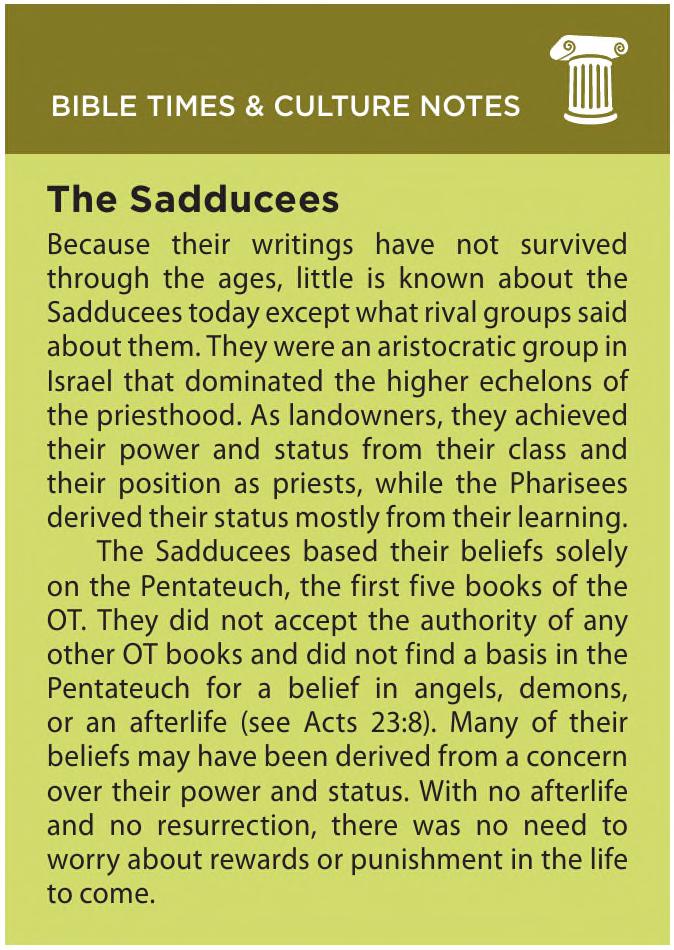
Bible Times & Culture Notes
The Sadducees
Because their writings have not survived
through the ages, little is known about the
Sadducees today except what rival groups said
about them. They were an aristocratic group in
Israel that dominated the higher echelons of
the priesthood. As landowners, they achieved
their power and status from their class and
their position as priests, while the Pharisees
derived their status mostly from their learning.
The Sadducees based their beliefs solely
on the Pentateuch, the first five books of the
OT. They did not accept the authority of any
other OT books and did not find a basis in the
Pentateuch for a belief in angels, demons,
or an afterlife (see Acts 23:8). Many of their
beliefs may have been derived from a concern
over their power and status. With no afterlife
and no resurrection, there was no need to
worry about rewards or punishment in the life
to come.
Original illustrations
End of source page 1585