PRINTED PAGE 1527NKJV · STUDY EDITION
Matthew 9:9 | 1527
8:28 The country of the Gergesenes may refer to (1) the village
of Khersa, near the eastern shore of the Sea of Galilee; (2) Gerasa,
about 30 miles southeast of the Sea of Galilee; or (3) Gadara, about
six miles away. This was Gentile territory.
8:29 We learn several things about demons in this passage: (1) they
recognize the deity of Christ; (2) they are limited in their knowledge;
(3) they know they will ultimately be judged by Christ (see 25:41;
James 2:19; 2 Pet. 2:4; Jude 6; Rev. 12:7–12); (4) they cannot act with-
out the permission of a higher authority—Christ.
9:2 Their faith refers to the faith of the paralytic as well as that of
the men who were carrying him.
9:5, 6 Jesus’ tactic caught the leaders off guard. Though these
leaders might deny His ability, or right, to forgive sins, the outward
physical healing could not be denied. It was far easier to say Your
sins are forgiven you because there would be no visible proof that
the sins were forgiven. The healing of the paralytic, however, was
proof that forgiveness of sins had occurred as well. Neither physical
nor spiritual healing pose any difficulty for God’s Son.
9:9 Matthew is called Levi in Mark 2:14; Luke 5:27. The tax office
was a toll booth set up alongside a highway to levy taxes on mer-
chandise transported on that road. Matthew probably worked for
Herod Antipas, tetrarch of Galilee. Tax collectors were considered
traitors by the Jews. They were despised because they generally
collected more than necessary and pocketed the difference, vastly
enriching themselves.
9 f Mark 2:14; Luke 5:27
27 2 Lit. What sort
of man is this
28 w Mark 5:1-4;
Luke 8:26-33 3 NU
Gadarenes
31 4 NU send us
into
34 x Deut. 5:25;
1 Kin. 17:18; Amos
7:12; Luke 5:8; Acts
16:39
CHAPTER 9
1 a Matt. 4:13; 11:23;
Mark 5:21
2 b Mark 2:3-12;
Luke 5:18-26
c Matt. 8:10
4 d Ps. 139:2; Matt.
12:25; Mark 12:15;
Luke 5:22; 6:8; 9:47;
11:17
8 e Matt. 8:27; John
7:15 1 NU were
afraid
sins are forgiven you,’ or to say, ‘Arise
and walk’? 6 But that you may know that
the Son of Man has power on earth to
forgive sins”—then He said to the para
lytic, “Arise, take up your bed, and go to
your house.” 7 And he arose and departed
to his house.
8 Now when the multitudes saw it, they
e marveled 1 and glorified God, who had
given such power to men.
Matthew Is Called
Mark 2:14; Luke 5:27, 28
9 f As Jesus passed on from there, He
saw a man named Matthew sitting at the
tax office. And He said to him, “Follow
Me.” So he arose and followed Him.
sea, and there was a great calm. 27 So the
men marveled, saying, 2 “Who can this
be, that even the winds and the sea obey
Him?”
Demons Are Cast into Swine
Mark 5:1-17; Luke 8:26-37
28 w When He had come to the other
side, to the country of the 3 Gergesenes,
there met Him two demon-possessed
men, coming out of the tombs, exceed
ingly fierce, so that no one could pass
that way. 29 And suddenly they cried out,
saying, “What have we to do with You,
Jesus, You Son of God? Have You come
here to torment us before the time?”
30 Now a good way off from them there
was a herd of many swine feeding. 31 So
the demons begged Him, saying, “If You
cast us out, 4 permit us to go away into
the herd of swine.”
32 And He said to them, “Go.” So when
they had come out, they went into the
herd of swine. And suddenly the whole
herd of swine ran violently down the
steep place into the sea, and perished in
the water.
33 Then those who kept them fled; and
they went away into the city and told
everything, including what had happened
to the demon-possessed men. 34 And be
hold, the whole city came out to meet
Jesus. And when they saw Him, x they
begged Him to depart from their region.
The Paralytic Is Forgiven
Mark 2:1-12; Luke 5:17-26
9
So He got into a boat, crossed over,
a and came to His own city. 2 b Then
behold, they brought to Him a paralytic
lying on a bed. c When Jesus saw their
faith, He said to the paralytic, “Son, be of
good cheer; your sins are forgiven you.”
3 And at once some of the scribes
said within themselves, “This Man
blasphemes!”
4 But Jesus, d knowing their thoughts,
said, “Why do you think evil in your
hearts? 5 For which is easier, to say, ‘Your
Bible Times & Culture Notes
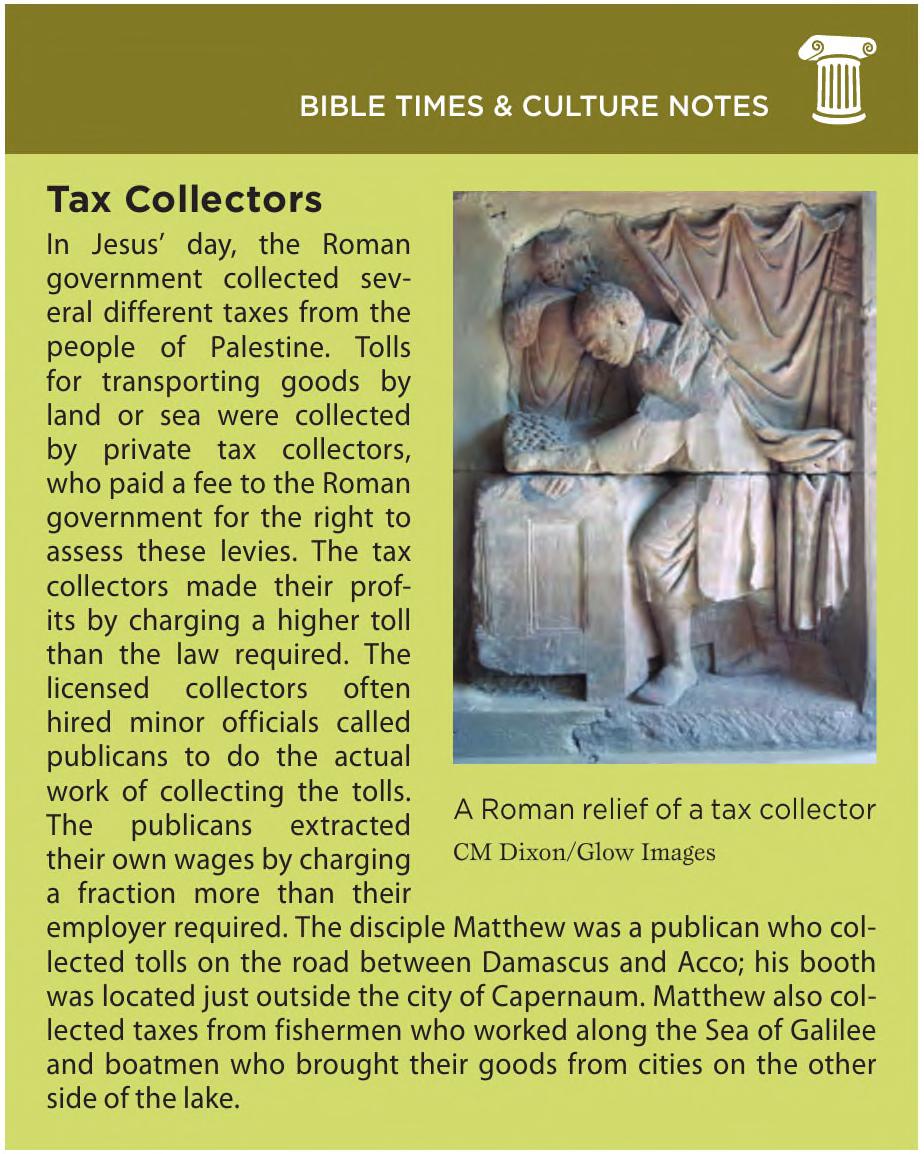
Tax Collectors
In Jesus’ day, the Roman
government collected sev-
eral different taxes from the
people of Palestine. Tolls
for transporting goods by
land or sea were collected
by private tax collectors,
who paid a fee to the Roman
government for the right to
assess these levies. The tax
collectors made their prof-
its by charging a higher toll
than the law required. The
licensed
collectors
often
hired minor officials called
publicans to do the actual
work of collecting the tolls.
The
publicans
extracted
their own wages by charging
a fraction more than their
employer required. The disciple Matthew was a publican who col-
lected tolls on the road between Damascus and Acco; his booth
was located just outside the city of Capernaum. Matthew also col-
lected taxes from fishermen who worked along the Sea of Galilee
and boatmen who brought their goods from cities on the other
side of the lake.
A Roman relief of a tax collector
CM Dixon/Glow Images
Original illustrations
End of source page 1562