PRINTED PAGE 1512NKJV · STUDY EDITION
1512 | Matthew 1:21
20 a Luke 1:35 7 Lit.
begotten
21 b [Is. 7:14; 9:6,
7]; Luke 1:31; 2:21
c Luke 2:11; John
1:29; [Acts 4:12;
5:31; 13:23, 38;
Rom. 5:18, 19 ;
Col. 1:20-23] 8 Lit.
Savior
23 d Is. 7:14
9 Words in oblique
type in the New
Testament are
quoted from the
Old Testament.
25 e Ex. 13:2; Luke
2:7, 21 1 Kept her
a virgin 2 NU a Son
CHAPTER 2
1 a Mic. 5:2 ; Luke
2:4-7 b Gen. 25:6;
1 Kin. 4:30 1 Gr.
magoi
2 c Luke 2:11
d [Num. 24:17 ;
Is. 60:3]
4 e 2 Chr. 36:14
f 2 Chr. 34:13 g Mal.
2:7
1:23 Behold . . . Immanuel: This is a quotation from Is. 7:14. In
this verse, the prophet Isaiah consoles King Ahaz of Judah. A co-
alition of two kings, King Rezin of Aram and King Pekah of Israel,
was opposing Ahaz. Isaiah tells Ahaz not to fear, for the plans of his
enemies would not succeed. As a sign to Ahaz, a son would be born
of a woman, and before that boy reached the age where he could
tell right from wrong, the two kings would no longer be a threat
to Ahaz. Some interpretations view Isaiah’s prophecy as directly
prophetic of Jesus’ birth and nothing else. According to this view,
only the miraculous birth of Jesus can be considered a sign. Since
the Hebrew noun translated virgin in Is. 7:14 can also mean “young
woman,” some have suggested that Isaiah was prophesying about
a son born during the lifetime of Ahaz—perhaps Isaiah’s son Maher-
Shalal-Hash-Baz (Is. 8:3). Others have interpreted Isaiah’s prophecy
as a prediction that a virgin, a contemporary of Isaiah, would marry
and have a child. The sign to Ahaz was the sudden dissolution of
Rezin and Pekah in the face of Assyria. Even though uncertainty
surrounds how this prophecy was fulfilled during Isaiah’s lifetime,
Matthew makes it clear that Isaiah’s words find their ultimate ful-
fillment in the virgin birth of Jesus, a sign to people of all ages that
God was with them.
1:25 Joseph did not know Mary physically until she gave birth to
Jesus. The clear implication of this verse is that Mary was a virgin
only until the birth of Jesus. The brothers and sisters of Jesus were
probably younger siblings born to Joseph and Mary after Jesus’
birth (13:55, 56). Joseph could not have had children by a previous
marriage, as some suppose, for then Jesus would not have been heir
to the Davidic throne as the oldest son of Joseph.
2:1 The events of ch. 2 probably took place some months after Jesus’
birth. Several reasons may be offered to support this conclusion:
(1) Joseph and Mary were living in a house (v. 11); (2) Jesus is referred
to as a child, not an infant (v. 11); (3) Herod murdered all the male
children two years old and under (v. 16); and (4) it would have been
strange for Joseph and Mary to offer the sacrifice of the poor, a pair of
turtledoves or pigeons (see Lev. 12:8; Luke 2:24), if the wise men had
just given them gold, frankincense, and myrrh. Thus the wise men
must have arrived after the ritual sacrifice described in Luke 2:22–24,
39. Herod the king is Herod the Great, who reigned over Palestine
from 37 b.c. until his death in 4 b.c. A crafty ruler and lavish builder,
Herod had a reign marked by cruelty and bloodshed. The word trans-
lated wise men can refer either to fraudulent sorcerers (see Acts
8:9, 11; 13:6, 8) or, as here, to a more honorable class of astrologers.
2:2 born King of the Jews: These words would have struck both
terror and fury into the heart of Herod. His star in the East may
refer to a star supernaturally introduced into the heavens, discern-
ible only to students of the sky. The star reappeared to guide the
wise men to where Christ was (v. 9). The fact that it was called “His
star” indicates that the wise men identified the star with the arrival
of the King of the Jews.
2:4 chief priests: This first mention of the Jewish council— “all the
chief priests and scribes of the people”—reveals that the Jewish
leaders were alerted early to the coming of the Messiah. Their quick
recital of Mic. 5:2 showed their prophetic astuteness concerning the
messianic prophecies (v. 6).
2:5 Matthew clearly records how the Jewish religious authorities,
who became Christ’s enemies later, unintentionally affirmed that
chief priests and f scribes of the people
together, g he inquired of them where the
Christ was to be born.
5 So they said to him, “In Bethlehem
of Judea, for thus it is written by the
prophet:
wife, a for that which is 7 conceived in
her is of the Holy Spirit. 21 b And she will
bring forth a Son, and you shall call His
name 8 JESUS, c for He will save His people
from their sins.”
22 So all this was done that it might be
fulfilled which was spoken by the Lord
through the prophet, saying: 23 d “Be
hold, 9 the virgin shall be with child, and
bear a Son, and they shall call His name
Immanuel,” which is translated, “God
with us.”
24 Then Joseph, being aroused from
sleep, did as the angel of the Lord com
manded him and took to him his wife,
25 and 1 did not know her till she had
brought forth e her 2 firstborn Son. And
he called His name JESUS.
Visit of Wise Men
2
Now after a Jesus was born in Bethle
hem of Judea in the days of Herod the
king, behold, 1 wise men b from the East
came to Jerusalem, 2 saying, c “Where is
He who has been born King of the Jews?
For we have seen d His star in the East
and have come to worship Him.”
3 When Herod the king heard this, he
was troubled, and all Jerusalem with
him. 4 And when he had gathered all e the
Jesus
(Gk. Iēsous) (1:21; Luke 1:31; Acts 2:36; 4:18; 13:23; 17:3)
Strong’s #2424
The Greek name Iēsous is the equivalent of the Hebrew
name Yeshua, meaning “The Lord Shall Save.” Although a
common name among the Jews (see Luke 3:29; Col. 4:11),
the name expresses Jesus’ work on earth—to save and
to deliver. This is affirmed by the explanation the angel
gives Joseph after telling him to name the virgin-born child
Jesus: “for He will save His people from their sins” (1:21).
After Jesus was crucified for the sins of His people and
raised from the dead, the early apostles proclaimed Jesus
as the one and only Savior (Acts 5:31; 13:23).
Bible Times & Culture Notes
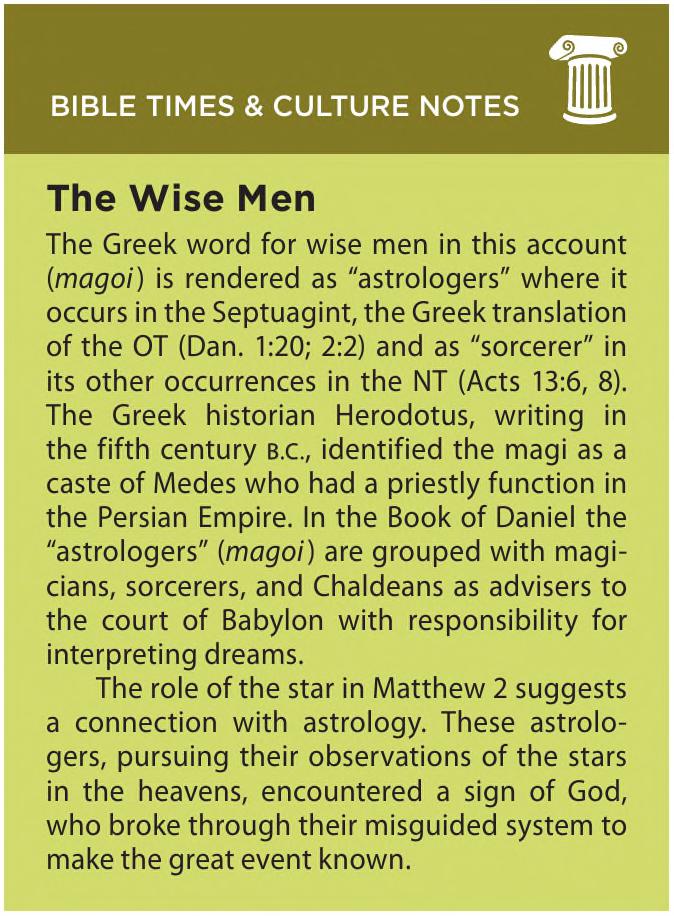
The Wise Men
The Greek word for wise men in this account
(magoi ) is rendered as “astrologers” where it
occurs in the Septuagint, the Greek translation
of the OT (Dan. 1:20; 2:2) and as “sorcerer” in
its other occurrences in the NT (Acts 13:6, 8).
The Greek historian Herodotus, writing in
the fifth century b.c., identified the magi as a
caste of Medes who had a priestly function in
the Persian Empire. In the Book of Daniel the
“astrologers” (magoi ) are grouped with magi-
cians, sorcerers, and Chaldeans as advisers to
the court of Babylon with responsibility for
interpreting dreams.
The role of the star in Matthew 2 suggests
a connection with astrology. These astrolo-
gers, pursuing their observations of the stars
in the heavens, encountered a sign of God,
who broke through their misguided system to
make the great event known.
Original illustrations
End of source page 1547