PRINTED PAGE 1508NKJV · STUDY EDITION
1508 Matthew INTRODUCTION
actions were a direct fulfillment of Old Testament prophecies. The genealogy of chapter 1 is recognizably Jewish,
tracing the lineage of Jesus back through David to Abraham, the father of the Jewish people. Furthermore the
Gospel mentions Jewish rulers (see 2:1, 22; 14:1) and customs such as ceremonial washing (see 15:2) without
explanation, indicating that Matthew expected his predominantly Jewish audience to be familiar with such
practices.
Purposes Matthew’s Gospel serves several purposes beyond presenting a mere biography of Jesus. One
purpose is to prove to Jewish readers that Jesus is their Messiah and promised King. The genealogy in chapter 1
points to Christ as the One who inherited God’s promises to David of an eternal dynasty. Jesus’ use of a familiar
messianic psalm in Matthew 22:41–44 would have clearly implied to any Jew that He was the heir of the Davidic
throne. Even though many Jews of Jesus’ time were blind to Jesus’ identity, Gentiles (such as the wise men)
identified Him as Israel’s promised King when He was a baby. Finally, the charge that hung above Jesus’ head
on the Cross clearly highlights His royalty: THIS IS JESUS, THE KING OF THE JEWS (27:37). But most important, the
Book of Matthew proves Jesus’ legitimate authority by highlighting His wise teaching and righteous life (7:28, 29).
Another purpose of the book is to outline the characteristics of the kingdom of God, both for Israel and the
church. Orthodox Jews would typically scoff at any assertion that Jesus is their Messiah, let alone their King.
They would retort, “If Jesus is King, where is the promised restoration of the kingdom of Israel?” Many Jews of
Jesus’ day rejected Him as Messiah, even though both Jesus and John the Baptist continually preached that
the kingdom was “at hand” (3:2; 4:17; 10:7). This rejection of Jesus by the Jews is a dominant theme of Matthew
(11:12–24; 12:28–45; 21:33—22:14). Because of this rejection, God postponed the fulfillment of His promises to
Israel and subsequently extended His blessings to both Jew and Gentile in the church.
Matthew is the only Gospel writer who speaks directly of the church (16:18; 18:17). He points to the Gentile
composition of this church by including several stories of the Gentiles’ faith in Jesus: the wise men, the centurion,
and the Canaanite woman. He records Jesus’ prediction that the gospel will be preached to all nations (24:14),
and the commission to the disciples to “make disciples of all the nations” (28:19). Jesus’ teaching pointed to the
blessings of the kingdom being extended to Gentiles. But one day, Israel will be restored to its place of blessing
(see Rom. 11:25–27; 15:8, 9).
A final purpose of Matthew is to instruct the church. An obvious clue to this is in the Great Commission:
“teaching them to observe all things that I have commanded you” (28:20). The discipling process involves
instruction in the words of Christ, and the Gospel of Matthew revolves around five of Jesus’ discourses (5:1—7:28;
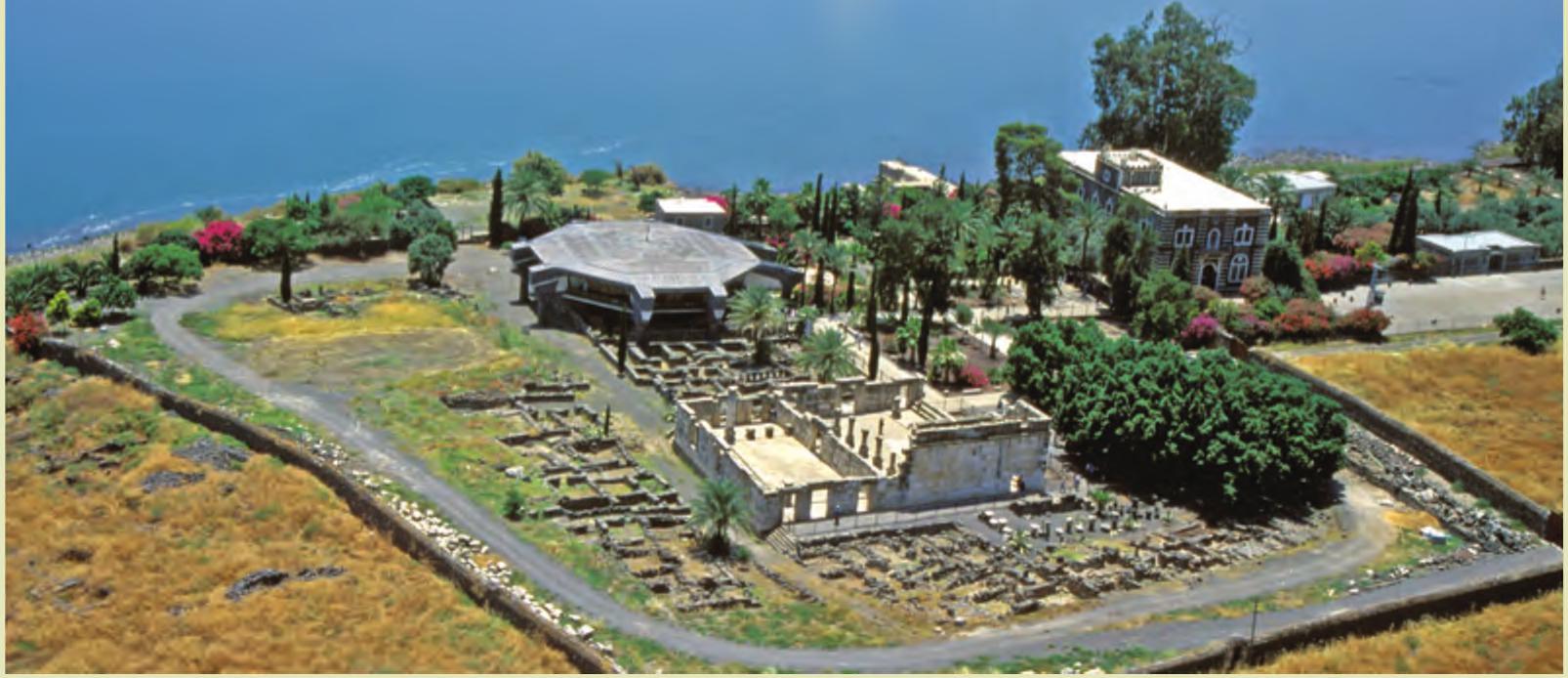
Aerial view of Capernaum, along the northern shore of the Sea of Galilee. Matthew was a tax collector in Capernaum,
and was met there and called by Jesus (Matt. 9:9).
Z. Radovan/www.BibleLandPictures.com
Original illustrations
End of source page 1543